

In May we added across the filings what SpaceX had promised to spend through 2030, and reached about $235 billion, against a business that does not yet generate cash. The first public quarter, reported August 4, was the chance to watch that gap close. It widened, to about $400 billion, and every added dollar went to one line, the AI build. The rockets now serve the compute, the fab the company called essential has gone quiet, and the mission that sold the shares got nothing. We hold the offering’s own plan as the measure and read the quarter against it: what got funded, what went quiet, and what a share is paying for.
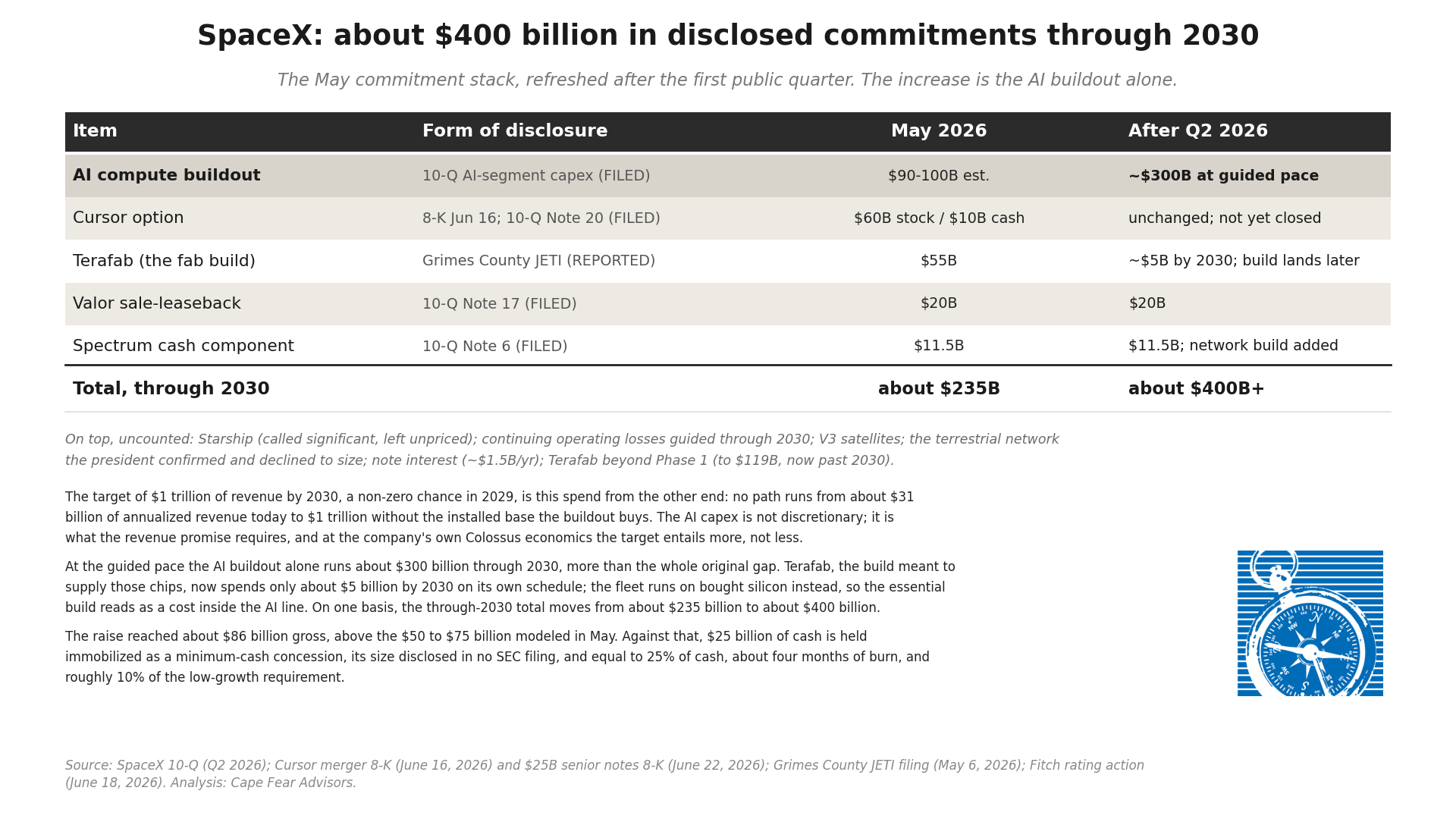
The largest need, and the quiet over it
Two months ago Terafab was the whole point. The semiconductor fab was the capstone of the pitch that sold the company, the centerpiece of the June 4 interview in which Jamie Dimon of J.P. Morgan, whose bank led the offering, drew the plan out of the controller, and the controller named the fab a necessity: there would not otherwise be enough chips, and “that’s why we need to do Terafab. It seems essential” (FILED). A company puts its essential project at the front of the document that sells its shares. The fab was important by the issuer’s own hand, and it was to begin before the decade turned.
It is a build of about $119 billion, and a build that size needs its own company, its own partners, its own financing, none of which the SpaceX balance sheet supplies. On all of it, structure, money, forecast, timing, the first public quarter said nothing. Terafab was absent from the use of proceeds, absent from the quarterly, absent from the earnings release, and absent from every question on the August 4 call. Its only motion sits in a Texas county records office, where the districts approved a tax abatement and the company signed a development agreement to invest five billion dollars by 2030 against the hundred-and-nineteen-billion headline (REPORTED). On the company’s own county schedule the fab spends almost nothing before 2028. The largest number in the gap exists, in the filed and public record, as a tax form.
The build was to end the need to buy chips at another maker’s margin. On the August 4 call the controller said the orbital fleet will run on NVIDIA silicon, “a very significant percentage of their GPUs next year” (REPORTED). So the company will buy the very thing the fab was to make. There is a reading that fits the schedule rather than fighting it: on the county profile the plant spends almost nothing before 2028, so buying chips through the interval is the bridge that timeline implied, not a reversal of it. The cost lives inside that reading, not against it. The essential project’s economics now carry years of buying, at a supplier’s margin in a shortage, the very thing it was meant to make; the fab meant to end the chip bill sits behind a growing one, and the interval prints in the accounts quarter by quarter. That is the cost of not beginning, in a line item. One quarter on, the capstone of the offering has no plan, no money, and no motion. Where did it go?
A hundred billion, raised and not earned
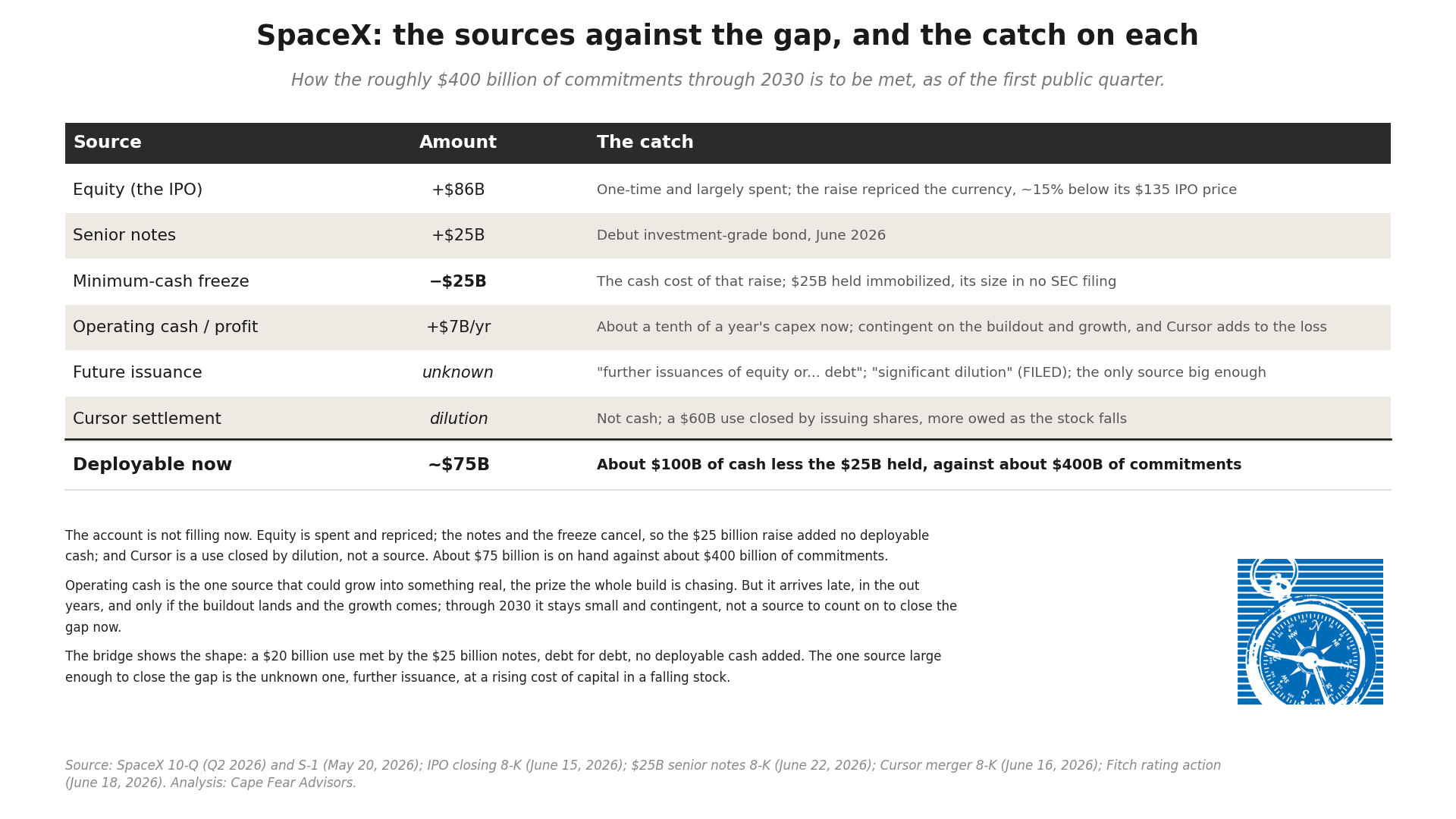
The next need is the cash itself, because a hundred billion dollars had to be raised to face the rest, and it was. SpaceX ended June with about $100 billion of cash and marketable securities, and its chief financial officer, Bret Johnsen, led the August 4 call with the number. By source, it is raised, not earned: about $85.7 billion of offering proceeds and $25 billion of new bonds, against $3.5 billion of operating cash for the half (FILED).
A quarter of it cannot move. The company holds a minimum cash balance of $25 billion, the commitment on which the agencies rest the investment-grade rating. In the public filings the commitment appears only as ordinary language: the company says it aims “to maintain an investment grade credit rating” and “to maintain strong liquidity,” and the reports keep the same posture, but nowhere in them is the number. The size, $25 billion, is Fitch’s, stated in the June 18 rating action (REPORTED); Fitch’s account places the specific commitment in the private bond documentation and the representations to the agencies. So the public record carries the commitment as routine, and a rating agency carried the amount. It is not ordinary by size. Twenty-five billion dollars is a quarter of the cash, about four months of the current burn, and roughly a tenth of the low-growth need we have counted.
This is a shape we have seen before. The roughly $20 billion a year that Google pays Apple to be the default search engine reached the public because an antitrust court compelled it; absent the case it would have stayed dark. The $25 billion here reached the public because Fitch stated it, going further than a rating action had to; absent that, it would have stayed dark too. Two commitments in the same band, each material by a plain reading, each with its size surfaced from outside the filings rather than within them, and each carried as ordinary. That last part is the hard one.
The freeze is the cash cost of the raise. With it off, the deployable figure is nearer $75 billion. At the pace just guided, $18.4 billion of capital a quarter with the next two “very similar,” that is about a year. The fortress raised to close a $235 billion gap is a one-year fuse on borrowed money, a quarter of it held to a commitment the filings carry only as ordinary language, its size known to the public only through a rating agency.
The coupon has begun to print, as we said it would. Interest expense ran $629 million in the quarter, beside the $18.4 billion capital line (FILED), and the $25 billion of notes carry about $1.46 billion a year going forward, the first payment due January 15, 2027, due whether or not the build begins. The notes retired the roughly $20 billion March bridge loan, a debt-for-debt exchange that added no cash the business can deploy, and the half’s accounts carry a $1.2 billion premium for extinguishing the old debt early (FILED). The raise has a mirror in the freeze: the company raised $25 billion in bonds and holds $25 billion in minimum cash, so the sum brought in is the sum that must sit still. A rating was obtained, and its price is a coupon, a premium, and a frozen quarter of the cash.
The use that grows as the price falls
The next is Cursor, agreed at $60 billion, and it is the only item that grows as the stock falls. It is structured as an option: $60 billion paid in stock if it closes, or $10 billion in cash if it does not (FILED). On the live branch, the stock, the price is a fixed value struck in shares at the seven-day average just before closing. Fixed value, floating shares: each down day, more shares are owed to carry the same $60 billion, and the company absorbs all of it. On the August 4 call the controller said the close is coming but that the company is “wary of sort of jumping the gun on regulatory closures” (REPORTED), which holds the window open longer. So for now it is dilution with no cash and no revenue, deepening with each decline and with each week the regulators take, and the decline that deepens it has run alongside the spending it adds. The other branch does not spare the balance sheet. It puts $10 billion of cash back into the gap the moment the stock deal falls through. Neither branch is free.
The only rung being funded
The money reaches the fourth need, and by the rate cash leaves it is the largest of all. Capital expenditure ran $18.4 billion in the quarter, $15.8 billion of it AI infrastructure (FILED), guided flat for the rest of the year on the August 4 call (REPORTED). At that pace the AI buildout alone runs on the order of $300 billion through 2030, more than the whole of the original gap, and it is the reason the deployable cash is a one-year fuse. This is the terrestrial data-center build behind the cloud business, and it pays while it lasts. On the plainest arithmetic the Colossus center rented to Anthropic cost about $13 billion and earns about $15 billion a year, close to a 50 percent return on the build after power and depreciation (REPORTED). That is the bull case, and its flaw is the calendar: a 50 percent return on a contract the customer can end in ninety days while it builds its own capacity elsewhere to replace it.
The company gave this build its own scoreboard. The quarterly introduced a new measure, nameplate compute draw, the installed power the AI fleet can pull, rising from 0.4 gigawatts a year ago to 1.4 gigawatts at June 30 (FILED). The filing states that the figure “reflects installed capacity and does not represent actual power consumption or utilization.” The number handed to the market to track the AI story measures what has been built, not what is used; it rises with capital spent, not with revenue earned or capacity filled. The revenue guide is drawn the same way, forward. On the August 4 call Johnsen put the company on a path to $100 billion of annualized run-rate by December, a single month’s expected revenue carried out to a year, and the controller called it “not a question mark,” reached “if we basically did nothing” (REPORTED). Against $7.8 billion recognized this quarter, about $2.6 billion a month, a $100 billion December run-rate is about $8.3 billion a month, more than triple the current pace in six months. “Nothing” carries the entire ramp landing on time and the ninety-day contracts staying put. It is a run-rate, not revenue booked, and annualized, not recurring. And it answers whether the buildout can be throttled: the controller put $1 trillion of revenue by 2030 on the record, a non-zero chance in 2029, and no path runs from about $31 billion of annualized revenue today to a trillion without the machines that spend buys. The buildout is not the company’s option to defer. It is the revenue promise read from the cost side.
The promise runs both ways, and this is the bull case in full. At $1 trillion of revenue a business of this kind should at last turn a profit and throw off cash, which would close the gap by making the company self-funding. That cash is a potential source, but in the out years and unknown in size now: the $400 billion still has to be spent to reach the scale that produces it, and the spending comes first. Cursor, itself a cash-burning business, adds to the loss before it adds to anything else, and any operating cash the forecast shows is contingent on the buildout landing and the growth arriving. Margins turning sooner would offset the need sooner, though on the filed trajectory that is a late-period event, toward the decade’s end, not a near-term one. One bank’s published estimate has the company burning about $106 billion cumulatively before free cash flow turns positive around 2030 (REPORTED), the same point in numbers: the relief is real, it is late, and it comes only if the ramp lands.
There is a discipline the bull case cannot skip, and it answers the case the company is pressing, that the cash flow to come will be large enough to justify the spend. From an analyst’s chair, revenue and capital move together: this revenue is made of machines, the machines are the $400 billion, and every dollar added to the top line attaches the capital that produces it. A model cannot lift the trillion without lifting the build, and a discounted-cash-flow valuation cannot net a number this large away by discounting the cash it might one day return. The $400 billion is not a cost the future cash flow erases. It is the price of that cash flow, paid first and in full. The whole question is whether the company reaches that scale before the cash and the patience run out, and nothing filed this quarter settles it.
Sixty days, and the plan had moved
There is a fair way to hold all of this, and it belongs in the reading. What the quarter shows is a business plan changing shape sixty days after it was sold. The document that sold the shares in June led with a semiconductor fab and a road to Mars; the first quarter’s cash led with an AI compute build and a new scoreboard to track it, and on the August 4 call the president, Gwynne Shotwell, added a line the offering had not featured, a terrestrial mobile network on the EchoStar spectrum, meant to take “quite a few” customers from the incumbent carriers, whose shares fell that afternoon, and she declined to size its cost (REPORTED). The prospectus permits exactly this. Its forward-looking language reserves the company’s right to change strategy, move capital, and set aside announced projects, and the change may be for the better: if the case for AI is right, pouring the cash into compute and holding the fab back is the correct call, and a market that priced the mission may be slow to reprice the turn. That case could come true. The difficulty is not that the change is wrong. It is that the change came fast, and following it is hard, because it leaves four documents that no longer point the same way. The aspiration is Mars, which gets nothing. The offering is Terafab, which gets nothing. The cash is the AI build, which gets almost everything. The headlines are two different hundred-billions, one of cash raised and one of run-rate projected for a single December, plus $14.1 billion of contracted sales and 1.4 gigawatts of nameplate. Four answers to the one question of what the company is. Sixty days in, a buyer has to choose which to believe.
What is measured, and what is not
That is the question the quarter forces, and we answer it the one way that keeps the reading straight: we do not rebase. The S-1 set out a large aspiration, priced it, and sold it, then laid out, in the ordinary language of what a business does from quarter to quarter, the steps meant to reach it, fixing the expectations, the measures, and the price along the way. The $235 billion gap was measured against those stated steps, and it stays measured against them, because a company changing its mind is the event a fixed baseline exists to catch. The 10-Q was the first ordinary-course report on that plan, and little in it was ordinary: the plan reshaped inside sixty days, eighteen billion dollars of capital in a single quarter, the essential fab gone quiet, a new measure minted to keep score of the turn. The company offers the quarter as routine. What it filed does not read as routine, and a fixed baseline is how a quarter like that is seen for what it is. So the gap holds, and it grows. What we track from here is the distance between the two sets: the things the offering promised, and the things the cash chose. The company may change what it builds. It does not get to change what it is measured against.
That is what the price is paying for. The premium above the standing businesses, the part no model reaches, is the value of the attempt, the option that one of these bets comes good and the company gets to do the thing it was sold to do. Trying is what holds the valuation up, and the cost of not beginning is that the option decays as the attempt recedes, quarter by quarter, pulled forward on the slide and pushed back in the cash.
“A company changing its mind is the event a fixed baseline exists to catch.”
The Moon is about 239,000 miles away, the mid-term step toward the mission. At the original gap that was about a million dollars a mile; at today’s it is closer to a million seven, and the quarter spent eighteen billion and closed not one of them. Anyone who bought this to fund the mission bought a plan for a plan for a plan, each of which must go right before the company earns the right to attempt the first. The gap did not narrow this quarter. It widened, from about $235 billion to about $400 billion, the money went to the fourth thing on the list, and the first thing, the essential one, went quiet.
Standing disclosure: Cape Fear Advisors holds no direct position, long or short, in the securities discussed here. Any exposure is indirect, through managed funds it does not control, which may now include index funds holding SpaceX. Anthropic is the developer of Claude, which is used in preparing this research, and Anthropic is also a compute counterparty to SpaceX, the customer whose contract is read here. That nearness cannot be fully checked away, which is why no claim here rests on trust in the tool: every figure carries a public source, and the record grades the rest. Others named have ties to Anthropic, among them Google, a second compute counterparty, and its parent Alphabet, an Anthropic holder; and companies not named here may hold positions or supply relationships that bear on the filers discussed, which is why every piece is re-checked for bias, ground facts, and filings rather than read against a fixed list. Figures are quoted from the filers and from named parties without characterization, and the same standard of reading is applied to every party named.
Analysis: Cape Fear Advisors.
This analysis also appears on Substack.
Start a Conversation →Notes
The gap, and the exhibits. The commitment stack and the sources against it are our own common-currency construction, not a filed figure; the components are filed, and each is tagged below. The total of about $235 billion is our estimate from “The $235 Billion Cash Gap” (May 21, 2026), which enumerated it without a single table; the May column here restates that enumeration on the common cash-to-be-deployed-through-2030 basis, with spectrum shown at its cash component and the bridge moved to the sources side. That piece modeled a raise of $50 to $75 billion gross; with the over-allotment the offering reached about $86 billion gross. The updated total of about $400 billion holds the same items on the same basis and carries the AI line at the guided pace; the increase is the AI line. The May stack carried Terafab at $55 billion, the Phase 1 figure; the update carries about $5 billion, the county schedule through 2030, and the AI line’s increase is larger than the total’s because the Terafab line fell. The $400 billion is a gross figure, the cash to be deployed. Operating cash flow is a potential offset in the out years, unknown in size and arriving after the spend; it does not lower the amount that must be deployed, only, on a lag, the outside cash needed to reach self-funding (see the crossover estimate below).
The quarter. SpaceX Form 10-Q for the quarter ended June 30, 2026 (accession 0001628280-26-052535): quarter revenue $7.81 billion (half $12.5 billion); capital expenditure $18.4 billion for the quarter, of which $15.8 billion AI-segment (half $28.5 billion); interest expense $629 million in the quarter (half $1.29 billion); operating cash flow $3.5 billion for the half; cash and marketable securities about $100 billion at June 30 ($93.5 billion cash, $6.5 billion marketable); nameplate compute draw 1.4 gigawatts at June 30 against 0.4 gigawatts a year earlier, with the filing’s own note that it “reflects installed capacity and does not represent actual power consumption or utilization.” FILED. The $14.1 billion of contracted sales is the company’s cloud-agreements bookings highlight from the Q2 release, and is not GAAP backlog or recognized revenue. REPORTED. The $100 billion annualized run-rate target for December and the $1 trillion revenue target for 2030 (with a non-zero chance in 2029), the “not a question mark” and “if we basically did nothing” phrasing, the “a very significant percentage of their GPUs next year,” the “wary of sort of jumping the gun on regulatory closures,” and the president’s terrestrial-network remarks are from the Q2 2026 earnings call, August 4, 2026. REPORTED.
Terafab. The “that’s why we need to do Terafab. It seems essential” quotation is from the June 4, 2026 video interview of Elon Musk by Jamie Dimon, filed as a Rule 433 free writing prospectus (accession 0001628280-26-041365, transcript at Exhibit B), and the roadshow free writing prospectus (accession 0001628280-26-040610). FILED. The up-to-$119 billion build scale and the $5 billion-by-2030 development-agreement figure are from the Grimes County, Texas JETI tax-abatement filing (May 6, 2026) and the associated development agreement. REPORTED, county records. The by-year spend profile (near zero before 2028) is our consolidation of the county schedule, read in “The Terafab Record.”
The cash, the freeze, and the coupon. The IPO closing Form 8-K (accession 0001628280-26-043288) records 638,888,888 Class A shares sold at $135.00, about $86.25 billion gross and $85.7 billion net after fees, with the over-allotment exercised in full. The $25 billion senior notes are in the notes Form 8-K (accession 0001628280-26-044955), five tranches, weighted average coupon about 5.855 percent, about $1.46 billion of annual interest, first payment January 15, 2027. The 10-Q for the half records proceeds from debt and other financing of $51.8 billion, repayments of $39.4 billion, and a $1.2 billion debt-extinguishment premium; the notes retired the roughly $20 billion March 2026 bridge loan, a debt-for-debt exchange that added no deployable cash. FILED. The $25 billion minimum cash balance: the commitment appears in SpaceX’s public filings as general language, the aim “to maintain an investment grade credit rating” and “to maintain strong liquidity” (S-1 and 10-Q, FILED); the specific figure, $25 billion, is stated in the Fitch rating action of June 18, 2026 (REPORTED), whose account places the commitment in the private bond documentation and the representations to the agencies. The finding here is that provenance: the filings carry the commitment as general language, and the size is Fitch’s. Earlier entries in this series carried the $25 billion as committed in the filings; with the first public 10-Q now in hand, we refine that language against the new filing, and the commitment’s size and effect are unchanged. The roughly $20 billion Google-Apple default-search payment cited for comparison is from the United States antitrust litigation. REPORTED.
The crossover. The estimate of about $106 billion of cumulative cash burn before free cash flow turns positive around 2030 is HSBC’s, reported through coverage (July 24, 2026), and read in “The Cost of Not Beginning.” REPORTED.
Cursor. Disclosed before the offering and read in “Cursor Stock and the Investment-Grade Refinancing”; the merger is recorded in Form 8-K (accession 0001628280-26-043411), with the $60 billion stock exercise or $10 billion cash alternative and the seven-day pricing average carried in the 10-Q (Note 20). FILED.
Valor and spectrum. Both appear on the exhibit and are carried here for completeness. The Valor equipment leases, about $20 billion recorded as failed sale-leasebacks with a related party, are in the 10-Q (Note 17). The spectrum purchase from EchoStar is about $11.5 billion of cash, of a $19.6 billion total, in the 10-Q (Note 6); the $11.5 billion is the spectrum purchase price, and the cost of the terrestrial network the president described on the August 4 call is separate and unstated. FILED for the purchase and lease figures; REPORTED for the network remarks.
Colossus economics. The approximate $13 billion build cost and about $15 billion of annual revenue on the Anthropic rental, and the resulting return, are reported estimates read against the filed contract terms, not a filed figure. REPORTED.
The registration statement. SpaceX Form S-1 (accession 0001628280-26-036936) and final prospectus 424B4 (accession 0001628280-26-042639), for the forward-looking language permitting a change of plan and the risk-factor language on future issuance (“further issuances of equity or convertible debt securities” and “significant dilution”). FILED.
Sources are public filings and named reported coverage; the figures re-derive from them.
Analysis: Cape Fear Advisors.