

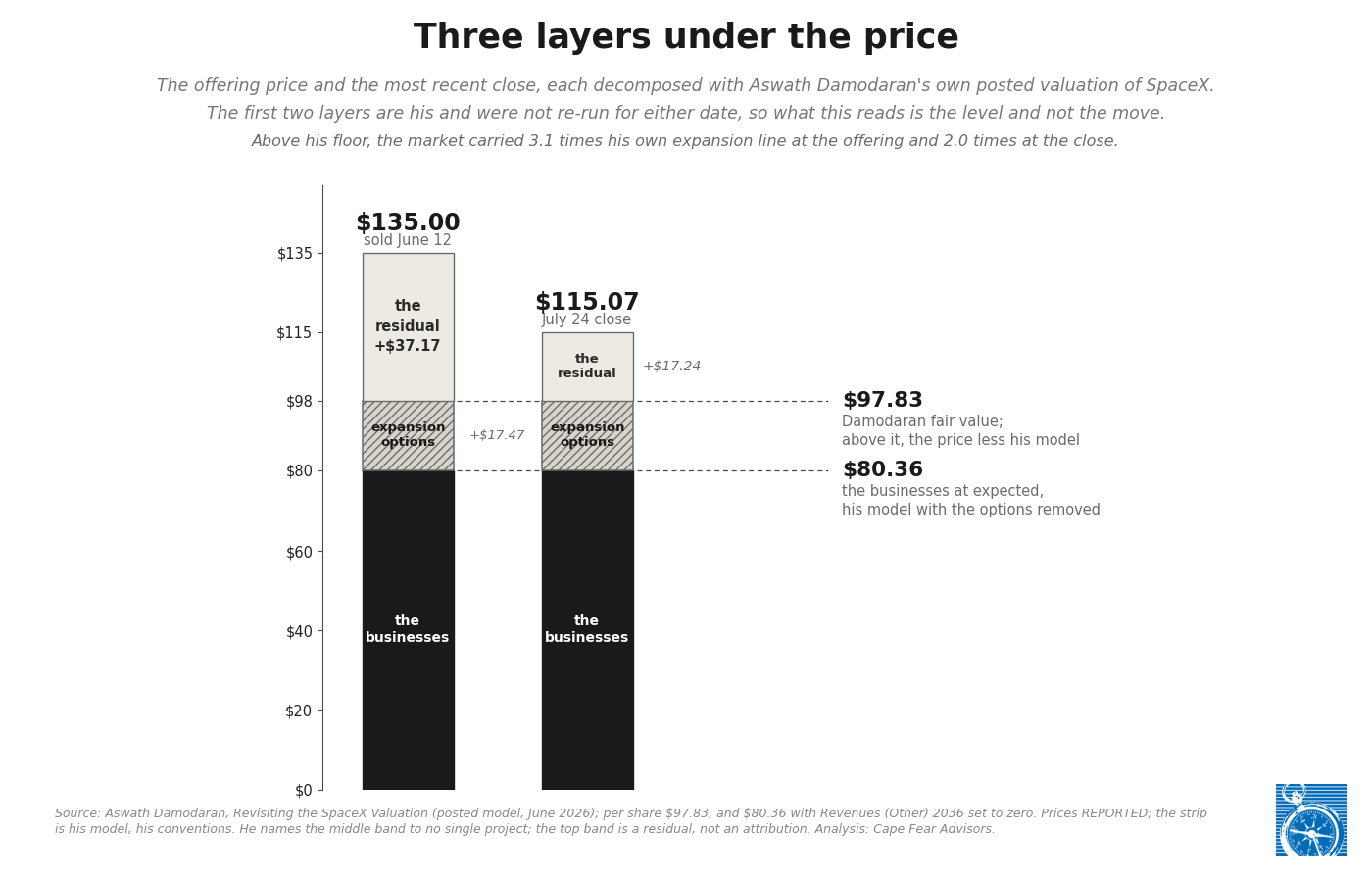
The price splits into three layers on the one model a reader can open, and above the standing businesses the market carried three times that model’s own line for what the company has not begun. Six weeks later the easy explanations are gone: the nearest cohort fell about a third as far, and what has been filed since is an acquisition settled in stock, a refinancing and three favorable ratings, none of them a repricing event and the only one with a direction pointing up. Behind it, two records of the chip project have run in parallel at very different levels of detail, and only one of them is filed. What is left standing in the record is time passing against a date the issuer set for itself.
The mark, and what has been filed since
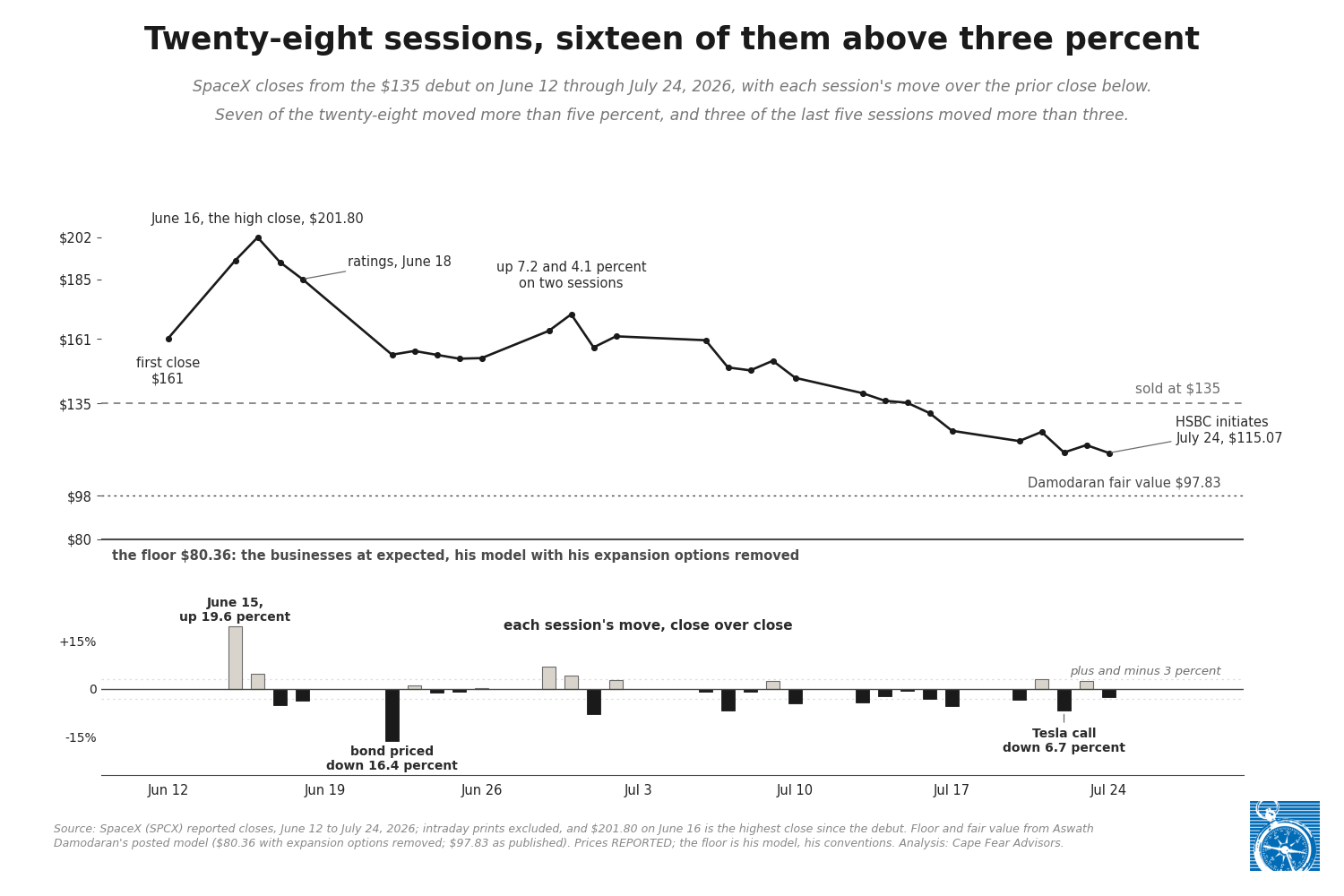
On June 12, 2026, SpaceX sold shares to the public at $135, the largest offering in history, and the market set the company near $1.79 trillion. Six weeks later it closed at $115.07 on July 24, about $1.53 trillion on roughly 13.26 billion shares, after a high close of $201.80 on June 16. (1) Headlines call the move a slump. Marked as a position, it is more particular. The entry is $135 and the plan behind it, and the question is not where the tape goes next but what has arrived since to justify the entry.
The record filed with the Commission since the debut is short. The acquisition of Cursor, disclosed before the offering and settled in stock, which changes the share count and not the cash need. A $25 billion bond, which refinanced and extended existing debt without adding capital the business can deploy. Investment-grade ratings from all three agencies on June 18. On the chip project, nothing: no material definitive agreement, no amendment, no completion. Part of the markdown is weather, because over the same six weeks the broad market softened and the AI trade cooled, so some of the decline belongs to everything and not to this company. What this piece reads is not the cause of any one day but the level across the stretch. (17, 18)
Sixteen of the twenty-eight sessions since the debut moved more than three percent, and seven moved more than five, from a first counted session up 19.5 percent on June 15 to a single session down 16.4 percent the day the bonds priced. Wide sessions are ordinary after an offering this size, and part of that dispersion is a market finding a clearing level for a float that did not exist in June. The amplitude has come down from those first-week extremes. The frequency has not: the last full week in the series moved 3.3, 3.1, 6.7, 2.6 and 2.7 percent, three of five sessions above three percent, six weeks in. Whatever is being argued about has not been settled by trading. (1)
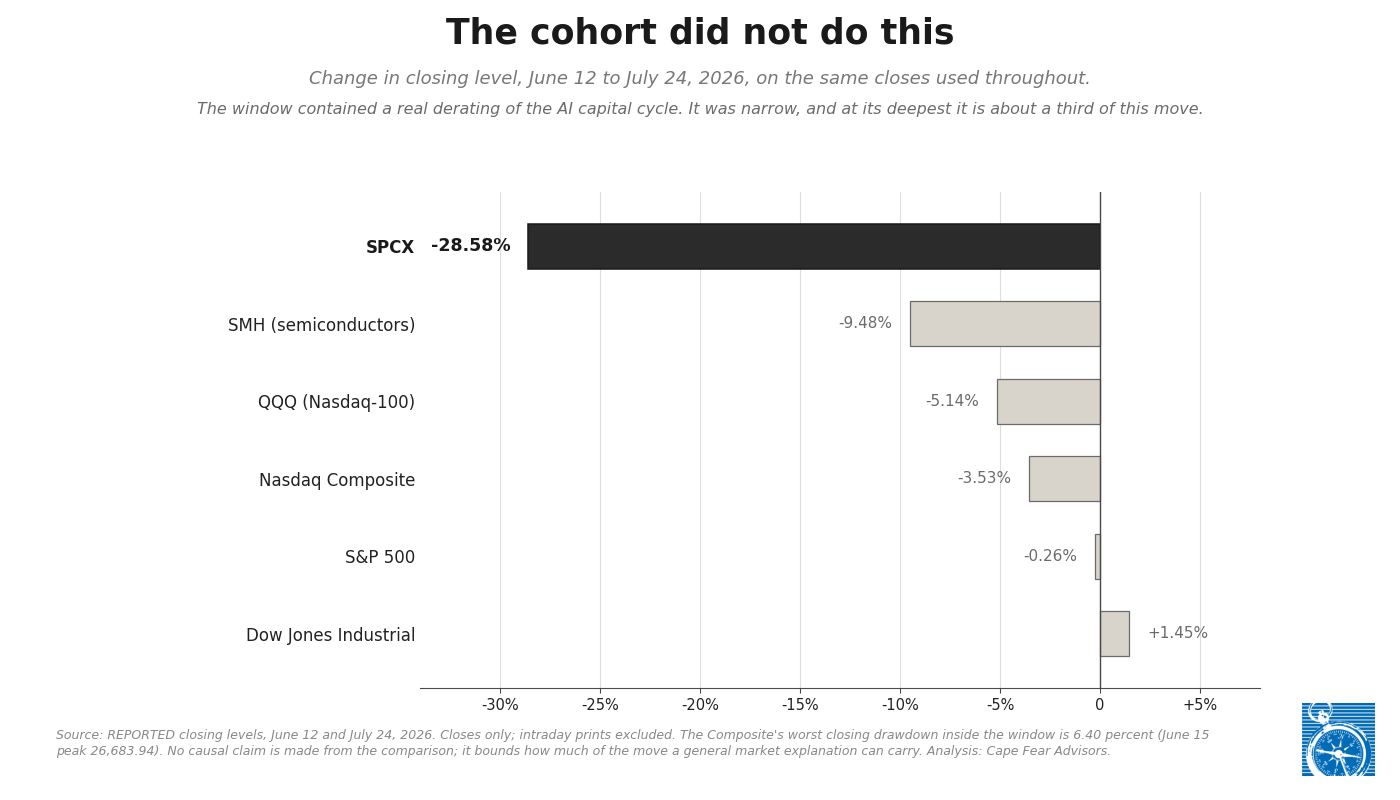
How much of that belongs to the market is answerable, and the answer is most of it does not. From the June 12 close to the July 24 close the stock came down 28.6 percent. Over the identical window the Nasdaq Composite came down 3.5 percent, the Nasdaq-100 tracker 5.1 percent, the S&P 500 three tenths of one percent, and the Dow finished higher. The nearest cohort available in a listed instrument, the semiconductor tracker, came down 9.5 percent, and that stretch did contain a real derating of the AI capital cycle: a foundry’s capital-spending guide on July 16, and a July 23 session in which one large platform fell about six percent on a capital-expenditure guide of $195 to $205 billion. So a cohort move exists, it was narrow rather than market-wide, and at its worst it is about a third of this one. Roughly two thirds of the decline has no cohort standing under it. That does not name a cause, and nothing here names one. It marks how much of the distance a general explanation reaches, and where it stops. (2)
The other ready explanation is company news, and the filed record set out above is the whole of it. None of those three items is a repricing event of that size, and the one that carries a direction carries it upward. A stock-settled acquisition moves the share count and not the cash need. A refinancing adds interest and not deployable capital. Three investment-grade ratings are favorable if they are anything. So the window holds no arriving fact large enough to account for the move, and on the one project the price was carrying it holds no filing at all. What is left standing in the record is six weeks passing against a date the issuer set for itself. This piece does not say the market priced that, because from outside no one can say which disagreement moved on which day. It says the record offers nothing else, and a residual is where a market keeps what it has not been given a way to itemize. (4)
They set the date
The schedule belongs to the issuer. The prospectus states that the company expects to begin deploying its orbital AI compute satellites as early as 2028, repeats that date in the forward-looking statements, and the roadshow materials filed with the offering carry the same line. The date was not buried in a risk factor. It was shown to buyers as part of the offer. (7)
The prospectus then names what stands between the company and the date. “Our ability to achieve orbital AI at scale depends on our ability to access a sufficient number of AI chips, significantly more than are currently available to us.” It names one answer, and the consequence of that answer failing. “While we expect to construct Terafab to address such supply constraints, Terafab may not be successful, in which case we may not have other sources of sufficient AI chips to meet our orbital AI compute demands.” The back half of that sentence is the company stating, in its own risk factor, that it has no second source. (7)
That phrase invites a reading it will not bear. The risk factor is about the sufficiency of supply for the company’s own demand, enough chips, in time, at the volume a constellation requires. It is not about whose silicon flies. On that second question the filed record says something close to the opposite of exclusivity: “We intend with our SpaceX AI satellites to allow people to put whatever GPU or TPU they want.” A customer may bring its own accelerator. The company may still be unable to obtain enough of its own. The two statements sit in different places and neither one answers the other. (8)
The controller said the same thing about supply in a filed interview, and said it as necessity. Asked by Jamie Dimon what compelled the chip build now, Musk named the constraint first. “What we see as a limiting factor is being able to make chips, both logic, memory, and packaging.” Then the state of the ground. “There’s not a single high volume computer memory fab in America right now. Zero.” The plant under construction in Idaho does not reach volume production until 2028 on his account, the New York projects later still, and then the arithmetic that decides it: “take the best case assumptions of the memory makers and the logic makers, it is not enough to meet the demand that is anticipated.” Then the conclusion, in three short sentences. “And that’s why we need to do Terra Fab. It seems essential. Otherwise we will not, there will not be enough chips.” The prospectus deals in may and will. This is a need, and a need cannot be deferred without cost. (8)
The paperwork behind the need is thinner than the language. What exists for the facility the company expects to be the world’s largest is “a general framework,” with financial terms, intellectual property rights, and the ultimate term of the collaboration all, in the prospectus’s words, not finalized. And there is the sentence the staff’s comments produced, which the prospectus repeats in four separate places: “Any specific projects undertaken pursuant to this framework will be subject to separate negotiations and agreements (including any development timelines, milestones and capital expenditures) and have not yet been determined.” Not the timeline undetermined. The projects. (12)
The record that is not filed
Beside that sits a second record, and it is not thin at all. It is in a Texas county clerk’s office, in two school districts, and with the state Comptroller, and this series read it in full in The Terafab Record. Between June 3 and July 21 that record filled in. A subsidiary named TeraFab AI, LLC has eight applications on file under the state’s Jobs, Energy, Technology and Innovation program, four with Anderson-Shiro CISD and four with Iola ISD, describing investment of up to $119 billion in phases and seeking roughly $1.66 billion of maintenance-and-operations tax benefit. A county judge signed a reinvestment zone. A deputy comptroller signed a recommendation on all eight. A county agreement took effect on June 3 over the county judge’s signature and was signed by the company’s chief financial officer on June 22, committing at least $5 billion of investment in Grimes County by 2030 and at least 1,800 full-time jobs by 2035, with $10 million payable and non-refundable by August 2, and a right to terminate at any time and for any reason on thirty days’ written notice, at a cost that stays small until a date the agreement itself names. Both school boards approved on July 14 by five-to-two votes. On July 21 the Governor’s positive determination was confirmed by the Comptroller’s office, though not by his own, and no verification letters have posted. Local coverage of the Iola vote reports a first construction phase intended before year end. (9)
None of that is in a filing. Not one line of it appears in an 8-K, and the two words that would carry it, a definitive agreement and a completion, are the two triggers the rules make mandatory. So the question of what to make of it has an answer already given, and given by the issuer. (10)
The answer is that all of it is ordinary course and none of it is material. That is not a reading imposed from outside. It is the company’s own determination, made the way determinations of this kind are made, by filing nothing, and the sizes agree with it. Ten million dollars is about one tenth of one percent of a single quarter’s capital spending at this company. Five billion by 2030 is less than a quarter of what the segment spent in 2025 alone. Against a $1.5 trillion market capitalization these are rounding. A commitment that can be exited on thirty days’ notice for a sum in the tens of millions is not a material definitive agreement in the sense the rules mean, and a permit, a zone, a school board vote and a governor’s determination are the ordinary machinery of putting a plant somewhere. The company judged all of it immaterial, and on the numbers the judgment is defensible. (10)
What follows from that runs the opposite way from the reading a holder might reach for. The absence of filings is not evidence that nothing is happening. It is evidence that what is happening is what the company already told the market it would do. The prospectus says Terafab will be constructed. That statement makes the attempt part of the ordinary course of the business, and an abandonment of the attempt, not its pursuit, would be the change large enough to require saying so. Silence on the attempt is the baseline holding. Progress against a plan already disclosed is exactly the thing that generates no news.
That settles what this piece is adding up, and it is not the cost of nothing happening. Something is plainly happening in Grimes County. The cost is the distance between what is happening there and what the filed record carries, because the filed record is the one the price was set on.
What ordinary course carries
The baseline carries the attempt. It does not carry the date, and the difference between those two is where the money sits.
The company has an account of its pacing, given by its chief financial officer in a filed interview. “We really take an approach from a capital allocation similar to what you would do in a just in time model.” On that doctrine capital arrives when it is needed and not before, which is discipline rather than delay, and a holder demanding to see spending early is asking the company to be worse at capital allocation than it says it is. (15)
The filing supplies the other half of that picture with the company’s own accounting. Capital expenditure in the AI segment ran $463 million in 2023, $5.6 billion in 2024, $12.7 billion in 2025, and $7.7 billion in the first quarter of 2026 alone, against $2.6 billion in the same quarter a year before. This is not a company that is slow to spend or short of the means to spend. And the prospectus says, in the same words every time it explains the increase, where the money went: “the rapid expansion of our terrestrial data centers, including the development, construction, and equipping of new facilities and supporting infrastructure.” Terrestrial. The capital is moving at scale and at speed, and the filed attribution puts it on the ground rather than in a fab. The state applications say the same thing in their own way, scheduling the heavy Terafab spending into 2028 and beyond. (13)
Two records of one project ran in parallel across six weeks at very different levels of specificity. One of them names phases, dollars, acreage, water, a payment date and an exit. The other says the projects have not yet been determined. Both are accurate to their own purpose, and neither is a failure of the other. What is true, and what a holder carries, is that the record with the specificity is not the record the securities laws deliver, and the holder who reads only what is filed sees the less specific of the two. The distance between them is not a disclosure defect. It is a measurement problem, and measurement problems have prices.
One model a reader can open
Of the four families of valuation, intrinsic, relative, asset-based and contingent claims, three go dark against this company: there is no true comparable for a business that is part launch, part satellite network, part data center and part chip ambition, so any peer group is a choice that makes the answer; there is no acquirer at a trillion and a half, founder-controlled and defense-adjacent, so the takeover premium that floors most companies is unavailable; and replacement cost is a different kind of floor from the one a franchise is priced on. Only real options has a slot for the question the market is arguing about.
Inside that one surviving family the practitioners disagree by a factor of six, measured from the lowest posted model to the highest bull case. Aswath Damodaran, who posts his model publicly, values the equity near $1.3 trillion, about $98 a share, and puts a band of $1.25 to $1.35 trillion around it, which on the prospectus count is about $94 to $102. Morgan Stanley is at $300, with a bull case at $600. JPMorgan is Overweight at $225. HSBC joined on July 24 with the lowest published mark, Hold at $115, on a sum of the parts to which coverage reports it added a doubling for the founder’s record, and it named the reason in the terms this piece has been using: investors, it wrote, are “already pricing in technologies that remain unproven, including orbital data centres, AI compute infrastructure in space and semiconductor manufacturing through its Terafab project.” Its own blue sky is $293. The published range now runs $115 to $600, and the low end doubles the businesses for the controller and still lands twenty dollars below the price the company set. The dispersion is a fact about the asset rather than noise to be averaged away: a company whose value almost no one agrees on, because almost all of it rests on things that have not happened yet. (14)
On Damodaran’s posted spreadsheet the operating business is worth $1.224 trillion and the equity $1.301 trillion, $97.83 a share, at a cost of capital of about 8.4 percent. Inside it sits a revenue line for other businesses, the large markets he thinks the company may enter and does not name. With that one line set to zero and nothing else changed, his own model returns $80.36 a share. The difference, $17.47, is what his model pays for everything the company is not yet in. He does not name that line to any one project, and the chip project is one of the things standing inside it rather than the whole of it. The price divides into three layers, all in his numbers and the tape: about $80 of businesses at their expected performance, about $17 of his own expansion-options line, and above both of those a residual, the part of the price his model does not reach. The first two layers are his and were not re-run for either date. Only the third one moved. It was $37.17 at $135 and it was $17.24 on July 24, so the entire $19.93 between the two marks sits in the layer above everything his model is willing to count. (3, 4, 5)
That $80 figure is a floor inside his model rather than a floor under the company, and it is not a pessimistic one: it still carries his full expectation for the AI business, revenue climbing from about $3 billion to a $160 billion target by 2036, which is itself an attempt. He would not accept the word optimistic for any of it, and the objection belongs in the record. He describes his own estimates as conservative, on the ground that he leaves out space travel and expanded business opportunities, and he defends a cost of capital close to the median for all US companies because most of the risk here is specific to the company, thins out in a diversified portfolio, and “cuts in both directions (upside and downside).” One input changes here, his own, and his model speaks. What survives the objection is that the floor sits well below the price, and the distance between them is what the tape has been arguing about. (3)
That distance is measurable at three marks. At $135, about $55 a share sat above the $80 floor, roughly 40 percent of the price, and closer to half given that the floor already assumes the aggressive AI case. At the June 16 high close of $201.80 the distance was $121. On July 24 it was $35. Damodaran’s own expansion line is a modest version of the same aspiration, $17.47, and he was candid about what it is, calling it in the earlier version of this valuation “a crude attempt to capture this part of the story.” Against that line the market paid about seven times at the high close, three times at the offering, and twice at the most recent close. Those multiples are a ruler and not an attribution. What sits above his fair value is a residual, and a residual absorbs every disagreement a buyer might have with him: his cost of capital, his revenue path, his terminal assumptions, and the attempt among them. That is not the same as calling it opaque. He names the largest of those disagreements himself, hands over the lever for each, and says plainly that “disagreements about market size and profitability across investors, especially in young companies, are natural and healthy.” What cannot be done from outside is to say which of them moved on any given day. What can be said is that the market assesses the whole of that quantity and prints its assessment at the close of every session, and that between two of those closes it came down by $19.93. (3, 4)
That last figure carries a caution that is best said in the open. Because his model was not re-run between the two dates, the fall in the third layer is arithmetically the same event as the fall in the price: $135 less $115.07 is $19.93, and no decomposition was needed to reach it. Any fixed valuation, his or anyone’s, subtracts out and leaves the same number; his low end gives premiums of $41.26 and $21.33, his high end $33.28 and $13.35, and the difference is $19.93 in all three. So the layers are not a measurement of the move. They are a measurement of the level: how much of the price on a given day stands above what a model with its working shown will pay, and how many multiples of that model’s own line for the not-yet-begun the market was carrying. At $135 it was three times that line. At the June high it was seven. On July 24 it was two. That is the reading, and it is the whole of it. (3)
He wrote something in April, before the prospectus existed, that sits against the tape. He ran that earlier valuation ten thousand times, took the median of the runs at $1.29 trillion, and said of the pricing rumored at the time that “a $1.75 trillion or even a $2 trillion pricing falls in the range of the distribution, though with little or no upside left for an investor paying that price.” The company priced in June at $135, which on the count used here is $1.79 trillion. That is the sequence. No cause is claimed from it, and he claimed none himself. (3)
What this piece does with that is reconcile the news to the changes in the tape, and the limit of the exercise should be said out loud: a move can come from news, from volatility, or from a reassessment of the residual, and from outside the tape those three cannot be separated. The one outside reading of the same stretch that puts a reason on paper is HSBC’s, initiating at the bottom of the published range on July 24, and it lands on the last two, pricing for technologies that remain unproven. It is a bank’s note reaching the record through coverage, and it is offered here as that and nothing more. (14)
Whose numbers, then. The controller set the offering price at $135, and a buyer that morning bought whatever the not-yet-begun was carrying at whatever he had set it. No other price was on offer. What is left to an outsider afterward is the choice of a yardstick, and this one is used because it is the least favorable to the case made here. His floor leaves the standing businesses $80.36 of the $135, about three fifths of it, and about seven tenths of the July 24 close. HSBC’s implies less: coverage reports its $115 rests on a sum of the parts the bank doubled for the founder’s record, which puts that sum near $58, somewhat over two fifths of the offering price. The rest of the published marks show no working at all. A range could be drawn across them, and it is not drawn here, because the one figure a reader can open and test is also the one that hands the standing businesses the largest share of the price. (6, 14)
He does not argue for anything lower, and it would be a misuse of him to suggest otherwise. He calls his own estimates conservative, he says the outliers are likelier on the upside than the downside, he declined the offering as too richly priced for his tastes rather than calling it overvalued, he will not sell it short, and he wrote in April that the company was one large correction away from being fairly priced or cheap and that he would be a buyer if that came. The model is his. Every use made of it here is this piece’s own. (6)
Lower numbers do exist inside that model, and reaching them requires no disagreement with him at all. His probability-of-failure input sits at zero, which is where the workbook starts. Work published here on June 7 measured the lever on that input: on his own convention that a failure returns about half of fair value, each percentage point takes roughly $6.1 billion off the operating assets, about 49 cents a share. His own published precedents, from his prior valuations of young companies, run 5 percent for Uber, 10 percent for Lyft, for Airbnb and for Zomato, and 20 percent for WeWork. At 10 percent his $97.83 becomes about $92.96, within a dollar of the $93.74 low end of his own June band. At 20 percent it is about $88.10. Both still stand above the $80.36 floor used here, so the shape of the reading does not change. Neither is offered as a correction of him, and neither is the number this piece is about: that switch is firm-wide and binary, and a schedule is not what it measures. (3, 5)
What the company can do now to earn the premium is a short list. On the AI compute side the best available outcome is to deliver, in full, the two contracts registered as material, about $1.25 billion a month from Anthropic and $920 million from Google. Those are already in every model, so delivering them meets the number rather than beats it, and both cancel on ninety days’ notice, which makes even full delivery revocable each quarter. The outcomes on compute are capped at zero on the upside and open on the downside. The only positive surprise left lives above the contracts, in the build. (15)
No slot in the model, no slot in the rules
Underneath the forecast is the assumption that matters most, and it arrives by default rather than by choice. The model carries a switch for the probability that the firm does not survive, and it is left off, which is where it starts; the note beside that input observes that young companies fail when they have trouble raising cash. Off is a survival assumption, and survival of a value built on growth is not passive. It assumes the company attempts, and it assumes the attempt lands roughly when the plan says. Every model books the benefit of the attempt, because the attempt is the plan and most of the value. What none of them carries is a state in which the attempt proceeds and the calendar moves, and the failure switch would not carry it either: it is firm-wide and it is binary, and it has nothing to say about a date. Booked, uncosted, and unconditioned. (5)
The reporting rules have the same hole in the same place. What obliges a current report is an event: entry into a material definitive agreement, its termination, the completion of an acquisition or disposition. Two further items exist for anything else, one for selective-disclosure cures and one for whatever the registrant chooses to report, and both are voluntary. Beyond that, a forward-looking statement generally carries no duty to update as circumstances change. So the rules capture things that happen, on the day they happen, at a size that clears a threshold. A date that slides carries no event, no counterparty, and no dollar figure, which leaves it outside every mandatory trigger there is.
That was tested on July 22. On Tesla’s second-quarter earnings call the controller of both companies, asked about the chip project, said that a location is expected to be announced soon and that details would come with the product launch rather than an earnings call. Four days later no announcement has followed. What that sentence is, and where it lives, decides how far it travels. It is oral, it is a timing statement about the project the prospectus puts between the company and the date, and it was made at a related party, on a call belonging to a different issuer, whose own filings have not used the word Terafab since March. A SpaceX holder who reads only SpaceX filings did not receive it. Nothing about that is irregular, and nothing about it was required to be filed. The rules have no slot for soon, in the same way and for the same reason that the model has no slot for later. (11)
What time costs
An option with no stated expiry does not obviously decay, which makes it fair to ask why the premium should erode rather than wait patiently. Beyond the 2028 schedule, the record supplies three more clocks. The compute contracts run to 2029, so the window in which a differentiated build could compound inside contracted demand narrows by a quarter every quarter. The customers are standing up their own capacity across 2027, the demand this series has watched approach. And the sharpest and most filed of the three is the rent. At the debut the company sold $25 billion of notes across five tranches at a weighted average coupon of about 5.86 percent, refinancing and extending the bridge loan it took in March, about $20 billion at roughly 4.6 percent. That is roughly $1.46 billion a year in interest, about half a billion more than the bridge it replaced, the first payment due January 15, 2027, running from June whether or not the schedule holds, and locked out as far as 2056. It prints in the next quarterly filing as interest expense beside whatever the capital line shows. Separately, the company committed in its filings to hold $25 billion in cash, a commitment the ratings rest on, capital it cannot deploy. Time is not free to this company. It has a coupon. (18)
The market is marking the wait in two places. The equity premium above the floor has narrowed from about $121 at the June high to about $35. The bonds, the June investment-grade debut, slipped below issue within days, about $305 million of paper losses, with the ten-year tranche’s yield climbing toward 6 percent and its spread above 160 basis points, junk-like against the grade on the label. The credit market’s stated reason is the reading in its own words: attention has moved from the growth narrative to cash flow and execution, against a first-quarter loss of $4.28 billion. The debt raised to earn a rating is being second-guessed by the market that trades it, and it added no capital the business can spend. Two witnesses, equity and credit, to one uncertainty. (18, 19)
The one who can begin
The schedule has an owner, and the structure that gives it one was part of what the shareholders bought. SpaceX is a controlled company. There are two classes of stock, one vote a share and ten, the founder controlling about 85 percent of the vote on about 42 percent of the economics and the public about 15 percent of the vote on about 60 percent. It is exempt from the requirement that a majority of its board be independent, the controller elects and removes the directors who hold control, and a shareholder proposal requires 67 percent of the voting power, which the vote structure places out of reach. The plan calls speed the advantage, and this structure was the price of the speed, not incidental to it. The right to set the pace of the attempt therefore sits with the controller, and the holders who bought it have no mechanism to affect it. (16)
The exposures run together on the same clock. The premium narrows as the window narrows, execution risk runs beside it, and financing risk sits under both, a company that has turned from returning capital to raising it against a funding gap larger than the offering. The financing has a reflexive edge, because the premium is also the currency: acquisitions have been paid for in the company’s own stock, xAI and Cursor both, so the mark that comes down is the coin the build would be bought with, and its decay raises the price, in dilution, of the expansion it was meant to fund. What helped the plan at $135 works against it at $115, without anyone deciding it should.
The other way an option ends
An option can also end without decaying. The holders’ claim on the attempt has no stated expiry, which is not the same as having none. The party who alone sets the pace of the build can also do other things, and some of them would settle the question by removing it rather than answering it. Asked on the same July 22 call about combining the two companies, the controller answered that it “has got to be done with the appropriate process.” Nothing on the subject is filed, and neither company has said a combination is contemplated. The merger question is a potential action and belongs in a different box from the timing statement made on the same call: one would change what the option is written on, the other changes when it pays. What the question illustrates is structural, and it reaches back to the vote: a holder waiting for an attempt waits inside a period whose terms can be changed by the same party, through acts the holders have no vote to affect. The defense of waiting is that flexibility has value. It assumes the flexibility survives the wait.
A shareholder bought two things, the businesses and a promise to attempt more, and the second is an option. The cost is not that nothing has begun. It is that the beginning which exists is not the beginning the filed record carries, and the one that would carry it, capital deployed at the scale the plan describes, is scheduled for years the coupon has already started running toward. Between those two lies uncertainty about timing that no model books and no rule requires anyone to report. In theory that uncertainty can raise what an option is worth. What it has plainly raised is the volatility of the stock, and the equity and the bond tape are both marking it. Good news could lift the premium again, and the longer the interval, the more of the price rests on the premium alone and the less on anything filed. What a holder is paying for, and paying to hold, is the time value of a promise to try, not even to succeed.
What a holder is paying for, and paying to hold, is the time value of a promise to try, not even to succeed.
Related, on the Quality of Cash shelf: The Quality of Cash: What Has to Happen Next (the anchor); SpaceX, Adding It Up: The $235 Billion Cash Gap; The Terafab Record; The Ninety-Day Annuity; The Probability of Failure; The Three Layer Cake: SpaceX’s Governance Structure; Cursor Stock and the Investment-Grade Refinancing; SpaceX Confuses Currency for Capital.
Standing Disclosure
Anthropic is the developer of Claude, which is used in preparing this research, and Anthropic is also a compute counterparty to SpaceX, the customer whose contract is read here. That nearness cannot be fully checked away, which is why no claim here rests on trust in the tool: every figure carries a public source, and the record grades the rest. Others named have ties to Anthropic: Google, the second compute counterparty, and its parent Alphabet, which holds a large position in Anthropic; and companies not named here, among the chip and cloud suppliers, may hold positions or supply relationships that bear on the filers discussed, which is part of why every piece is re-checked for bias, ground facts, and filings rather than read against a fixed list. Figures are quoted from the filers and from named analysts without characterization, and the same standard of reading is applied to every party named.
Analysis: Cape Fear Advisors.
Notes
How to read the labels. Every load-bearing figure below carries a source and a status. FILED means a document filed with the Commission and cited by accession, which any reader can pull. REPORTED means the public record outside the Commission’s files: county and state documents, local coverage, market data, and analyst work reached through coverage or posted by its author. The distance between those two words is what this piece is about, so they are used strictly and nothing is left unlabeled.
(1) Prices and size. REPORTED market data, with the offering itself FILED. IPO priced $135 on June 12, 2026; the first close was $161.11, 19.3 percent above the offering price. Closing prices only are used throughout, and intraday prints are excluded: the highest close since the debut is $201.80 on June 16, 2026, and the most recent close pinned here is $115.07 on July 24, 2026, a market capitalization near $1.53 trillion. The share count used for both capitalizations in the text is 13,257.5 million: Damodaran’s 12,535.3 million basic shares, which are the shares outstanding before the offering and the denominator his per-share figure divides by, plus the 638,888,888 Class A shares sold, plus the 83,333,333 over-allotment shares. At $135.00 that is $1.790 trillion and at $115.07 it is $1.526 trillion. Excluding the over-allotment the count is 13,174.2 million and the two figures are $1.779 trillion and $1.516 trillion, which is within about a percent at each mark; the fuller count is used because the over-allotment was in fact exercised. The session-move counts, sixteen of twenty-eight sessions above three percent and seven above five, are computed from the same reported daily closes, June 15 through July 24, close over prior close, so the first move inside the count is June 15’s 19.5 percent over the June 12 close rather than the debut’s 19.3 percent over the offering price; June 19 and July 3 were market holidays. No session in the twenty-eight sits at exactly three or exactly five percent, so the strict reading and the inclusive one return the same counts. This piece publishes on Sunday, July 26, 2026, so the July 24 close is the last session before publication and no session intervenes between the pinned price and the print. FILED: SpaceX Form 8-K reporting the IPO close (accession 0001628280-26-043288) records 638,888,888 Class A shares sold at $135.00. The base offering raised about $75 billion; the underwriters’ over-allotment (the green shoe) of 83,333,333 shares was exercised in full, about $11.25 billion more, taking the gross to about $86.25 billion. Damodaran’s model, written at pricing, uses the $75 billion base, and his per-share figure is not merely little affected by the over-allotment but exactly invariant to it: the per-share result is equity less the offering proceeds, divided by the pre-offering basic share count, so proceeds and the shares issued for them cancel and the size of the shoe drops out.
(2) The cohort. REPORTED, all of it, and none of it FILED. Closing levels on June 12 and July 24, 2026: SPCX $161.11 and $115.07, down 28.58 percent; Nasdaq Composite 25,888.84 and 24,975.82, down 3.53 percent; the Nasdaq-100 tracker QQQ $721.34 and $684.23, down 5.14 percent; the S&P 500 7,431.46 and 7,411.98, down 0.26 percent; the VanEck semiconductor tracker SMH $619.96 and $561.19, down 9.48 percent; the Dow Jones Industrial Average 51,202.26 and 51,947.25, up 1.45 percent, recorded because a rising index is the harder fact for a market-wide reading. Measured on closes throughout, on the same convention used for the stock. The Composite’s worst closing drawdown inside the window is 6.40 percent, from a June 15 peak of 26,683.94 to the July 24 close. The stock’s decline is about three times the deepest cohort proxy and about eight times the Composite. Window events referenced in the text are reported: TSMC’s capital-expenditure guidance on July 16, 2026; the July 23, 2026 session in which Alphabet fell about 5.9 percent on 2027 capital-expenditure guidance of $195 to $205 billion and the Composite fell 2.15 percent. Also inside the window and not separated out here: a June 16-17 FOMC meeting at which forward guidance was withdrawn, crude oil up about 6 percent, the ten-year note near 4.675 percent, and newly implemented tariffs of 10 to 12.5 percent. No causal claim is made from any of it. The comparison is used only to bound how much of the move a general market explanation can carry.
(3) The model. Neither FILED nor REPORTED, and the distinction is the reason this piece uses it: a named practitioner published his valuation with the spreadsheet attached, so any reader can open it, change the one input changed here, and re-run it. Aswath Damodaran, “Revisiting the SpaceX Valuation: A Post-Prospectus Update”, June 2026, and his posted spreadsheet (SpaceX2026IPOUpdated.xlsx); the earlier valuation it updates is “To a Trillion(s) Dollars and Beyond: A SpaceX IPO Odyssey”, April 2026. Value of operating assets $1,224,448 million; value of equity $1,301,299 million; value per share $97.83; basic shares 12,535.3 million; cost of capital 8.37 percent initial and 8.25 percent terminal; probability of failure input set to zero. Setting his “Revenues (Other) in 2036” input to zero, with every other input and convention unchanged, recomputes the equity at $1,082,278 million and the per share at $80.36; the difference, $17.47 a share, is the value his model assigns to the expansion options. The per-share figure reduces to (equity minus IPO proceeds) divided by basic shares. The three distances above the floor cited in the text are $54.64 at the $135 offering price, $121.44 at the June 16 close, and $34.71 at the July 24 close, which are 3.1, 7.0, and 2.0 times his expansion-option line. Measured instead against his fair value of $97.83, the market premium was $37.17 at the offering and $17.24 at the July 24 close, a decline of $19.93. His floor and his expansion-option line are outputs of a model rather than marks in the tape, and the model was not re-run for either date: its riskfree input is 4.56 percent, dated June 1, 2026, and a 25 basis point change in that one input moves the per-share result by roughly $2.15 to $2.57. So neither of the first two layers differs between those two dates, and the whole of the move sits in the third by construction. That is what the two columns of the layers exhibit show. Because a model value that does not change between two dates subtracts out of both premiums, the $19.93 is invariant to which of his figures is used and is arithmetically identical to the change in the price itself: against his band of $1.25 trillion to $1.35 trillion for the equity, which reduces to about $93.74 and $101.72 a share on the same convention, the premium runs $41.26 and $21.33 at the low end and $33.28 and $13.35 at the high end, a fall of $19.93 in each case. The decomposition is therefore used in this piece for the level and not for the move. In the earlier April valuation he reports a base of $1.22 trillion and a median of $1.29 trillion across ten thousand simulation runs; that post states no other percentile, gives no share count and no per-share figure, so nothing per-share is taken from it here. The probability-of-failure arithmetic cited in the text is this piece’s own, computed on his posted workbook and on the measurement published in SpaceX, Adding It Up: The Probability of Failure, June 7, 2026: with a failure modeled to return about half of fair value, each percentage point of failure probability removes about $6.1 billion of operating asset value, which on 12,535.3 million basic shares is about $0.487 a share, so 10 percent gives about $92.96 and 20 percent about $88.10 against his $97.83. The precedents quoted are his own from prior valuations, 5 percent for Uber, 10 percent for Lyft, Airbnb and Zomato, 20 percent for WeWork. He does not apply any of them to this company, the input in the posted workbook is at zero, and no claim is made here that he intended otherwise.
(4) What the third layer is, and is not. It is a residual, and it is placed in that bucket here knowingly. It is the price less his fair value, so it absorbs every disagreement a buyer might have with his forecasts, not the chip project alone: a 50 basis point cut in his terminal cost of capital by itself moves about $12.00, against an expansion line of $17.47. Part of what a buyer pays for the chip project may also sit inside the first layer, in the AI segment his floor still carries in full, so the layers are not clean partitions of the thing they are named for. The decomposition is used here as a scale for reading the size of the move, not as an attribution of the move to any one cause. The market does the attribution, once a day, at the close, and the whole of this piece is an attempt to reconcile a filed record to that number rather than to replace it.
(5) What his expansion line is called, and when it runs. His workbook labels the segment three spokes and his April 2026 post describes it as unnamed large markets, plural. It is not a Terafab line and is not read as one here. It is also not undated: his revenue row for it ramps from zero beginning in 2032. His own option-value sheet is switched off in the posted workbook, so the line is a revenue segment inside the discounted cash flow and is called that throughout rather than an option value. The crude attempt phrase is his, from the April 2026 version of the valuation: “In a crude attempt to capture this part of the story, I will attach an expected revenue in 2036 to these other businesses of $50 billion and an operating margin of 30%”; the June input used here is $100 billion, double the April figure. The characterization of the line as low probability and high payoff is this piece’s summary of his discussion and not his phrasing. What he writes of these lines is that they are “all options that may not be viable at the moment, but if they become viable, could add immense value”, and of one of them that the possibility “may be low, but it does exist.” The June post refers to the “expansion options embedded in each business”, plural and business by business, which is a further reason not to read the line as a single project. The probability-of-failure input discussed in the text is the workbook’s default setting rather than an affirmative choice about this project, and it is a firm-wide distress truncation with no connection to any project’s schedule.
(6) Why this model, and what the others imply. Damodaran’s floor of $80.36 is 59.5 percent of the $135 offering price and 69.8 percent of the $115.07 close on July 24. HSBC’s $115 target is reported through coverage to rest on a sum-of-the-parts valuation that the bank then doubled for the founder’s record; read literally, that puts its sum of the parts near $57.50, which is 42.6 percent of the offering price and half of its own target. Morgan Stanley at $300 with a $600 bull case and JPMorgan at $225 publish no decomposition, so no such share can be computed from either. The doubling is a characterization in coverage and not a figure taken from the note, which is not public, and it is used here only for the comparison stated in the text: among the published marks that show any working, the one used here assigns the standing businesses the largest share of the price. His own posture is recorded so that it is not mistaken for this piece’s: in April he wrote that the company was “one big correction away from being fairly priced or even cheap” and that “If that happens, I will be a buyer”; in June he wrote that at the rumored $1.8 trillion it was “too richly priced for my tastes” while adding that “That does not mean that I will never buy the stock”; and in both he says he would not sell it short. He describes his estimates as conservative and writes that if there are outliers they are likelier on the upside. He nowhere calls the stock overvalued, and this piece does not report him as having done so.
(7) Timing. FILED. The 2028 date is the issuer’s, stated three ways: “We expect to begin deploying our orbital AI compute satellites as early as 2028” appears in the business section, in the AI compute discussion, and in the forward-looking statements list of the S-1 (accessions 0001628280-26-036936 and 0001628280-26-042639); the roadshow materials filed as a free writing prospectus (accession 0001628280-26-040610) carry the same deployment line. The chip constraint and the absence of a second source are quoted from the S-1 risk factors verbatim.
(8) Terafab, and the spelling. The S-1 spells the project “Terafab” as one word. The filed interview transcript renders it “Terra Fab,” two words, throughout; earlier entries in this series noted the same difference. Both spellings appear here as they appear in their sources, and nothing turns on the difference. The interview is a Rule 433 free writing prospectus, a June 4, 2026 video interview of Elon Musk by Jamie Dimon of J.P. Morgan hosted by Mary Erdoes, filed in connection with the registration statement (accession 0001628280-26-041365), with the transcript filed as Exhibit B to that free writing prospectus. The quotations here are FILED, taken from that exhibit, which carries the filer’s own note that the transcript was “slightly edited for clarity.” Quoted in the text: “What we see as a limiting factor is being able to make chips, both logic, memory, and packaging”; “There’s not a single high volume computer memory fab in America right now. Zero”; “take the best case assumptions of the memory makers and the logic makers, it is not enough to meet the demand that is anticipated”; “And that’s why we need to do Terra Fab. It seems essential. Otherwise we will not, there will not be enough chips”; and “We intend with our SpaceX AI satellites to allow people to put whatever GPU or TPU they want.” On the scale of the plant, “we expect that the Terafab is going to be around 100 million square feet, which is 10 times the size of the Tesla Gigafactory Texas” (free writing prospectus, accession 0001628280-26-041761, Exhibit B).
(9) The Texas record. REPORTED throughout and FILED nowhere: these are county, school-district and state records, and local coverage of them, none of which is a document filed with the Commission. Read in full in The Terafab Record. Eight applications under the Texas Jobs, Energy, Technology and Innovation Act were filed by TeraFab AI, LLC, four with Anderson-Shiro CISD and four with Iola ISD, describing phased investment of up to about $119 billion and seeking about $1.66 billion of maintenance-and-operations tax benefit. Grimes County commissioners created a reinvestment zone in early June, and the county released the agreement documents on June 6 (KBTX); a deputy comptroller signed recommendations on all eight applications on June 15 (Comptroller, J0038 Anderson-Shiro recommendation; KBTX, June 18); the county agreement carries an effective date of June 3, 2026, the date the county judge signed, and SpaceX’s chief financial officer signed on June 22, reported June 23 (KBTX). The two dates are separate and both are correct; the payment clock runs from the effective date. The county agreement’s principal terms as reported: at least $5 billion invested in Grimes County by 2030, at least 1,800 full-time jobs by 2035, a $10 million non-refundable payment due August 2, 2026, a Sunday, which KBTX reports as sixty days from the June 3 effective date, and a right to terminate “at any time and for any reason” on 30 days’ written notice, with the cost of exit rising on a schedule the agreement names. Early press rendered the exit cap as $60 million; The Terafab Record works from the posted agreements rather than that characterization, and readers who need the mechanics should read it there. Both school boards approved on July 14 by 5-2 votes (KBTX, July 15; The Texan); Iola coverage reports a first construction phase intended before year end. On July 21 KBTX reported, on confirmation from the Texas Comptroller’s office, that the Governor submitted a positive determination; verification letters have not posted, the confirmation was verbal, and the Governor’s office did not respond to requests. Remaining steps per that reporting: formal execution by the applicant, both districts and the Governor, submission to the Comptroller, and then the first construction phase. Also in the record and not relied on here: a July 2 county request for an Attorney General opinion on withholding certain SpaceX communications from a records request (KBTX), and a July 9 report on incomplete applications and weeks of corrections in the state file (KBTX; KWTX). The two stations are sister outlets and carry the same Terafab reporting, so items below are cited to whichever posted the text version. Sources: KBTX and KWTX (Bryan-College Station and Waco), The Texan, and the posted county and Comptroller documents.
(10) Materiality, and whose judgment it is. The absence is itself the evidence, so it is stated plainly: no document FILED by SpaceX with the Commission carries any part of the Texas record. The characterization of it as ordinary course and immaterial is the issuer’s own determination, evidenced by the absence of a filing, and nothing here asserts that anything was required to be filed and was not. The arithmetic supports the determination: the $10 million payment is about 0.1 percent of the roughly $10.1 billion of capital expenditure in the first quarter of 2026 alone, and the $5 billion investment commitment through 2030 is under a quarter of the $20.7 billion of company-wide capital expenditure recorded for 2025. The relevant current-report triggers are Item 1.01 (entry into a material definitive agreement), Item 1.02 (termination of one), and Item 2.01 (completion of an acquisition or disposition of assets). Items 7.01 and 8.01 exist for Regulation FD disclosure and for other events at the registrant’s option, and are voluntary. A forward-looking statement generally carries no duty to update absent a duty to correct. This paragraph describes the framework, not a legal conclusion about any particular item.
(11) The July 22 statements. REPORTED. Elon Musk on Tesla’s second-quarter 2026 earnings call, July 22, 2026. On the chip project, published transcripts render the line as an expectation to announce a location soon, with details to come at a product launch rather than on an earnings call; transcript providers differ on one word, one rendering “a location” and another “the location,” a difference that bears on whether a site is settled and pending announcement, so the text above paraphrases rather than quotes on that point. Sources reviewed: Investing.com and Alphastreet transcripts and a Not a Tesla App summary. On combining the two companies, the quoted words “has got to be done with the appropriate process” are reported by Fortune (Shawn Tully, July 25, 2026). Tesla’s own second-quarter earnings exhibit and its Form 10-Q contain no use of the word Terafab; Tesla’s filed count of the word remains zero since March 2026. Also said on that call, and not used here: a statement that the chip project is necessary to scaling Optimus production, which is scoped to Tesla’s own demand and not to SpaceX’s orbital deployment, and a description of a separate development fab in Austin, which is Tesla’s facility and Tesla’s spending. No filing on a combination exists, neither company has stated on the record that one is contemplated, and nothing here should be read as predicting one.
(12) The undetermined-projects sentence. FILED. Verified verbatim in the S-1 at four separate places (the summary, the business overview, the strategy section, and the Terafab discussion): “Any specific projects undertaken pursuant to this framework will be subject to separate negotiations and agreements (including any development timelines, milestones and capital expenditures) and have not yet been determined.” The scope is the projects, not only the schedule. The characterization of the arrangement as “a general framework,” with financial terms, intellectual property rights, and the ultimate term of the collaboration not finalized, is the prospectus’s own; the revision arose from the staff’s comments (comment-letter correspondence). Nothing here treats that sentence and the Texas applications as inconsistent: the framework sentence concerns the collaboration with the named partners, and the state filings are conditional, phased, and exitable.
(13) Capital expenditure, by segment. FILED. From the S-1’s MD&A and segment discussion: AI segment capital expenditure of $463 million in 2023, $5,633 million in 2024, $12,727 million in 2025, and $7,723 million for the three months ended March 31, 2026 against $2,567 million in the prior-year quarter. Space segment $1,497 / $2,032 / $3,832 million and Connectivity $2,455 / $3,498 / $4,178 million for 2023 / 2024 / 2025. These sum to $4.4 billion, $11.2 billion, and $20.7 billion, which reconcile exactly to the three capital-expenditure bars carried in the filed roadshow presentation. The prospectus attributes the increase, in each period and in identical words, to “the rapid expansion of our terrestrial data centers, including the development, construction, and equipping of new facilities and supporting infrastructure.” That language attributes the increase; it does not state that the segment contains nothing orbital, and no such claim is made here.
(14) Street targets. REPORTED, and none of it FILED: bank targets reach the record through coverage, and the notes themselves are not public. Morgan Stanley (Adam Jonas), $300 base target with a $600 bull case. JPMorgan initiated Overweight at $225. HSBC initiated Hold at $115 on July 24, 2026, with a blue-sky case of $293 and an estimate of about $106 billion of cumulative cash burn before free cash flow turns positive around 2030; reported through coverage (TheStreet, Yahoo Finance, MarketScreener, CNBC, July 24, 2026), with the note itself not public and the analyst not named in the coverage reviewed. All reported through coverage; the banks’ per-segment breakdowns are not public.
(15) The businesses and the contracts. FILED. SpaceX Form S-1 and final prospectus (accessions 0001628280-26-036936 and 0001628280-26-042639). The Anthropic compute agreement (about $1.25 billion a month) and the Google agreement (about $920 million a month, via free writing prospectus), both cancellable on ninety days’ notice, are disclosed there and in related free writing prospectuses; the SEC staff cited Item 601(b)(10) on the Anthropic agreement (comment-letter correspondence, accession 0000000000-26-005505). The pace-of-spending language is the company’s own: “During this investment period, our capital expenditures will scale as quickly as we are able to deploy power and compute to address the $26.5 trillion potential market opportunity for AI,” and “we believe speed is a competitive advantage... we continue to prioritize execution speed, capacity expansion, and technological leadership over near-term margin optimization.” The just-in-time characterization is the chief financial officer’s, in a separately filed interview.
(16) Governance. FILED (S-1; read in The Three Layer Cake: SpaceX’s Governance Structure): a controlled company with two share classes, one vote a share and ten; the founder controlling about 85 percent of the vote on about 42 percent of the economics, the public about 15 percent of the vote on about 60 percent of the economics; exempt from the independent-board-majority requirement; the controller elects and removes the controlling directors; and a shareholder proposal requires 67 percent of the voting power.
(17) Cursor. FILED. Acquisition disclosed before the offering, settled in stock (Form 8-K, accession 0001628280-26-043411).
(18) The bond. FILED for the terms, REPORTED for the trading. Debut $25 billion offering, five tranches, priced June 22-23 and settled June 26, 2026 (Form 8-K, accession 0001628280-26-044955): $7.0 billion at 5.35% (2031), $6.0 billion at 5.65% (2033), $6.0 billion at 5.875% (2036), $2.5 billion at 6.60% (2046), $3.5 billion at 6.65% (2056); weighted average coupon about 5.855 percent, about $1.46 billion of annual interest, semiannual on January 15 and July 15, first payment January 15, 2027. The offering refinanced and extended the March 2026 bridge loan (about $20 billion at roughly 4.6 percent, maturing September 2027), a debt-for-debt transaction rather than new deployable cash; separately, the company committed in its filings to a $25 billion minimum cash balance, which the agencies credited as supporting the rating, immobilizing that capital (read in Cursor Stock and the Investment-Grade Refinancing). Reported paper losses of about $305 million within days of pricing; the 2036 tranche’s yield toward 6 percent and spread above 160 basis points; the “junk-like despite investment grade” characterization (Connect Money, The Motley Fool, Advisor Perspectives, June-July 2026). Investment-grade ratings assigned June 18, 2026 (Moody’s Baa1, Fitch BBB+, S&P BBB).
(19) Operating figures. FILED. First-quarter 2026 net loss of $4.28 billion on $4.69 billion of revenue; capital expenditure of about $10.1 billion in the quarter, of which about $7.7 billion was AI. The funding gap and the compute-contract terms are read in earlier entries in this series: The $235 Billion Cash Gap, The Ninety-Day Annuity, and The Probability of Failure.
Analysis: Cape Fear Advisors.
This article is also available on Substack.
Contact Cape Fear Advisors