

SpaceX sold its offering in part on two large compute contracts, with Anthropic and Google, headlined in the tens of billions and carried on the page through 2029. Against their own terms, the contracts cancel on ninety days’ notice, ramp at a fee the filing leaves blank, and rest on capacity the company has yet to build against a September 30 deadline, while the larger customer contracts its own capacity elsewhere. Every material change to the arrangement is a filed act, and the mid-August 10-Q and any interim 8-K are where it shows. This reads the revenue side of the cash gap; the uses side was read before.
Our $235 billion cash gap estimate has travelled far, a number others have reached for, and used to mark the distance between a filing’s prose and its math, between what a document discloses and what it does not. It was read from the uses side: the commitments the S-1 disclosed through 2030, each correct in its own note, larger in sum than the offering could raise. The sources and uses behind it have moved since, the proceeds among them, and this note does not re-price the whole bridge. It takes two lines we separated then and can read on their own, apart from Terafab, which we track on its own calendar: the AI-segment revenue, the compute the company agreed to sell, and the AI-segment capex, the build that revenue takes. We read these two contracts once before, for their timing and their weight in the price the offering asked. The uses side was read then. This is the revenue side.
The S-1 warned in prose and quantified where it disclosed the two compute contracts. Capital needs are significant, funding depends on the markets, cash flow will stay negative: warnings without figures. The two contracts carried the figures. Anthropic and Google, disclosed in detail, their headline values on the page and into the reporting on the offering. The company made these commitments specific, specific enough to carry into that reporting, and that specificity is what a later filing gets measured against.
The headline is the ceiling
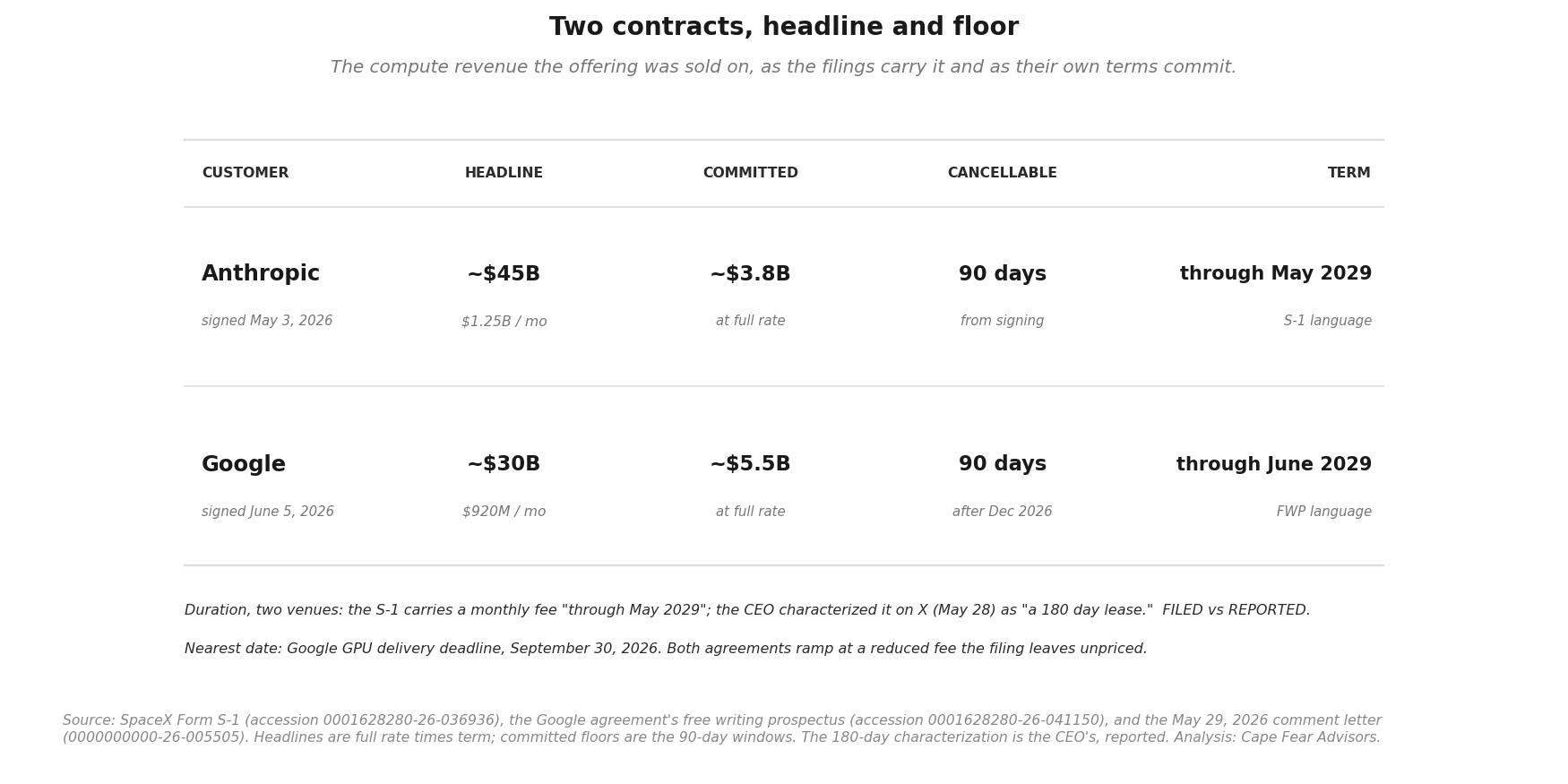
The headline is the most the arrangement can pay. Anthropic runs $1.25 billion a month, about $15 billion a year, a monthly fee the filing carries through May 2029 and repeats in more than one place. Google, $920 million a month. Carried to their terms, the two headline near $45 billion and $30 billion.
Then the conditions take it back, set out in the terms below the headline. Both contracts cancel on ninety days’ notice, Anthropic’s from signing, Google’s after December 31, 2026. Both ramp at a reduced fee, Anthropic in May and June, Google through September, and in each case the reduced fee carries no amount. The full monthly number arrives only when both the fee and the delivered capacity reach full, and the capacity depends on a build not finished until the fall, so the full rate lands months after the fee ramp ends. The months before run lighter on both counts, by amounts the filing does not state. Priced against the terms, the most either side can be held to is about $3.8 billion for Anthropic, its first ninety-day window, and about $5.5 billion for Google, whose cancellation cannot start until after December 31, leaving a committed window nearer six months. Both fall further once the unpriced ramp is honored. A ceiling on the page, a fraction of it committed, and the difference left blank. Headline forward, the reductions in the terms behind it.
The two readings sit in two rooms. The S-1 carries a monthly fee through May 2029, which reads as three years. On May 28, on X, the chief executive called it “a 180 day lease with 90 day notice mutual cancellation thereafter,” said “the short term was our request, not Anthropic’s,” and added that “if compute gets super tight I said we might need it back.” Neither company filed a clarification. One room holds the annuity carried into the offering; the other holds a six-month lease the seller says it may take back. The filing runs long, the officer runs short, and the record has not squared them.
Material to sell, material to unwind
A filing cannot make these contracts central enough to sell an offering and ordinary enough to change without notice. The SEC staff drew that line: reviewing the registration, on the Anthropic agreement it asked what consideration the company gave to filing the agreement, and cited Item 601(b)(10). That rule exempts an ordinary-course contract from being filed as an exhibit unless the business is substantially dependent on it. A single contract worth about $15 billion a year, set against $18.7 billion of total revenue in 2025, is a contract the business leans on, whatever label the filing gives it. Material by the staff’s citation and by the company’s own size, and a material contract’s expected delivery does not change quietly. Material to sell, material to unwind.
The nearest date is capacity
Delivery comes before cancellation as the first test. The plant provided about a gigawatt of compute (filed), reached in the first quarter of 2026. The Google agreement, whose free writing prospectus sets its capacity at about 110,000 GPUs, runs a reduced fee through September and starts the full $920 million a month in October, behind a GPU delivery deadline of September 30. The timing only fits capacity that is not yet built. A seller with 110,000 GPUs already running would bill the full rate at once, not wait for October, and the delay leaves about $2.76 billion, three months at $920 million, of full-rate billing on the table. No seller forgoes $2.76 billion to postpone the meter on capacity already running. The October start is the tell: the capacity earns full rate only once it exists. The remedy corroborates it, since the agreement lets Google terminate or take fewer chips at a reduced fee if the September delivery is missed, a failure case written for hardware not yet in place. The existing gigawatt was not sitting free in any case: the Anthropic agreement already spans both clusters, and the company’s own risk factors say it needs access to significantly more AI chips than are currently available to it. The revenue waits on the build, and the build comes first. The reduced-fee ramp reads the same on both contracts, on overlapping clocks: the filing carries the ramp, not the reason.
That forks by September 30, harder and sooner than ninety days. To make the Google date SpaceX builds the capacity, capital out now against the gap; or it misses, and after a month’s grace Google may terminate or take fewer chips at a reduced fee, either of which discloses; or it serves Google out of what the Anthropic lease already covers, and that changes what Anthropic bought, which discloses too. Build, miss, or move it, and two of the three are material changes to a material contract’s delivery.
The bridge builds itself out of the job
The generous case: SpaceX spends what it takes and delivers both, in full, on time. It has then built for demand with an end date on it. The contracts run to May and June 2029 at the outside; the cancellation and the officer’s own six months pull the real line nearer; and the plant outlasts the revenue. That is the operator’s problem this series has read before, a long asset against short, cancellable demand, on SpaceX’s book this time.
And the customer is standing up its own supply. On July 22, the day this piece is dated, Anthropic and AMD announced up to two gigawatts of AMD capacity for Anthropic, the first gigawatt in the first half of 2027, with an AMD equity stake in Anthropic of up to $5 billion (reported). TeraWulf’s roughly 401 megawatts land for Anthropic late in 2027 (filed). On marginal-cost dispatch, capacity a buyer owns or has already paid for would run ahead of a rental at $1.25 billion a month, which puts Colossus at the margin, the first shed when the owned capacity comes on. That capacity arrives across 2027, so this year is captive and the displacement is a 2027 question. SpaceX built the bridge; the far bank is going up under the customer’s own hand. The build case pays, now, to stand a bridge meant to be idle the day the traffic it carries has better ground to stand on.
Where it resolves
We do not know which way SpaceX goes, and we are not calling it. These are the outs we can see; there may be others we cannot, and an out we did not name would be its own tell, because on this record every resolution files. Two filings are close. The mid-August 10-Q is the one that must: its capex will show whether the build was made, a large number the ordinary-course case and the gap feeding, a small one a silence on a headlined obligation; and ASC 280 requires disclosure of a customer past a tenth of revenue, which Anthropic clears several times over, so the quarter against the deal comes through whether or not the name is printed. How much comes through is a separate question. The Anthropic months in the quarter ran at the reduced ramp fee, so the specifics of consumption and price may be advanced or may fall beneath the threshold for a first partial quarter; the relationship is material, its opening months need not be. The concentration shows; the precision is the filing’s call. Over both sits the Item 303 duty on known trends, now carrying the day’s AMD fact. An interim 8-K is the open window: a termination is an Item 1.02 event and a material amendment an Item 1.01 event, prompt and required either way.
As of this writing, July 22, no such notice is on the record, and no 8-K has been filed, though an 8-K runs up to four business days behind its trigger, so the record speaks with a short lag. On our reading, cancellation runs ninety days from signing, so a change meant to reach the October step to full rate would have gone out around July 1, and none has. On the CEO’s reading, a 180-day base, the notice window has not even opened, so October is firm either way. The working read is that the plan holds: the company expects to deliver the full $1.25 billion a month to Anthropic around October, once the build completes, on top of what Google is owed and what the company’s own models take. That is the load the September 30 build has to carry, and the capex line and the concentration disclosure are where carrying it, or failing to, will show.
The positioning is where the choice shows. A change might be announced as internal need reclaiming the capacity, the line the officer laid down on X in May, or as a new relationship that forced the old ones to give. The story does not change the mechanics. Any change to either commitment takes the ninety-day notice the contracts name, and a notice that materially changes a material contract discloses. The story can set how the change reads, not whether it files. Intent posts to X; the commitment changes only on the record.
So the question stays open, and the answer is legible however it lands. The offering carried the ceiling, the contract commits ninety days, the customer is standing up its own supply, and squaring those three is a filed act every time. The record has two dates to speak, and how a company that made a large matter of these commitments settles them is the question the record answers.
Exhibit. The two compute contracts, as the filings carry them and as their own terms commit.
| Anthropic | ||
|---|---|---|
| Monthly fee (headline) | $1.25 billion | $920 million |
| Annual rate | ~$15 billion | ~$11 billion |
| Contract ceiling (headline) | ~$45 billion | ~$30 billion |
| Cancellation notice | 90 days, from signing | 90 days, after Dec 31, 2026 |
| Committed floor | ~$3.8 billion (first 90-day window) | ~$5.5 billion (~6-month window) |
| Ramp period | May-June (reduced, unpriced) | Through September (reduced, unpriced) |
| Full rate start | ~July 2026 (post-ramp) | October 2026 (post-delivery) |
| Term (filed) | Through May 2029 | Through June 2029 |
| Duration (officer, X) | “180 day lease” | Not addressed |
| Capacity | Colossus I and II (~1 GW) | ~110,000 GPUs |
| Delivery deadline | Not specified | September 30, 2026 |
| Remedy on miss | Not specified | Terminate or reduce at pro-rata fee |
Anthropic and Google, headline against floor, ramp, cancellation, term, and the filed-versus-reported note on duration. Sources: S-1 (accession 0001628280-26-036936), FWPs (accessions 0001628280-26-040610, 0001628280-26-041150), SEC comment letter (accession 0000000000-26-005505), Elon Musk on X (May 28, 2026).
Notes
SpaceX Form S-1, accession 0001628280-26-036936; final 424B4, accession 0001628280-26-042639. FILED. Prospectus Summary: 2025 revenue “on a consolidated basis of $18,674 million” (about $18.7 billion), and the clusters providing “approximately 1.0 gigawatt of compute power.” The Anthropic Cloud Services Agreement at $1.25 billion a month is disclosed in the S-1 and quoted verbatim in the comment letter below; its “through May 2029” term is carried in the offering free writing prospectus (0001628280-26-040610). The company’s risk factors state it needs access to significantly more AI chips than are currently available to it, the shortfall Terafab is meant to address.
SEC comment-letter correspondence from the Division of Corporation Finance, UPLOAD accession 0000000000-26-005505 (May 29, 2026), verbatim: “We note the revisions made in response to prior comment 3, including that Anthropic will pay you $1.25 billion per month for access to compute capacity across COLOSSUS AND COLOSSUS II. Please tell us what consideration you gave to filing this agreement. See Item 601(b)(10).” FILED.
Google Cloud Services Agreement: disclosed via a Rule 433 free writing prospectus, accession 0001628280-26-041150, filed June 5, 2026. It states the agreement was entered June 5, 2026 and provides for $920 million per month from October 2026 through June 2029 across about 110,000 GPUs. The agreement conditions Google’s obligation on delivery of the committed GPUs by September 30, 2026; on a missed delivery, after a one-month grace period, Google may terminate or take fewer chips at a pro-rata-reduced fee. The Anthropic monthly fee and the Terafab framework also appear in the June 4, 2026 roadshow free writing prospectus (accession 0001628280-26-040610) and the UK retail free writing prospectus (accession 0001628280-26-040874); Terafab is set aside in this piece and read on its own calendar.
Elon Musk, X, May 28, 2026: the 180-day characterization and the “might need it back” statement. REPORTED.
Anthropic and AMD, up to 2 GW of MI450-series capacity, first gigawatt H1 2027, AMD equity investment up to $5 billion in Anthropic (AMD investor relations, July 22, 2026). REPORTED.
TeraWulf Form 8-K, accession 0001104659-26-080583 (the ~401 MW, twenty-year Anthropic lease, delivery late 2027 to 2028). FILED.
“What the Compute Contracts Commit” (June 6, 2026), this series, which carries the contract terms, the ramp months, and the May 3 and June 5, 2026 signing dates shown on the exhibit; and “The $235 Billion Cash Gap” (May 21, 2026).
ASC 280-10-50-42 (customer-concentration disclosure); Item 303 of Regulation S-K (MD&A trends and uncertainties); Form 8-K Item 1.02 (termination of a material definitive agreement) and Item 1.01 (entry into or material amendment of a material definitive agreement).
Standing Disclosure
Anthropic is the developer of Claude, which is used in preparing this research, and Anthropic is a counterparty to the two contracts read here. That nearness cannot be fully checked away, which is why no claim in this piece rests on trust in the tool: every figure carries a public source, and the record grades the rest. Others named in this piece have ties to Anthropic: Google is the second counterparty, and its parent Alphabet holds a large position in Anthropic; AMD, whose capacity announcement is noted here, is taking an equity stake in Anthropic; and TeraWulf leases capacity to Anthropic. Companies not named here, among them the GPU and cloud suppliers behind the capacity, may hold positions or supply relationships that bear on the filers discussed, and that possibility is part of why every piece is re-checked for bias, ground facts, and filings rather than read against a fixed list. Figures are quoted from the filers without characterization, and the same standard of reading is applied to every filer named.
Analysis: Cape Fear Advisors.
This article is also available on Substack.
Contact Cape Fear Advisors