

Two disclosures, shorter than usual because we published longer versions on Wednesday and Thursday.
Nothing here identifies an error, an inconsistency, or a bad actor. Every filing is taken on its face as accurate and complete under the rules that govern it. Advance rates move, spreads move, and a lender revising terms between one facility and the next is the ordinary operation of a credit market.
The required share, the decomposition and the three tests are ours. The tag marks who answers for a figure, not who holds title to it: FILED means the filer said it, REPORTED means a publication said it, and OURS means we said it and the error is ours to carry. Anyone with the same documents reaches the same arithmetic, and a reader who prefers different inputs substitutes them and runs it again. Every figure carries its source.
The machinery has to be in place before any of this applies
The size of the artificial intelligence build is estimated everywhere and documented almost nowhere. One corner of it is documented. Where a supplier funds a customer, the customer’s lenders write down what they will advance, and that term decides how much of the customer’s spending has to come back to the supplier before the supplier is whole again. The term is filed. It has been filed four times between July 2025 and August 2026, and the requirement it sets is half again what it was.
Circular financing is a phrase doing service for several arrangements, most of which are ordinary. The one this piece measures has a specific shape, and the shape is checkable.
It also comes in two currencies. A supplier can lend to a customer and a supplier can take stock in one, and both put capital into a company that spends part of it back with the supplier. What differs is the instrument left behind and who prices it. A loan leaves a term that a credit market marks continuously and in public: an advance rate, a spread, a rating, a maturity. A placement leaves a position marked by a tape, or by nothing at all until a funding round prices. This piece reads the credit form, because the credit form writes its terms down.
A company sells something. It puts money into a customer. The money stands where a lender requires equity, and the facility that opens buys the thing the company sells. The question is whether a company is funding its own demand, and that turns on whether the commercial machinery exists.
Which sorts the positions in NVIDIA’s reported equity book into three groups, each decidable from a filing. (1)
The machinery is in place. CoreWeave qualifies: a $2,000m placement in January for about 23 million Class A shares at $87.20, four filed credit agreements defining what lenders advance against the equipment, and equipment that is NVIDIA’s to sell. Nebius holds a commercial relationship and a warrant, on a lower grade of evidence.
The machinery is incomplete, and the position stands as an investment. The equipment is there and the leverage is not. Space Exploration Technologies sits here, at $20,976m and 33.1 percent of the book, the largest position in it after Intel. Its final prospectus names NVIDIA four times, and every one of them describes equipment rather than a counterparty. Twice in the list of market and industry sources, as the titles of two SemiAnalysis reports. Twice in the business section, describing its own fleet: approximately 325,000 NVIDIA graphics processing units across two sites, sold as capacity to Anthropic under Cloud Services Agreements at $1.25 billion a month through May 2029, ramping in May and June 2026 at a reduced fee, and terminable by either party on ninety days’ notice after an initial three-month period.
So the equipment is filed and the purchases behind it can be inferred. What no filing read for this piece supplies is the third element: a credit agreement stating what a lender will advance against that equipment. Without it there is no advance rate, and without an advance rate the requirement has no first input. NVIDIA appears nowhere among principal stockholders, in related-party transactions, or in any disclosed purchase commitment. The position may be an excellent investment. It is not this one.
The relationship runs the other way. Intel at $29,989m is a manufacturing relationship, the largest single position in the book, and money enters this system from outside it. Coherent and Synopsys supply NVIDIA on what is publicly understood of their businesses, which is a lower grade of evidence than a filing, so they are named and left uncounted.
The book shows one instrument form, and that matters more than the sorting.
At June 30 it carries Nebius at 1,190,476 shares. A Schedule 13G filed three weeks later reports 9.3 percent beneficial ownership, including a pre-funded warrant over 21,065,936 Class A shares struck at $0.0001. A warrant at a hundredth of a cent is the stock in every economic sense, and the position is eighteen times what the report shows.
Warrants, purchase commitments, capacity backstops and residual value guaranties all carry equity-like exposure. None of them reaches the position report. (2)
What a placement has to capture to get its money back
In the one relationship where the machinery is filed end to end, the narrow question comes first: what has to happen for the money to come back.
A contribution of E stands beside a program of E divided by one minus the advance rate a. Some share s of that program is spent with NVIDIA, at gross margin m, so the gross profit is E over one minus a, times s, times m. Set that equal to E and solve for the share:
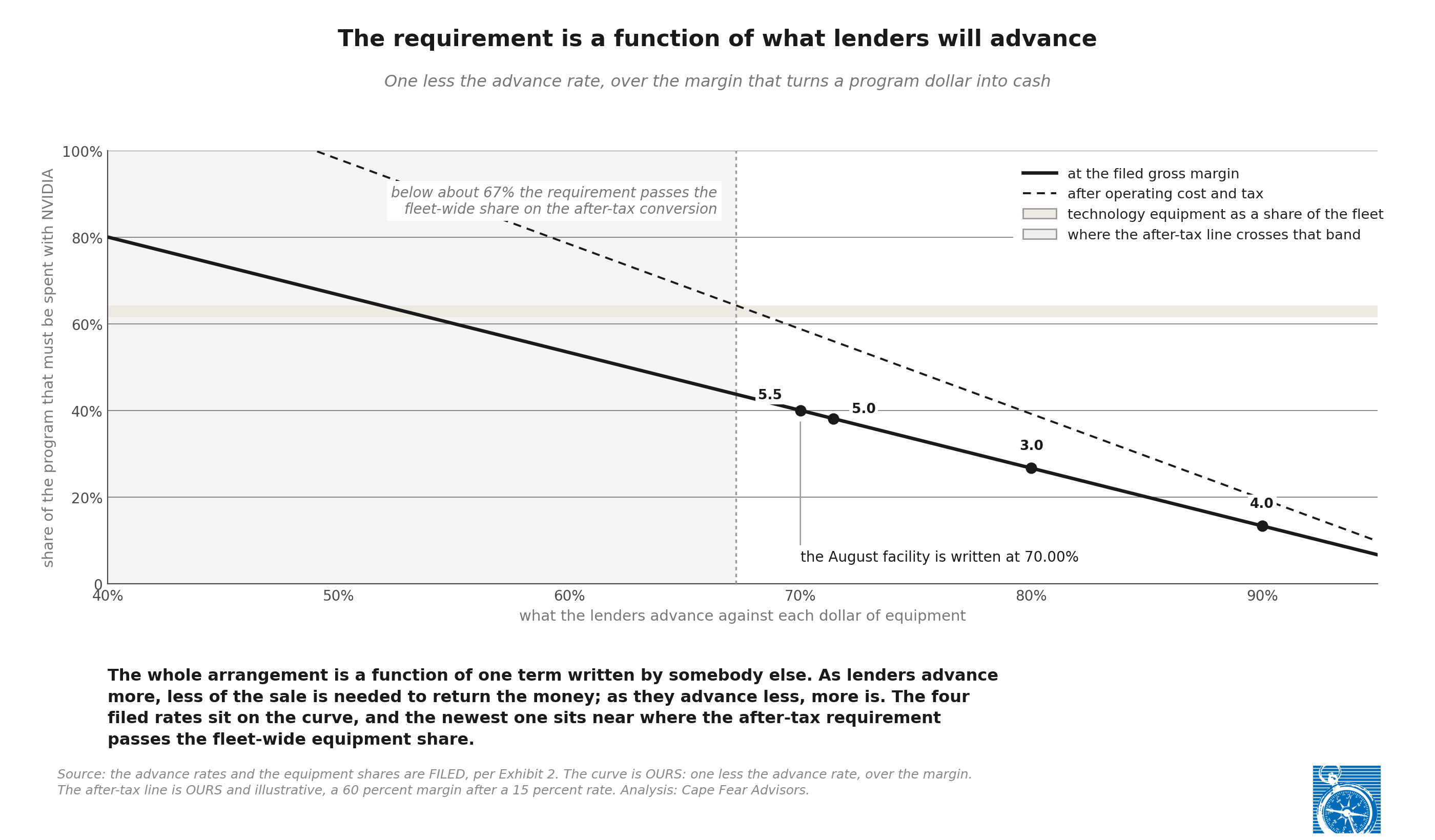
The share of the program that has to be spent with NVIDIA, for a placement to return its own cash, is one less the advance rate, divided by the gross margin.
required share = (1 - a) / m
In plain terms. NVIDIA placed $2,000m. The August facility advances seventy cents against each dollar of equipment cost, so that placement stands beside a program of about $6,667m. If forty cents of every program dollar comes back as an NVIDIA sale, the gross profit on those sales is about what was placed. Everything above forty cents is return, and the stock sits on top of it.
The unknown is gone. The share was the one term no filer discloses, and asking what the share has to be removes it. Both remaining inputs are filed: the advance rate, in each credit agreement, and the gross margin, in the income statement. No other input enters it.
And there is no time in it. The gross profit arrives as the equipment ships, against cash that left once, so the question is one of size and no discount rate, horizon or cost of capital enters it.
What the line decides is whether an arrangement of this kind pays for itself on its own commercial terms. Above the requirement the sale has repaid the cash and the shares are a residual, so the arrangement clears whatever they do. Below it the sale has repaid part, and the shares carry the balance. That is the whole accretive-and-dilutive question for a circular arrangement, and the threshold that decides it is set by two filed inputs. (3)
Four rates, and the requirement rises by half
Each agreement defines what its lenders advance at the funding date. Set beside what each release says about the customers behind it, and beside what each rate then requires: (4)
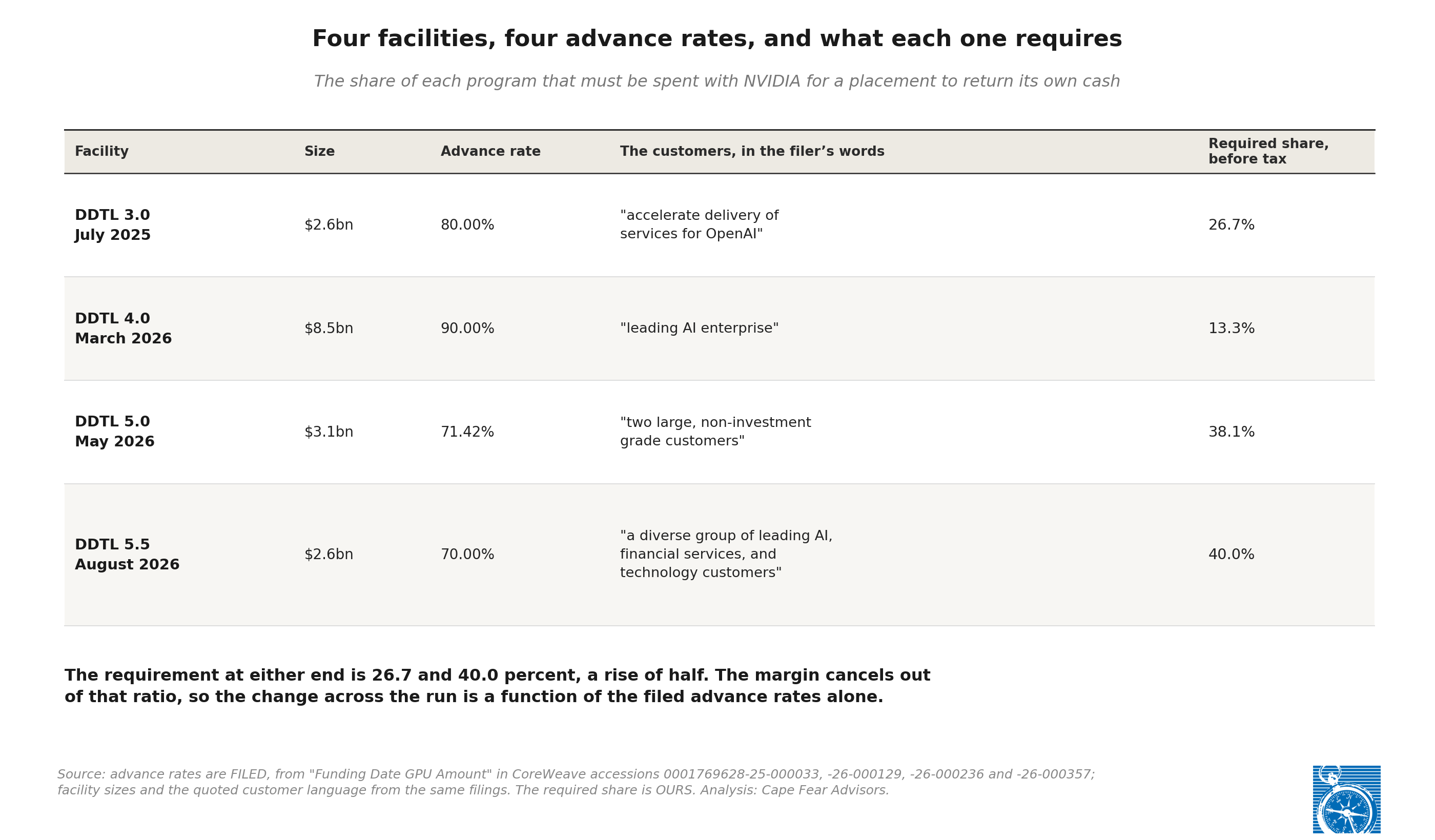
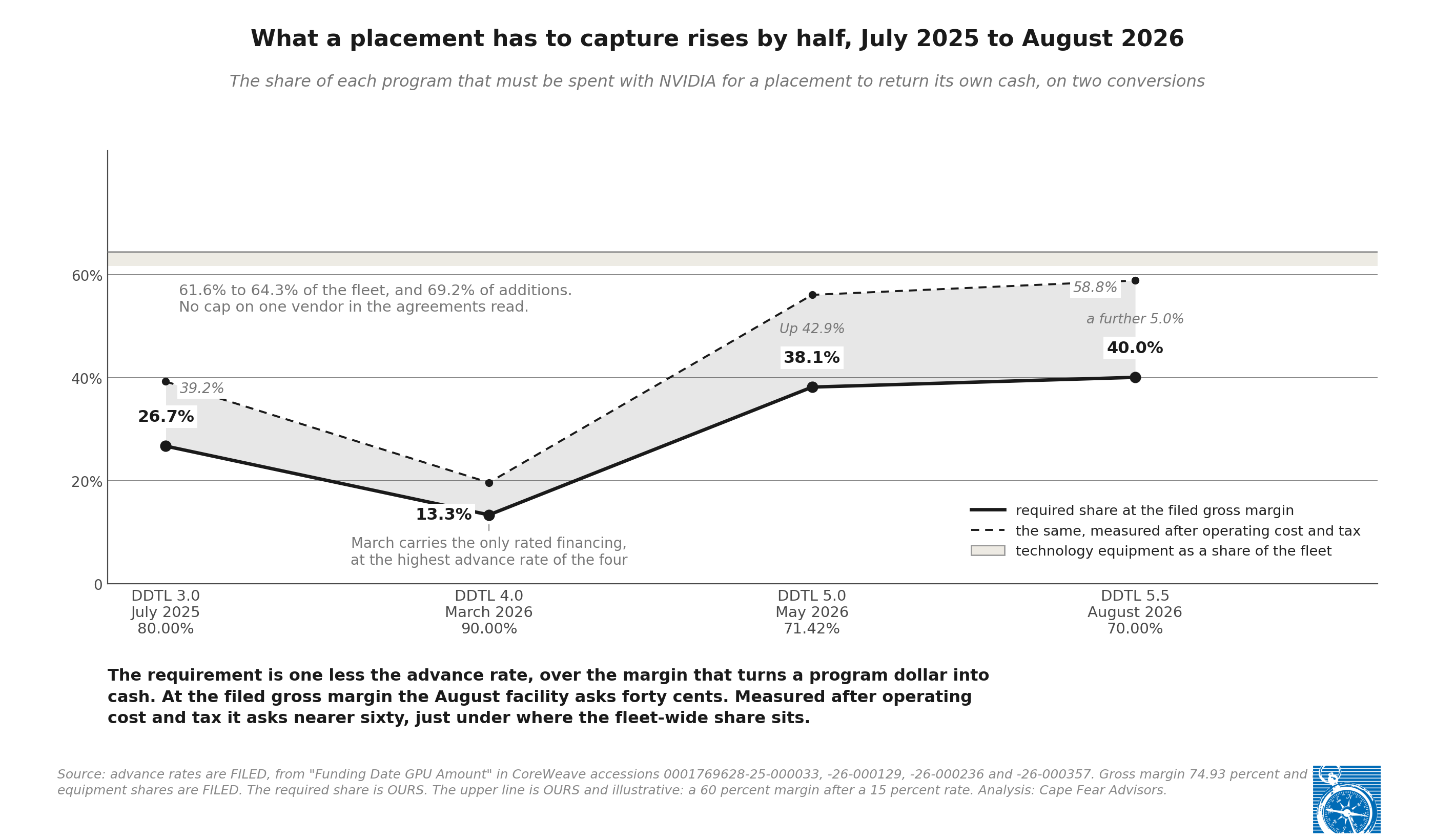
Under the July 2025 facility, a placement returned its cash if about twenty-seven cents of every program dollar came to NVIDIA. Under the August 2026 facility it takes about forty. The requirement rises by half, and the margin cancels out of that ratio, so the rise is a function of the filed advance rates alone.
The rise is one step and then a plateau. Between July 2025 and May 2026 the requirement rises 42.9 percent. Between May and August it rises a further 5.0 percent. About 86 percent of the rise from July 2025 to August 2026 was in place by May, so the August facility continues where May sat instead of stepping up from it.
March runs the other way, and its own release explains it. DDTL 4.0 “received ratings of A3 by Moody’s and A (low) by DBRS, representing the first investment-grade rated financing secured by HPC infrastructure and an associated customer contract.” (5)
It reached investment grade at the highest advance rate of the four, and a rating ordinarily falls as loan to value rises. A3 at 90.00 percent inverts that, which holds where a rating rests on the counterparty contract in place of collateral cushion. So March is where a customer’s credit substituted for the cushion, and it makes a poor base for measuring a trend in the cushion. The comparison that survives is the pair at each end: DDTL 3.0 and DDTL 5.5, both $2.6bn, neither stating a customer rating, July 2025 against August 2026.
One limit on all of it. These are four facilities and at least three underwriting models, so the rate series and the model series move together. DDTL 3.0 lends against an asset. DDTL 4.0 lends against execution, at more than three times the size of the facilities at either end, and it is the only one described as non-recourse. DDTL 5.0 and DDTL 5.5 state neither model. The advance rate cannot be read apart from what each lender was underwriting, and the agreements do not say what that was for the two most recent. (6)
Three things moved, and the filings name all three
The counterparty, on one step. DDTL 5.0’s release states that proceeds “will support the purchase and deployment of infrastructure dedicated to customer contracts with two large, non-investment grade customers,” against March’s A3 and A (low). Between those two the rate falls about eighteen points and the stated credit falls with it.
The collateral mechanics, across the run. DDTL 3.0 capped outstanding loans each month at 85 percent of the equipment’s depreciated value, so the borrowing shrank as the fleet aged. That continuing cap is absent from the three later agreements, “Test Date GPU Amount” carries zero uses in all three, and “Stabilized” appears thirty-five times in DDTL 4.0 and not once after. (7)
And renewal risk on the equipment, which is the filer’s own account of the newest facility:
“Unlike prior delayed draw term loan facilities backed by customer contracts extending through the maturity of the debt, the DDTL 5.5 Facility carries an approximate five-year maturity while its underlying customer contracts average approximately three years in length. By financing these shorter-date commitments, lenders are signalling confidence in the long-term value of NVIDIA GPUs running on CoreWeave’s cloud platform and a willingness to underwrite renewal risk.”
The facility outlives its contracts by about two years, and on the last step the company puts its lenders on the machines. Three explanations, each sourced to a filing, and the requirement runs the same under all three, because it takes the rate as given.
Forty cents is where the requirement starts
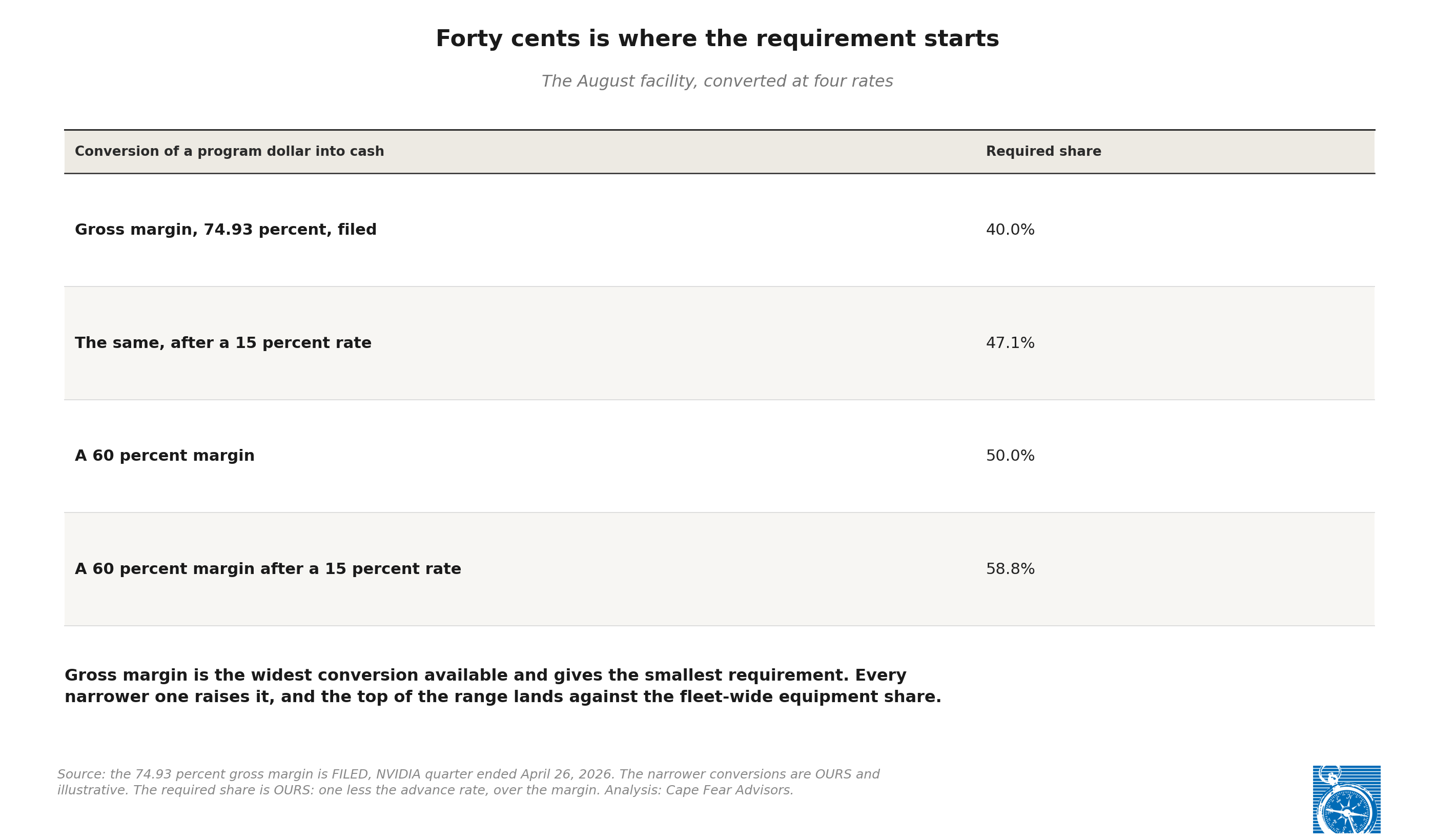
The requirement converts program dollars into returned cash at gross margin, which is the widest conversion available and therefore produces the smallest requirement. Every narrower conversion raises it.
Gross profit stands above operating cost, so converting at an operating margin raises the requirement, and gross profit is taxed as it is earned, so converting after tax raises it again.
The two ways money comes back are taxed differently, and the difference carries weight. Gross profit on a sale is operating income, taxed in the period it is earned, and the cash leaves for the tax authority in that period. An increase in the carrying value of the stock is a mark: it prints in earnings, it carries deferred tax rather than a payment, and it can reverse to nothing without a dollar ever having moved. So a pre-tax dollar of sale and a pre-tax dollar of mark are not the same dollar. On a cash-return test the sale dollar is worth more. On a reported-earnings test in the quarter it prints, the mark counts the same as the sale.
The requirement is a cash test, which makes forty cents its floor. The upper end of the range lands against the fleet-wide equipment share. (8)
What no filing supplies is the answer
Forty cents of every program dollar is a requirement. Whether it is met is a different question, and no filer discloses NVIDIA’s share of anything CoreWeave buys.
The filings supply one figure in the neighborhood, and it works as a scale reference. Technology equipment was $33,823m of CoreWeave’s $52,622m of gross property and equipment at June 30, or 64.3 percent, against 61.6 percent at December 31, and additions in the June half ran 69.2 percent. That describes the fleet, and the facilities fund GPU servers and related infrastructure specifically, so a program is more equipment-heavy than the fleet it joins. NVIDIA also sells networking. So the fleet share gives a sense of scale, and nothing in the agreements read here caps what one vendor may capture. (9)
So the requirement stands on its own, next to a blank. Forty cents in the dollar is what has to be true. The one number that would settle whether it is true is disclosed by nobody, and it would take one line in a segment note to settle it.
What it looks like if the requirement is met
What the arrangement returns depends on the share captured, which nobody files, so the example is run at three shares.
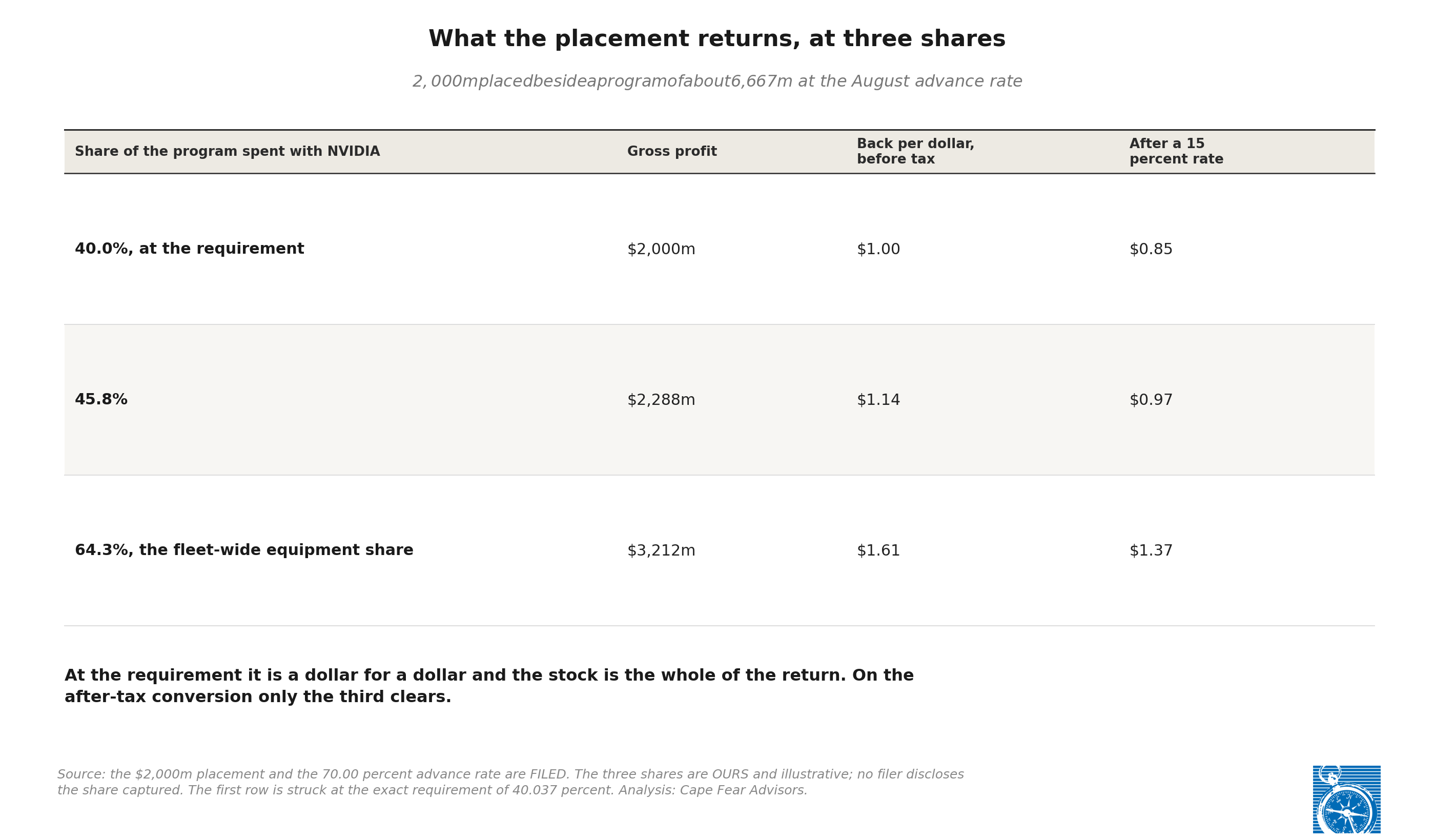
At the requirement it is a dollar for a dollar and the stock is the whole of the return. Below it the sale returns less than it consumed, and the shares have to close the gap or the arrangement does not clear. (10)
On the after-tax conversion only the third clears, which is the range from the section above arriving in the example.
One assumption belongs to the example alone. The identity prices a marginal dollar: money placed where a lender requires equity stands beside a program of its own size over one less the advance rate, whatever else is in the capital structure. The example goes further and stands a single placement beside a whole program, as though it were the only equity behind it. CoreWeave raised equity and equity-linked capital from several sources across the same period, so a placement supplying part of the equity behind a facility stands beside a proportionally smaller program, and the recovery per dollar falls with it. The example takes the most favorable reading available, which is a second sense in which forty cents is a floor. The cross-facility ratio is untouched by any of it, because the same assumption stands on both sides and divides out. (11)
One qualification travels with the whole table, and it is separate from the conversion. The dollar placed carries whatever it costs the participant, so a company funding a placement from cash needs less margin above the requirement than one funding it from borrowings. On identical terms the same arrangement can clear for one participant and fail for another. (12)
One percent of the earnings, and a much larger share of the story
At the middle of those three shares, the placement opens roughly $2,288m of gross profit before tax. Against what NVIDIA already earns, gross profit of $153,463m in fiscal 2026, and $61,157m in the April quarter which annualizes to $244,628m, that is 0.94 to 1.49 percent of the earnings base. (13)
Which is the wrong denominator for the question the market is asking.
NVIDIA introduced a sub-segment in the April quarter called AI Clouds, Industrial and Enterprise, splitting data center demand between the four named hyperscalers and everyone else. The stated purpose is to show demand broadening beyond a handful of buyers. Data-center compute ran $60.4bn in that quarter, up 77 percent. (14)
Self-funded demand is a rounding error in the earnings base, and it sits inside the cohort whose growth carries the claim that demand is broadening beyond four customers. The first half of that is computed. The second half waits on a denominator: the $60.4bn is data-center compute overall rather than the sub-segment, and the sub-segment’s own size is not disclosed.
So whether self-funded demand matters to that cohort’s growth rate is the pre-registered question rather than a finding here. Wednesday either supplies the denominator or does not, and either outcome is informative. What can be said now is that the level and the margin are different questions, and that the line deciding the second one is written in a credit agreement, where it moved three times this year.
One borrower files the terms, and the rest of the market does not
The apparatus producing an advance rate against this equipment is a set of defined terms inside the credit agreements, and a full-text search of EDGAR run on August 22 returns them from one filer. “Funding Date GPU Amount,” ten filings, all CoreWeave. “GPU Depreciated Amount,” ten filings, all CoreWeave. “Test Date GPU Amount,” one filing, CoreWeave. (15)
One looser phrase is unresolved. “Loan to cost” alongside GPU returned eleven filings across four filers on August 21 and one filing on the August 22 rerun, and the two results have not been reconciled, so neither is used here. The phrase also appears in CoreWeave’s March presentation, which quoted 90 percent loan to cost rising to about 102 percent after stabilization, and which is a company document rather than a filing. (16)
The four rates above rest on those defined terms, and the terms come from one borrower’s filed schedules.
What the book can carry, and the direction it is traveling
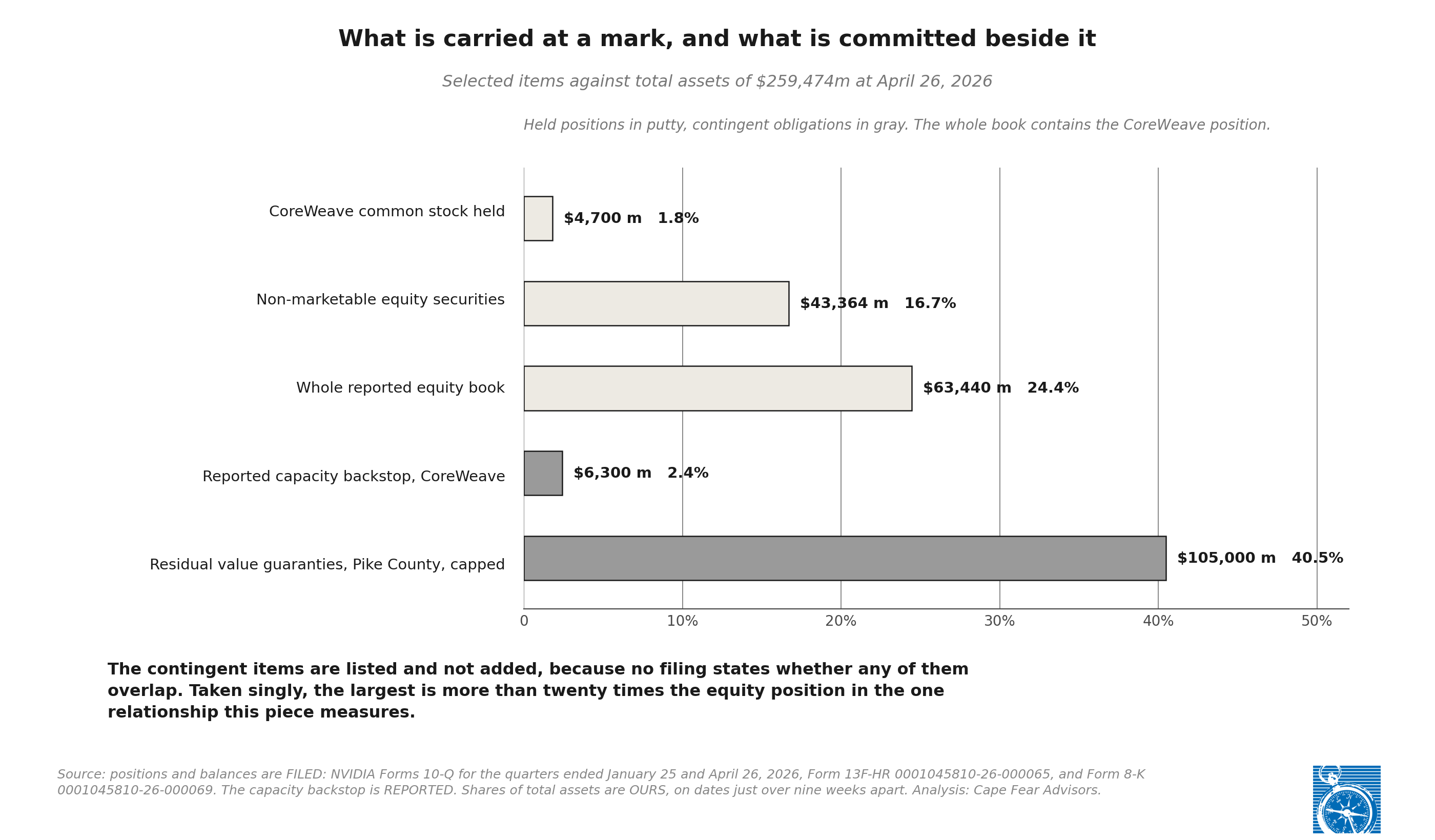
The CoreWeave position was $4,700m at June 30. Total assets were $259,474m at April 26, so the position is 1.81 percent of them, and the whole reported equity book is 24.45 percent. The two dates are just over nine weeks apart and the ratios are stated on that unmatched basis. (17)
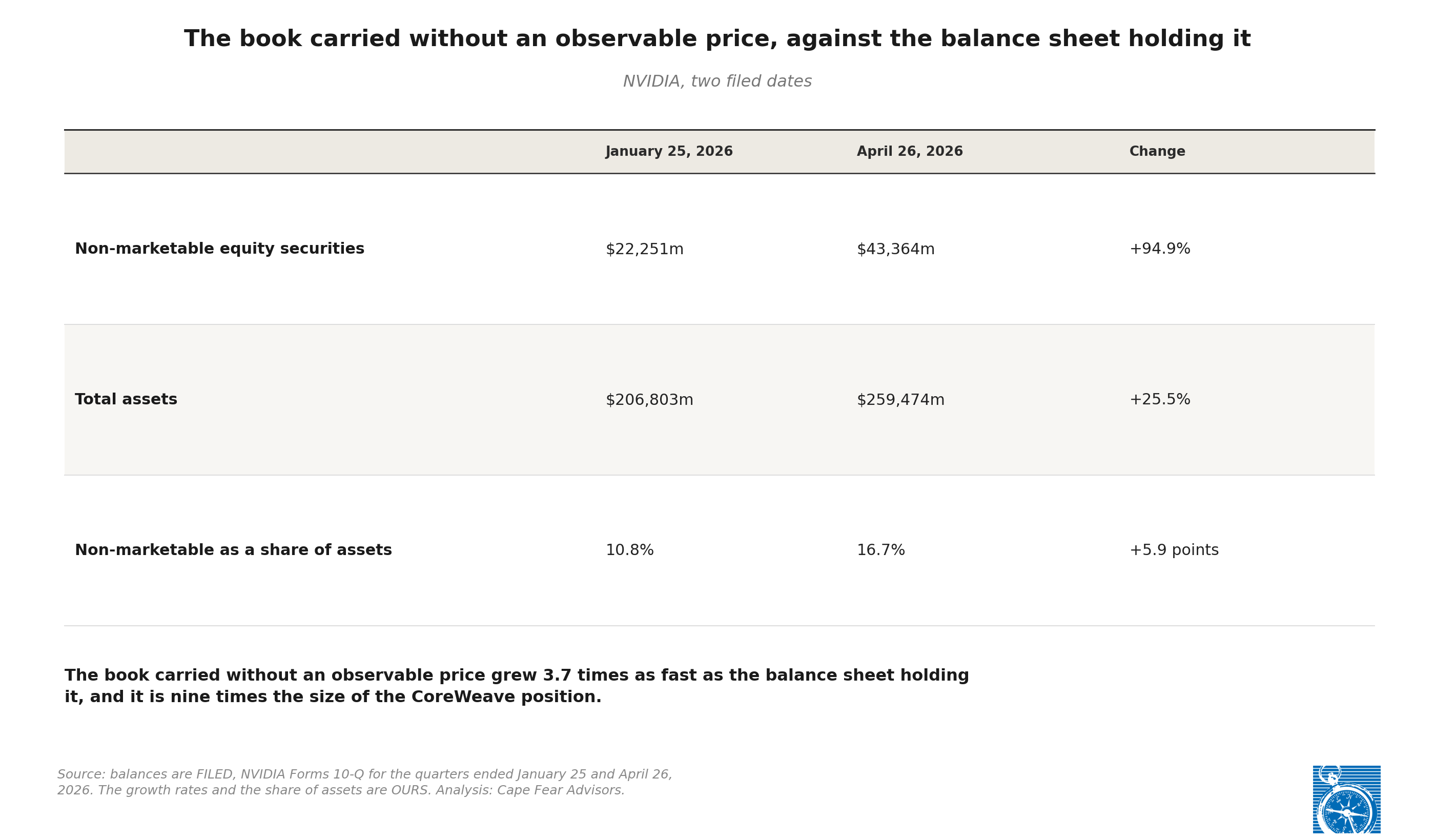
The book carried without an observable price grew 3.7 times as fast as the balance sheet holding it, and it is nine times the size of the CoreWeave position. Two observations are a line. The third arrives Wednesday. (18)
And the positions are the smaller half of what is committed. On August 17 NVIDIA entered residual value guaranties over leases for approximately 4.25 gigawatts of IT load at a site in Pike County, Ohio. The aggregate payment obligation is “cumulatively capped at $105 billion.” It is filed under Item 2.03, as a direct financial obligation or an obligation under an off-balance-sheet arrangement. That is $24,706m per gigawatt of guaranteed minimum value, on a twenty-year tail from each lease commencement, conditioned on ready-for-service dates expected from 2028, with the tenant reimbursing whatever is paid. Credit support for a further 3.8 gigawatts sits at the company’s sole discretion. Alongside it, a program announced August 10 states residual value support of up to 25 percent of an opportunity across platforms designed to mobilize over $500bn, and a reported $6,300m capacity backstop stands behind the CoreWeave relationship. (19)
Whether those overlap is stated nowhere, so they are listed one by one. Taken singly, the largest is $105,000m against $259,474m of total assets, which is 40.5 percent. Against that, an equity position at 1.81 percent is the part of the arrangement that can be absorbed without anyone noticing.
One relationship, and a large one in absolute terms. The placement was $2,000m at cost and the position stood at $4,700m at June 30. It sits beside a program of roughly $6,667m at the August advance rate, with a reported $6,300m capacity backstop behind the relationship. Against $259,474m of total assets it is under two percent, and it is less than a twentieth of the $105,000m written in Ohio. It is also a $4,700m position standing beside a $6,667m program, between two named parties, on filed terms. The system is measured in trillions and it moves in capillaries, and this is one capillary with both ends visible. (20)
The Ohio guaranties also terminate on the earliest of several events, one of which is “OpenAI achieving a satisfactory credit rating.” The support is written to end when the rating arrives. That is the March substitution, seen from the other side, in a second filer’s operative text.
The last two times, and what moved first
This has run before, and the analogues are here to be used. Both episodes were readable in filings while they were still running, on measures that were in the documents at the time, and the disclosure each one produced is part of why the measures used here exist at all.
Lucent committed $7bn to $8.1bn of customer financing and drew $1.6bn, then provisioned $3.5bn of loan losses across 2001 and 2002. Nortel committed $3.1bn and drew $1.4bn. Cisco committed $2.4bn and drew about $600m, and its investment book moved from $190m of net gains in fiscal 2001 to $858m of net losses the year after. The measure analysts used at the time was commitments against drawn, and it is filed every quarter. (21)
Seven years later the same variable ran the second episode. A repo haircut is one less an advance rate, and across nine collateral classes it stood at 0.0 percent in the first half of 2007, reaching 17.1 on AA-AAA mortgage paper and 53.5 on AA-AAA collateralized debt obligations during 2008. (22)
In both episodes the advance rate moved late. What moved first in 2007 was the seller’s own retained equity. Countrywide carried $3,040.6m of retained interests in its own securitizations, roughly a fifth of shareholders’ equity. It impaired $697.7m of them in the first half of 2007, against $69.2m a year earlier, before any haircut moved. Second was the gap between committed and drawn, widening as third-party capital left. Third was the advance rate. (23)
A retained interest is a seller’s continuing exposure to a sale it has already made, carried at a mark rather than at a price anyone paid. That is the class of instrument that moved first, and an equity position taken alongside a sale sits in the same class. (24)
So the rate is a price and an amplifier. It sizes how violent an unwind becomes once something else moves, and the something else has an address: the equity carried at a mark, the commitments not yet drawn, and the performance of what has already been sold.
Which side of the arrangement the amplifier sits on follows from where the leverage is. A supplier whose cash came back through a sale holds a mark and a completed transaction. A borrower whose equipment secures the facilities holds the rate itself, on every facility, at every test date. The requirement measures what the supplier needs. The advance rate is the borrower’s term, and it moved ten points between July 2025 and August 2026.
The same arithmetic runs on the other instruments
The requirement above is one arrangement solved, and the method under it runs on any of them.
Every one of these separates into four pieces, each filed in a different place. Cash that left, which is filed. The commercial claim the cash opened, rarely disclosed and derivable from a leverage rate and a margin. The equity residual, filed in position reports, and only for one instrument form. The contingent obligation written along the way, filed when it becomes an obligation and sized late.
An undisclosed input then takes one of three treatments. It cancels, where it stands unchanged on both sides of a comparison. It bounds, where the sign is known and the size is not, so the answer becomes an inequality in a stated direction. It decomposes, where the parts separate. An item of unknown sign reaches none of the three, and the $6,300m capacity backstop sits there, carried at zero because that is the treatment its disclosure supports. (25)
One structural difference is named here and worked separately. A placement is cash out, and it is cash out because the lender requires equity in that position for the facility to open. A residual value guaranty leaves the cash in place. It improves a facility where a placement releases one, it costs a contingent obligation where a placement costs a dollar, and it opens the same revenue gate. In Pike County the equipment sells and the gross profit arrives with no placement standing underneath it. The requirement above divides by a dollar that left. Where no dollar leaves, the price of the same revenue is written somewhere else, and it is written as a contingency. (26)
A fourth move is the one this piece uses. Where an input is undisclosed, solve for it. Ask what it would have to be, and the answer is made of filed numbers even when the input is not.
And it runs in reverse. Read backwards, the same line splits a carried position in two. It says how much of the dollar that left the gross profit has already returned, and what remains of the carrying value stands on the mark alone. The placement the cash bought is carried as an asset, and the gross profit it opened is recorded separately, so the accounts show both. (27)
The comparison that travels sets the commercial claim against the cash that left. Where the claim repays the cash, the equity is residual and the arrangement clears whatever the shares do. Where it does not, the arrangement requires the shares to appreciate, and the mark stops being a byproduct and becomes the return.
Run across the instrument forms, that decomposition is the next piece. The credit terms are where this one found its numbers. The residual is where the valuation consequence lands, and the residual is an equity question.
Three tests, and a reprint schedule
Whether the commercial machinery is in place, which decides whether any of this applies.
What a placement has to capture to return its cash, and which way that requirement is moving.
Whether the funder carries the position to zero without consequence, and whether that capacity is rising.
All three describe a position and leave the price of every security alone. A reader who prefers different inputs substitutes them and runs the arithmetic again, which is the argument for publishing the method. We searched for a published version of this construction and found none. Others may exist. (28)
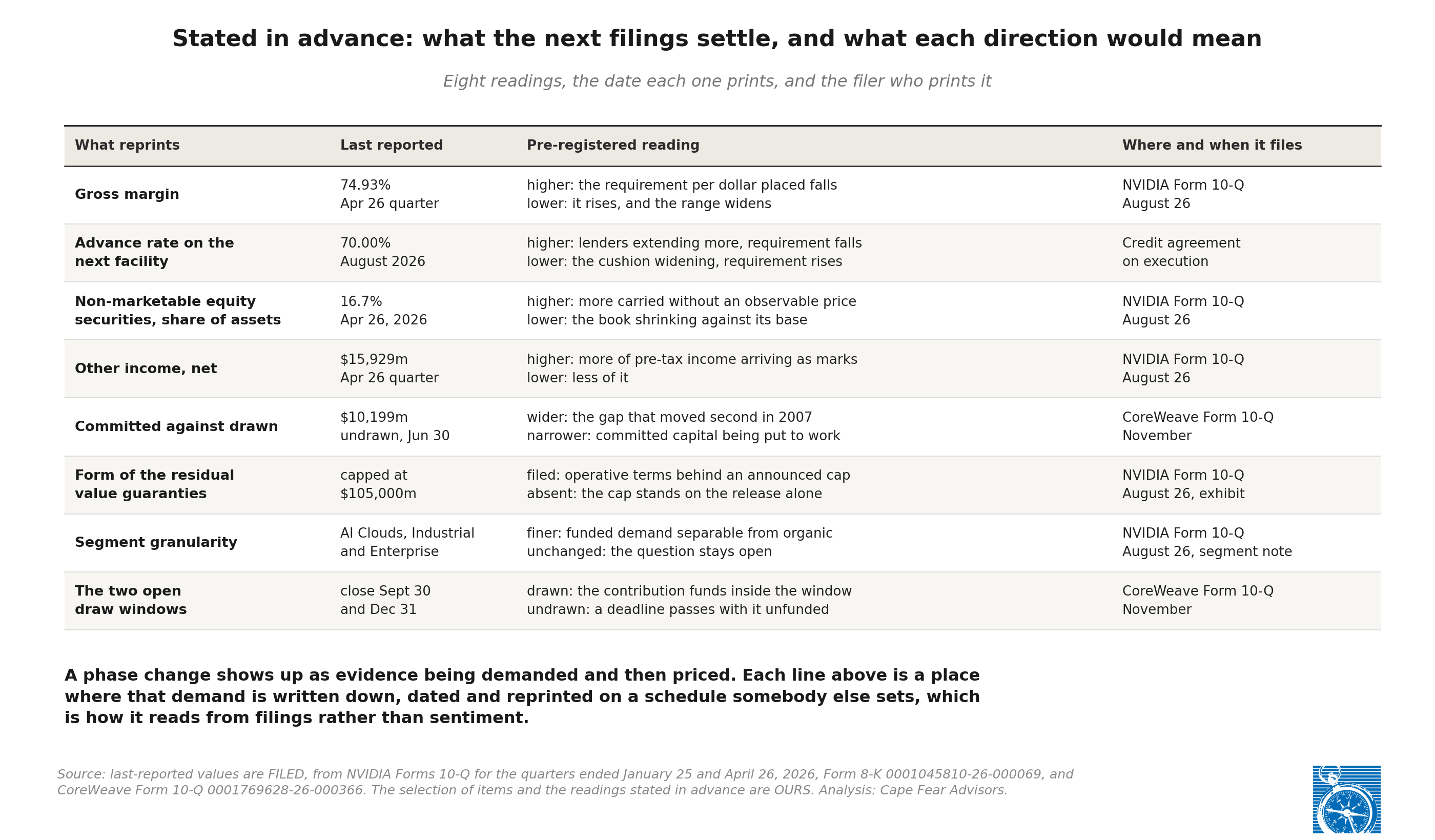
A phase change in a market of this kind shows up as evidence being demanded, and then priced. Each of these is a place where that demand is written down, dated, and reprinted on a schedule somebody else sets, which is what makes it readable from filings.
NVIDIA reports the quarter ended in late July on Wednesday. Three figures here reprint that day and one of them moves the requirement directly: the gross margin, which is the only assumption-free input the requirement has besides the advance rate. The non-marketable book, the total assets it sits inside and the other income line carrying the marks reprint with it. The form of the Ohio guaranties files as an exhibit to the same report. And the segment granularity either lets an outsider separate funded demand from organic demand inside that 77 percent, or does not.
The other clock belongs to CoreWeave. DDTL 5.0’s draw window closes September 30 and DDTL 5.5’s on December 31, and the third-quarter report in November is the first observation of what this borrower does at a deadline with the contribution unfunded.
What it does to a growth rate
What artificial intelligence sells today is estimated. The aggregates in circulation are assembled from leaks, private disclosures and inference, and every forecast that supports a valuation compounds from a base of that kind.
The requirement measured here says nothing about the size of that base. It says something about its composition.
Where a supplier funds a customer and the customer spends part of the proceeds with the supplier, some part of what is counted as revenue in this system was supplied from inside it. No filer discloses that part. The size is unavailable and the sign is available: to whatever extent revenue is funded by its own vendor, the base a forecast compounds from is larger than the demand underneath it, and the growth required to reach any given valuation is higher rather than lower. An inequality in a stated direction is available where a level is unavailable. (29)
Which is why a segment note decides more here than an earnings line does. The earnings line settles what was sold. The segment note settles who paid for it, and whether an outsider can tell the two apart.
Four credit agreements produced four requirements, and the arithmetic that turns one into the other is two lines long. It runs again when the fifth one files.
Notes
Probe clock. Every search below carries its date and its hour and reports what it returned, including zero; every probe that is a read rather than a search names the documents read. The EDGAR searches supporting notes (1), (7), (15), (16) and (19) were run on the morning of August 22, after the August 21 filing window had closed. The search in note (28) runs across published research and commentary, which moves at any hour, and it carries its own qualification.
(1) FILED. NVIDIA Form 13F-HR for the period ended June 30, 2026, accession 0001045810-26-000065, reporting eight positions totaling $63,440m at fair market value. A Form 13F reports market value at the period end and carries no cost basis, so every position above is a mark. The CoreWeave placement is the exception in this piece, because its price is filed by the other party: CoreWeave Form 10-Q for the quarter ended June 30, 2026, accession 0001769628-26-000366, stating a January 2026 securities purchase agreement with NVIDIA Corporation for approximately 23 million Class A shares at $87.20, aggregate gross proceeds of $2.0 billion. The sorting into three groups is OURS and is arguable position by position. The SpaceX line rests on a full-text search of Space Exploration Technologies Corp.’s final prospectus filed under Rule 424(b)(4), accession 0001628280-26-042639, run August 22, 2026 at approximately 10:30 am Eastern and returning four occurrences of NVIDIA: two report titles in the market and industry data sources, and two identical passages in the business section stating the approximately 325,000 units, the Anthropic Cloud Services Agreements entered in May 2026, the $1.25 billion monthly fee through May 2029, the ramp in May and June 2026 at a reduced fee, and termination by either party on ninety days’ notice after an initial three-month period. Whether SpaceX buys its accelerators from NVIDIA directly or through one of the channels described in note (4) is stated nowhere, and the sorting does not turn on it. The sorting turns on the absence of a filed advance rate, which is the input the requirement needs and which no filing read for this piece supplies. The reciprocal search across every filing by that registrant has not been run.
(2) FILED. Schedule 13G reporting NVIDIA’s beneficial ownership of Nebius Group N.V., disclosed July 21, 2026, including a pre-funded warrant over 21,065,936 Class A shares at an exercise price of $0.0001. A Form 13F reports Section 13(f) securities at a period end and a Schedule 13G reports beneficial ownership on its own basis, so the two are compared here as counts and not as equivalents. The characterization of a warrant at that strike as economically equivalent to the stock is OURS.
(3) OURS. The reading of the requirement as the line between an arrangement that pays for itself commercially and one that requires its shares to appreciate is ours. The threshold is computed from two filed inputs; which side of it any arrangement sits on turns on the share captured, which no filer discloses, and which this piece therefore leaves open.
(4) FILED, four accessions. DDTL 3.0: 0001769628-25-000033, filed July 31, 2025, event July 28. DDTL 4.0: 0001769628-26-000129, filed March 31, 2026. DDTL 5.0: 0001769628-26-000236, filed May 18, 2026. DDTL 5.5: 0001769628-26-000357, filed August 10, 2026, event August 7. Credit agreements at exhibit 10.1, parent guarantees at exhibit 10.2, press releases at exhibit 99.1. Advance rates read from the “Funding Date GPU Amount” definition in each agreement. The required share is OURS, computed as one less the advance rate, divided by NVIDIA’s gross margin of 74.93 percent for the quarter ended April 26, 2026, from XBRL. Both inputs are filed and no other input enters it. A reader preferring the fiscal 2026 margin of 71.07 percent gets 28.1 percent and 42.2 percent at the two ends, and the same ratio of 1.50. Two qualifications attach to the margin and neither is a filed fact about this program. The 74.93 percent is company-wide across a product mix that is not this program’s mix, so applying it here is an assumption of applicability. And NVIDIA’s Form 10-Q defines its direct customers as add-in board manufacturers, distributors, original design manufacturers, original equipment manufacturers and system integrators, placing cloud service providers in a separate indirect class. Where hardware reaches a cloud provider through one of those channels, the margin realized is the margin on the sale into the channel rather than on the price the cloud provider pays, which would lower the effective conversion and raise the requirement. The direction is stated; no filing supplies the size.
(5) FILED, DDTL 4.0 press release, quoted. The customer is described in the same release as a “leading AI enterprise” and is neither named nor rated there. The reading that a rating achieved at the highest advance rate of the four rests on the counterparty is OURS, and a reader may hold that the non-recourse structure, the execution milestones or the collateral alone carried it. See note (19) for a second filer’s operative text on the same substitution.
(6) FILED and OURS. Facility sizes as announced: $2.6bn, $8.5bn, $3.1bn and $2.6bn. The non-recourse description is DDTL 4.0’s own release. The 85 percent continuing cap in DDTL 3.0, and its absence afterward, are FILED. Term counts are OURS from the filed exhibit bodies. That DDTL 5.0 and DDTL 5.5 state no model is a reading of ours from the absence of those terms, and a reader may hold that a model is present under vocabulary this probe did not search. The three lending models are set out at length in “CoreWeave, the Key, the Lock and the Clock,” August 20, 2026.
(7) FILED for the continuing cap and the quoted release language. Term counts are OURS: “Test Date GPU Amount” in use in DDTL 3.0 and zero uses in the three that follow; “Stabilized” and “Stabilization” thirty-five uses in DDTL 4.0 and zero afterward. Olga Usvyatsky of Deep Quarry recognized the first change of lending model and published it on April 4, 2026. The DDTL 5.5 passage is quoted verbatim from exhibit 99.1 to accession 0001769628-26-000357; the words investment grade appear nowhere in that accession, on a full-text search scoped to it and rerun August 22, 2026 at approximately 10:15 am Eastern, returning zero hits.
(8) OURS. The required share in the body converts at NVIDIA’s filed gross margin. The table converts at narrower rates to show the range, and the 60 percent margin and 15 percent rate in it are illustrative rather than filed. NVIDIA’s effective tax rate is filed and reprints with the July quarter; this piece states a range rather than pinning a rate, and a reader preferring the filed rate can substitute it in the same two lines. The description of tax on marks is general: an unrealized increase in carrying value prints in earnings and carries deferred tax, and generally does not become a tax payment until the position is sold. The point that a pre-tax dollar of sale and a pre-tax dollar of mark are not interchangeable on a cash test is OURS.
(9) FILED. CoreWeave property and equipment schedule: technology equipment $33,823m against $52,622m of gross property and equipment at June 30, 2026, and $20,903m against $33,941m at December 31, 2025. Additions in the half were $12,920m of $18,681m. The fleet share is a scale reference and not a ceiling. The facilities fund GPU servers and related infrastructure, so a program can carry a higher equipment share than the fleet does, and NVIDIA supplies networking as well as accelerators. The figure is stated here as a sense of scale. No cap on a single vendor’s share appears in the four credit agreements, the property and equipment schedule or the segment disclosures read for this piece, checked August 22, 2026 at approximately 9:00 am Eastern. That is a read of the documents named, and it carries no evidence about terms filed elsewhere.
(10) OURS. $2,000m divided by one less 0.7000 is $6,667m; times 45.8 percent times 74.93 percent is $2,288m. The 45.8 percent share is disclosed by no filer and is used here as an illustration rather than an estimate. The first row is struck at the exact requirement of 40.037 percent rather than at the rounded 40.0, so the identity closes and every division a reader performs on the row returns what it prints. No filing links the January placement to any facility or draw, and this piece models no counterfactual in which the placement was withheld.
(11) OURS. The identity is marginal and holds whatever else stands in the borrower’s capital structure. The worked example is not marginal: it attributes a whole program to a single placement. CoreWeave raised equity and equity-linked capital from several sources over the same period, and no filing apportions any facility’s equity among its providers. The figures for those raises are not stated here because this piece has not pinned them to filings; a reader apportioning the placement pro rata scales the program and the recovery per dollar in the same proportion. The cross-facility ratio is unaffected, because the assumption stands identically on both sides and divides out.
(12) OURS. The point that a participant’s own cost of the funds placed shifts where the requirement bites is stated and not quantified, because no filing supplies a marginal cost of funds for a placement.
(13) FILED. NVIDIA gross profit of $153,463m for fiscal 2026 ended January 25, 2026, and $61,157m for the quarter ended April 26, 2026, annualized at four times as marked. The ratios are OURS and rest on the middle share in note (10). Both sides of the ratio are gross profit, so the comparison stands on a consistent basis before tax; converting both after tax leaves the ratio unchanged.
(14) REPORTED. The AI Clouds, Industrial and Enterprise sub-segment and the $60.4bn at plus 77 percent are from NVIDIA’s first-quarter fiscal 2027 reporting and contemporaneous coverage. Segment definition under ASC 280 follows the management approach, which carries genuine latitude, and the company’s stated rationale is to show demand broadening. Whether the reported granularity permits an outsider to separate funded demand from organic demand is the open question, pre-registered in our files on August 8, 2026.
(15) OURS, from EDGAR full-text search rerun August 22, 2026, at approximately 10:00 am Eastern, over a five-year window to that date. The window is stated because it differs from the earlier run, which covered filings from 2001 forward; every term here was coined in 2025 or later, so the shorter window should reach all of them. “Funding Date GPU Amount” returned ten filings, “GPU Depreciated Amount” ten, and “Test Date GPU Amount” one, every hit CoreWeave in all three. An absence in the corpus is an absence of filed language and carries no evidence about who borrows against this equipment.
(16) OURS and REPORTED, same search and hour as note (15). An earlier run of this search on August 21, over a corpus reaching back to 2001, returned eleven filings across four filers. The rerun over a five-year window returns one. The window difference is the candidate explanation and it is untested; the narrower result is the one printed, and the wider claim is withdrawn until a search reproduces it. The loan-to-cost figures are from CoreWeave’s March 2026 investor presentation, which is a company document and not a filing.
(17) FILED, per note (1) for the positions and NVIDIA’s Form 10-Q for the quarter ended April 26, 2026 for total assets.
(18) FILED for the balances; the growth rates and the 3.7 times comparison are OURS.
(19) FILED and REPORTED. The residual value guaranties, the approximately 4.25 gigawatts, the “cumulatively capped at $105 billion,” the discretionary credit support for approximately 3.8 gigawatts further, the trigger and remedy terms, the reimbursement, the termination on “OpenAI achieving a satisfactory credit rating,” and the Item 2.03 designation are all from NVIDIA Form 8-K, accession 0001045810-26-000069, accepted August 17, 2026. Our earlier reading of the Pike County arrangement, across the accounts published at the time, is at “Circular Financing, in Chips, Land, Power and Demand,” August 17, 2026. The form of the agreements is stated there as an exhibit to the Form 10-Q for the quarter ended July 26, 2026, which had not filed as of a docket check run August 22, 2026 at approximately 10:00 am Eastern, returning no NVIDIA filing later than the August 17 Form 8-K itself. The $24,706m per gigawatt is OURS, arithmetic on two filed figures. The 25 percent residual value support and the over $500bn of third-party capital are from the company’s published announcement of August 10, 2026, which describes the platform program and does not state whether the Ohio commitment sits inside it. The $6,300m capacity backstop is reported.
(20) FILED for the $2,000m, the $4,700m, the $6,667m, the $259,474m and the $105,000m, per notes (1), (10), (17) and (19); REPORTED for the $6,300m capacity backstop. The comparisons are OURS.
(21) REPORTED, contemporaneous coverage and company filings of the period. Lucent’s separate Securities and Exchange Commission settlement concerned revenue recognition and not customer financing, and the two should be kept apart.
(22) Gorton and Metrick, “Securitized Banking and the Run on Repo,” Journal of Financial Economics, 2012, Table 2.
(23) FILED. Countrywide Financial Form 10-Q for the quarter ended June 30, 2007: retained interests of $3,040.6m at December 31, 2006 and $2,735.5m at June 30, 2007; impairment of retained interests of $697.7m for the first half of 2007 against $69.2m a year earlier.
(24) OURS. The classification is ours. A retained interest and an equity position taken alongside a sale are both a seller’s continuing exposure to a sale already made, and both are carried at a mark rather than at a price anyone paid. No filing groups them, and a reader may hold that the differences in instrument, counterparty and accounting treatment matter more than the similarity.
(25) OURS. Carrying an item at zero reflects an undisclosed sign and is not a valuation of it. In 2007 the sponsor supports behind $753bn of asset-backed commercial paper were sized by nobody in advance, and sponsors absorbed an estimated $68bn to $204bn while outside investors came out close to whole, per Acharya, Schnabl and Suarez, “Securitization Without Risk Transfer,” Journal of Financial Economics, 2013.
(26) OURS. The distinction between a placement, which is cash out standing where a lender requires equity, and a residual value guaranty, which is a contingent obligation improving a facility rather than releasing one, is a reading of the two instruments as filed. No filing states that the Pike County structure was chosen in preference to a placement, and none is asserted here.
(27) OURS. Reading the requirement backwards to separate a recovered basis from a carrying value that stands on the mark is ours, and it is named here rather than measured. No filing states gross profit attributable to a funded counterparty, so the split is a method and not a figure in this piece.
(28) OURS. Searches run August 21 and rerun August 22, 2026 at approximately 11:00 am Eastern, across published research, academic literature and market commentary. The nearest published figures found were a revenue multiplier on placements into a model developer, which stops at revenue, and a November 2000 sell-side note valuing equipment vendors as lenders, which applied a multiple to the firm and not to a placement. Work behind paywalls is outside the reach of this search.
(29) OURS. No filer discloses what share of revenue in this system is funded by a vendor to the same system. The direction of the error in a compounding base is stated here without any claim about its size, which is the second of the three treatments set out above. No aggregate revenue estimate for the industry is adopted or relied on anywhere in this piece.
Standing disclosure: Cape Fear Advisors holds no direct position, long or short, in the securities discussed here. Any exposure is indirect, through managed funds it does not control, which may now include index funds holding the public companies named, among them NVIDIA and CoreWeave. Anthropic is the developer of Claude, which is used in preparing this research, and Anthropic is also a compute counterparty within the same circle of arrangements read here. That nearness cannot be fully checked away, which is why no claim here rests on trust in the tool: every figure carries a public source, and the record grades the rest. Anthropic is also a named party in the record read here, as the customer under the compute agreements in the SpaceX prospectus; OpenAI, named here in the filings read, competes directly with Anthropic; and companies not named here may hold positions or supply relationships that bear on the filers discussed, which is why every piece is re-checked for bias, ground facts, and filings rather than read against a fixed list. Figures are quoted from the filers and from named parties without characterization, and the same standard of reading is applied to every party named.
Analysis: Cape Fear Advisors. Not investment advice.
Published August 22, 2026.
This piece also appears on Substack. Cape Fear Advisors is an independent advisory firm based in Portsmouth, NH.
Contact Cape Fear Advisors