

NVIDIA placed $2,000m in January and Jane Street about $1,000m in April, and both stood in a commercial relationship with CoreWeave when they bought. Yesterday’s piece measured what the first of those dollars returned to the party that placed it. This one measures the other side. About $1,914m has to stand beside the undrawn commitments on the two newest facilities, the balance sheet can free about $1,111m of it from cash after scheduled principal, and the two windows close on September 30 and December 31. What the credit agreements settle is that the cure has to be common equity, and the elimination below is why the other routes to the contribution each carry a cost the equity does not. What the arithmetic settles is that leverage applied to a return on capital in service of negative 0.74 percent multiplies a negative, on the returns demonstrated to date, so the reason to supply it lives on a commercial contract rather than in the stock. Which leaves the door to be opened by someone already in the room.
Two disclosures, shorter than usual because we carried the fuller version at the foot of yesterday’s piece.
Nothing here identifies an error, an inconsistency or a bad actor, and we did not go looking for one. Advance rates move, spreads move, and a borrower that agrees to changed terms has agreed to terms.
The activation measure, the rationing curve and the elimination below are ours. The filings present none of them in that form, and building them was a choice we made. Every figure carries its source, every quotation carries its section, and the accessions are public.
The keyhole, measured
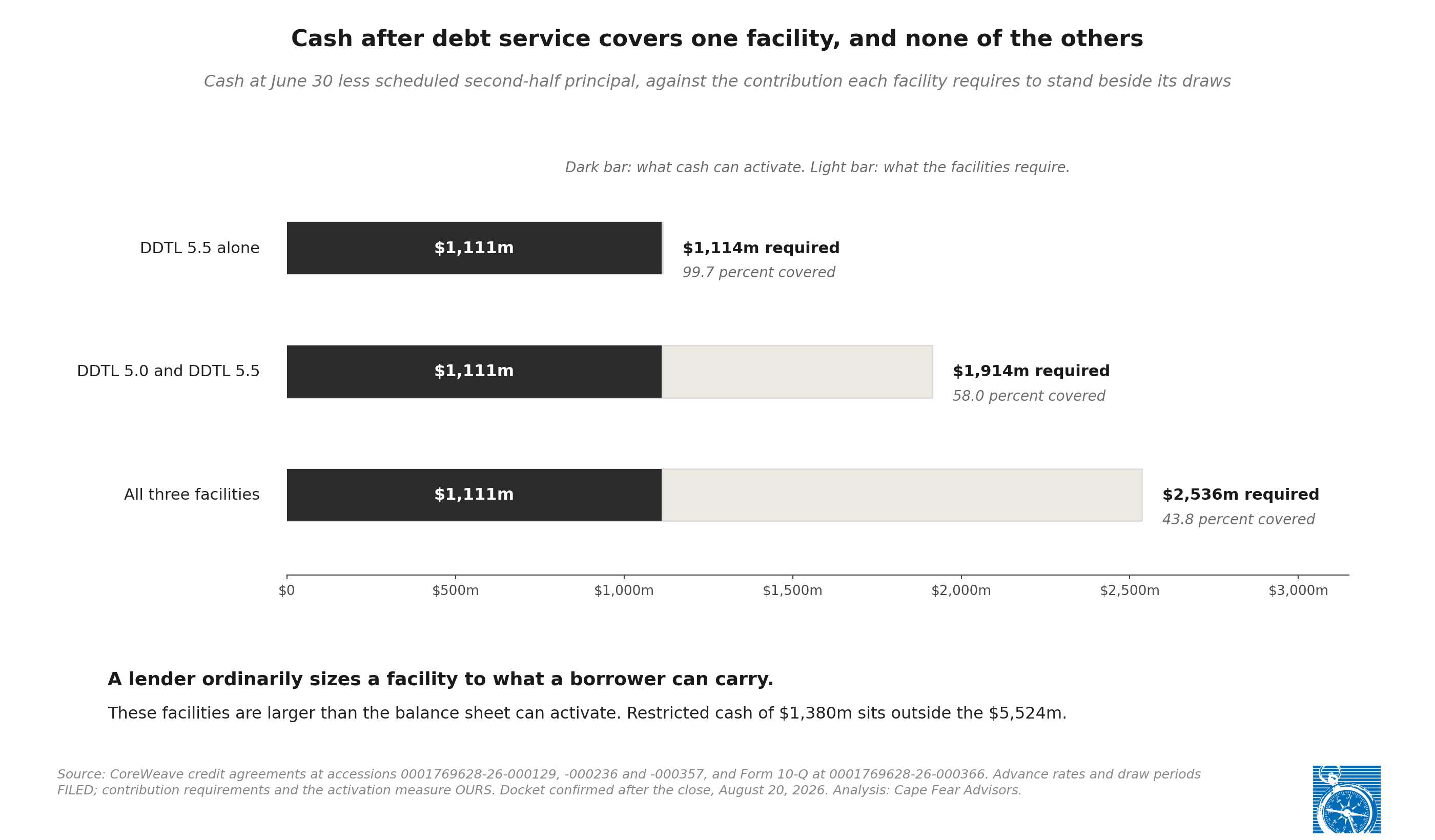
Cash and equivalents stood at $5,524m on June 30. Scheduled principal for the second half is $4,413m. What is left is about $1,111m, and drawing the two newest delayed draw facilities in full calls for about $1,914m to stand beside them (1).
So the company can turn on about 58 percent of its own committed capacity out of cash after scheduled debt service. Across all three delayed draw facilities the requirement is about $2,536m and the figure falls to about 44 percent (2).
A lender ordinarily sizes a facility to what a borrower can carry. These facilities are larger than the balance sheet can activate.
Restricted cash of $1,380m sits outside the $5,524m, held as bank deposits behind the collateralized loan facility, and reaches none of it (3).
Every commitment carries an expiry, and two closed this year
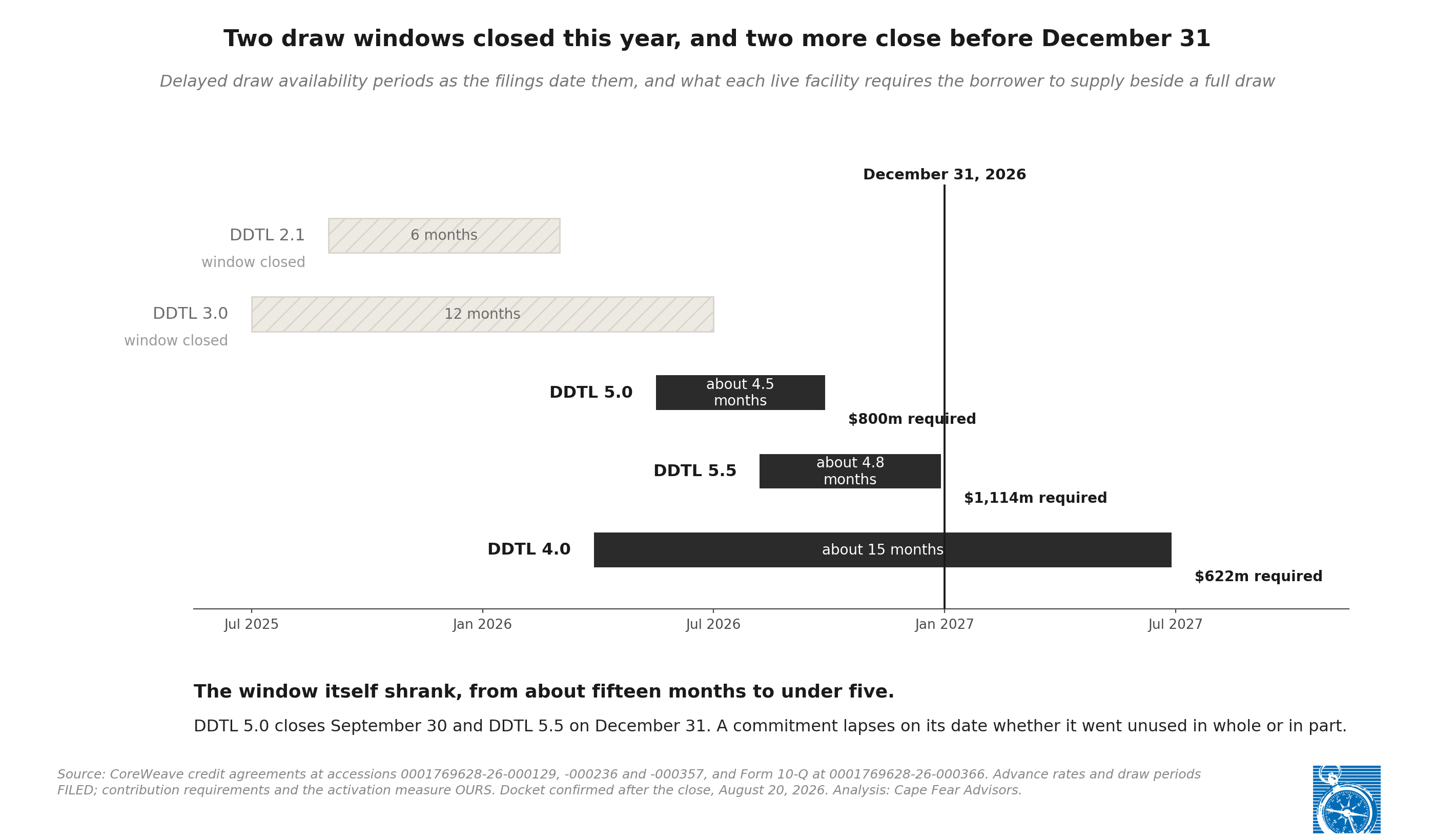
DDTL 2.1’s draw period ended in March 2026 and DDTL 3.0’s in July. What remains live is DDTL 5.0 to September 30, DDTL 5.5 to December 31, and DDTL 4.0 to June 2027 (4). Two of the three close inside this calendar year.
One term takes four agreements to see, and it is the window itself. DDTL 4.0 gave about fifteen months from signature to expiry. DDTL 5.0 gives about four and a half months and DDTL 5.5 about four and eight tenths. Covenant tables carry spreads and coverage ratios; a draw period sits in the definitions instead, one document at a time, which is why it was the last term we found and the one that sets the deadline (5).
And the clock carries its own accelerant. The Commitment Termination Date in each agreement is the earlier of the outside date and the date the commitments reach zero, so drawing a facility in full starts its coverage test the month after. The company needs the draws, because the draws are the money that buys the equipment. Every draw shortens the runway to the test the draws create.
The requirement scales, so it rations
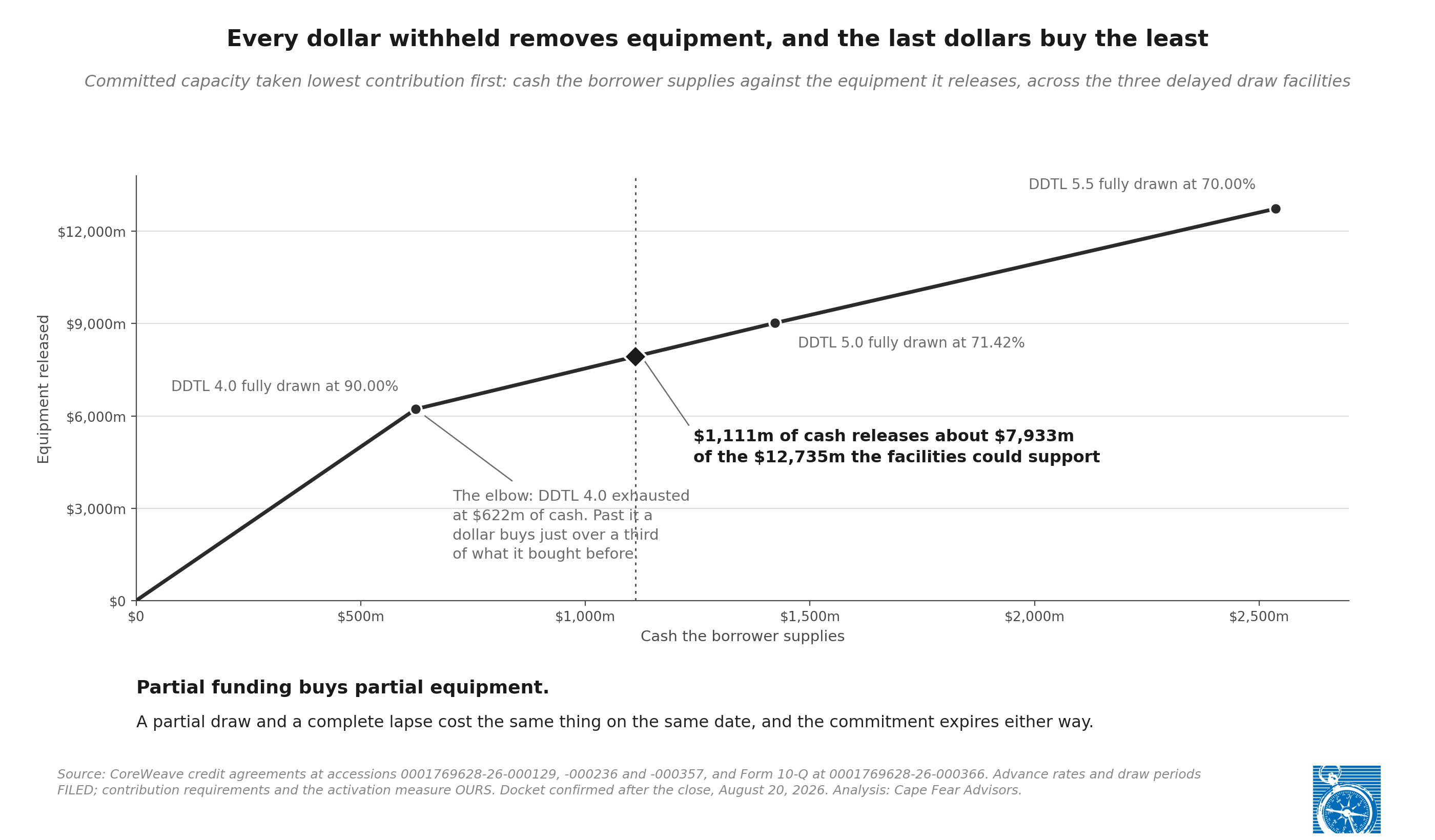
A threshold would be simpler to read and it is the wrong shape. The requirement moves with the draw. About $250m of cash supports a draw of about $583m and buys about $833m of equipment. About $500m supports $1,167m and buys $1,667m. The full $1,114m on DDTL 5.5 draws $2,600m and buys $3,714m (6).
So the consequence of partial funding is proportional and quiet. Every dollar withheld removes about $3.33 of equipment, and the unused commitment lapses on its date whether it went unused in whole or in part. A partial draw and a complete lapse cost the same thing on the same day, and only one of them looks like a decision.
The program is the other half of it. About $10,199m of undrawn commitment supports about $12,735m of equipment, against guided capital expenditure of $20,883m to $24,883m for the second half. Between $8,148m and $12,148m of the program therefore stands outside every committed facility (7). That counts every committed dollar toward the half, including DDTL 4.0’s capacity running into 2027, which floors the gap: any of it that funds 2027 spending enlarges the second-half shortfall instead of closing it. The contribution is the part of the program the lenders decline to fund.
The reason has to come from inside the relationship and outside the stock
The elimination runs in two stages, and the second is the one that usually goes unrun.
The instruments, and three tests decide among them.
The contribution test, at the funding date. Each agreement caps what the lenders advance and says nothing about where the balance comes from. A customer advance passes it: on the funding date the money is cash, and its source is unconstrained.
The leverage test, in the parent guarantee, which caps Total Indebtedness less Unrestricted Cash at 6.00 times Consolidated Adjusted EBITDA. A customer advance passes this one too, because a contract liability is not Indebtedness. Convertible notes fail it until they convert, and $6,587.5m of them has been issued since December 2025 (8).
The cure test, if a coverage ratio is missed. Section 7.03 of each agreement is titled Right to Equity Cure, and it states that a cash shortfall or a covenant breach
“may be cured on or prior to the applicable Anticipated Cure Deadline (the ‘Cure Right’) by the receipt of Equity Proceeds (which shall be in the form of common equity or other equity in a form reasonably acceptable to the Administrative Agent).”
The March and May agreements name that alone. The August agreement adds one alternative, and it is a signature rather than money: an Additional Master Services Agreement, or a renewal of an existing one, that satisfies the Eligibility Criteria (9). A customer advance reaches none of it.
Common equity is the only instrument that passes all three. A prepayment opens the door and cannot mend a stumble behind it, which is a different objection from being turned away at the door, and a smaller one.
Leverage multiplies whatever the business returns
Naming the instrument leaves the supplier open. Somebody has to have a reason, and the security’s own return falls short of supplying one.
Leverage multiplies a return on capital. We published CoreWeave’s on August 16, measured on capital in service, and it runs at negative 0.74 percent (10). Applied to a negative return, leverage multiplies a negative, and it does so faster as the advance rate falls and the spread widens. On a business earning its cost of capital the same three facilities would read as growth financing and the arithmetic would run the other way. Here the borrowing enlarges a shortfall, and it is the residual that holds the enlarged end of it.
The forward version says the same thing. Priced against CoreWeave’s own most expensive filed borrowing, a buyer of the common has to forecast an after-tax operating margin between about 54.9 and 67.8 percent, against a guided low double digit. Reading the guidance at 10 to 13 percent, closing that distance calls for capital turns between about 4.2 and 6.8 times what the company has demonstrated, or an all-in cost of capital near 1.8 to 2.6 percent against 10.82 to 12.07 percent filed (11).
So the compensation sits somewhere other than the stock. And the same sentence that requires equity keeps the compensation out of the stock, because a preference engineered to pay a buyer would be equity in a form the Administrative Agent has to accept. The reason lives on a separate commercial contract. That is a description of the lock rather than a prediction about any party: whatever turns this key holds a claim on the company beyond the share certificate.
The population is three private placements since the listing, and one of them brought no cash: OpenAI took 8,750,000 shares at $40.00 against a contract of up to $11.9bn, with proceeds of zero. Two brought money. NVIDIA placed $2,000m on January 23 and Jane Street about $1,000m on April 15, alongside a $6bn platform commitment announced the same day. Both stood in a commercial relationship with CoreWeave at the time (12). NVIDIA’s supply relationship predates its purchase; Jane Street’s platform commitment was announced the same day.
And the lock cost $87m to put in place, whether it opens or not
One filed difference between two documents, twelve weeks apart.
DDTL 4.0 and DDTL 5.0 define the advance as the rate multiplied by Funding Date Capital Expenditures plus “any amount required to pay fees, premiums and expenses incurred in connection with the Transactions, including any fees and expenses incurred pursuant to the Fee Letters.” The loan funded its own costs.
DDTL 5.5 stops at seventy percent of Funding Date Capital Expenditures. The clause is gone (13).
The FY2025 debt note prices what that means. “In conjunction with the issuance of the DDTL 3.0 Facility, the Company capitalized $82 million in debt discount and issuance costs,” on a facility of up to $2.6 billion (14). That is 3.15 percent. DDTL 5.5 is the same size and was marketed at 97, which is 3.00 percent, and REPORTED where the $82m is FILED. The same fee, the same recipients, a different payer, and it now leaves the account that also has to fund the contribution.
And the payment attaches to the facility rather than to the draw. It buys the lock, and the key is a separate cost. The note prices the cost in conjunction with the issuance, on a facility of up to $2.6 billion, so the company bought the whole commitment at signing and takes it in pieces. At the DDTL 3.0 rate that is about $82m, and the undrawn fee of 0.50 percent per annum adds about $5m across the 146 days from August 7 to December 31 (15).
Which turns the rationing curve into a price. Drawn in full, the up-front cost runs 3.15 percent of the money taken. At half drawn it runs 6.30 percent, and at a quarter drawn 12.60 percent. A commitment that lapses unused has cost about $87m for a lock that was fitted and left shut.
DDTL 3.0 shows what that looks like on a real facility. At December 31, 2025, five months after signing and with seven months of window left, $340m was outstanding against a commitment of up to $2.6 billion, and amortization had not begun, so the balance is the amount drawn. The $82m of costs capitalized at issuance is 24.1 percent of what had been taken (16). The window closed in July 2026 and the third quarter report says how much of the remainder followed. The construction is OURS and it carries one limit: whether the discount accrues on the committed amount or on funded amounts sits in a Fee Letter that the agreements reference eleven times and attach nowhere.
What a lender moves, and what stays put
Two limits on this reading, and both belong in the body.
A covenant date is negotiable, and this borrower group has negotiated one. On December 31, 2025 an amendment to the DDTL 3.0 Credit Agreement postponed the initial debt service coverage test to October 31, 2027, reduced the minimum liquidity requirement to $100.0m for two months, delayed a contract realization test, and permitted unlimited equity cures until October 28, 2026. The Form 8-K reports the changes and discloses no consideration of any kind (17). Strategic Options Trader published the amendment and the October 28 sunset on July 27, 2026, before we reached the filing, and his reading of what an unlimited cure does to a covenant repays the trip.
November 2026 is therefore a date rather than a wall. What an amendment to a test date moves is the clock. Cash beside a draw comes from somewhere else, every advance rate on this borrower stands as written, and the arithmetic in the first three sections survives any change to a testing date.
The second limit is that the lending model has changed twice. Olga Usvyatsky recognized the first change and published it on April 4, 2026: DDTL 4.0 moved from asset-based limits to execution-based borrowing. DDTL 3.0 capped outstanding loans each month at 85 percent of Funding Date Capital Expenditures less the GPU Depreciated Amount, which made the loan shrink as the equipment aged. DDTL 4.0 carries no such continuing cap and conditions its draws on delivery, commenced power, power contracted for the term of the master services agreement, insurance and the customer’s written acceptance, with capacity expanding as sites reach Stabilization (18).
Her piece told us what to look for. The second change is in DDTL 5.0 and DDTL 5.5, signed in May and August, in documents that did not exist when she wrote.
Three lending models, July 2025 to August 2026
Reading the four agreements together shows what happened after that.
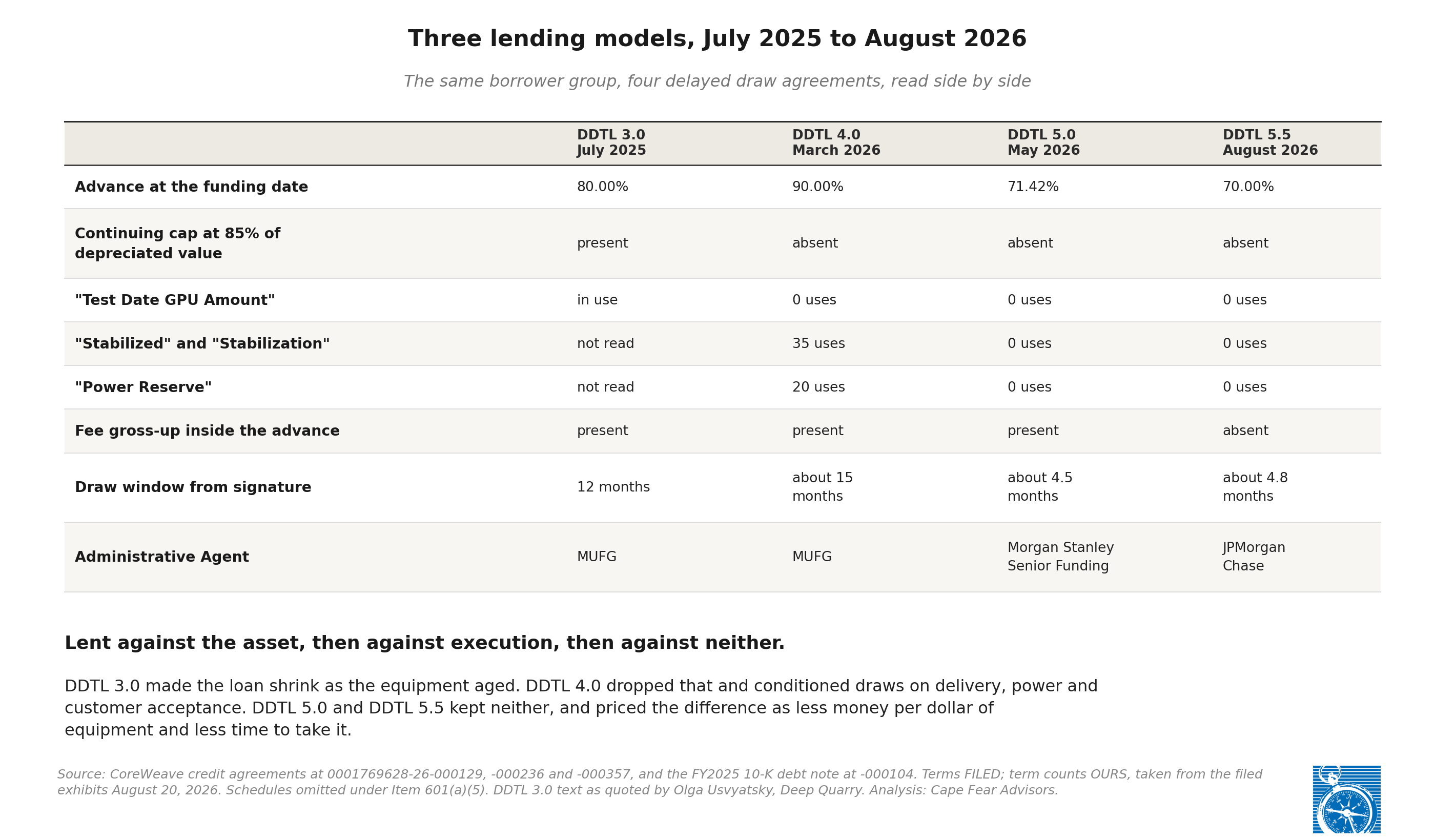
DDTL 3.0 lent against an asset and made the loan amortize as the asset wore out. DDTL 4.0 lent against execution instead. DDTL 5.0 and DDTL 5.5 dropped both models, and what replaced them is less money per dollar of equipment and less time to take it (19).
What was marketed in March, and what was signed in August
CoreWeave’s own March presentation on DDTL 4.0 states the terms it was marketing: a 90 percent loan-to-cost advance during construction, a shift after stabilization to a 1.2 times coverage test site by site that “implies up to ~102% LTC,” a structure described as Project Finance and ABS style, ratings of A3 from Moody’s and A low from DBRS, non-recourse to the parent with a customary bad-boy guarantee, and a cost of capital 175 basis points inside DDTL 3.0 (20). Five months later the same borrower group signed at a 70 percent advance, with an unconditional parent guarantee, a four and eight tenths month window and the fees paid from cash.
One artifact carries the lineage. “GPU Depreciated Amount” survives in all three agreements that followed DDTL 3.0, defined in identical words on a six-year straight line with a half-month convention, and in the filed body of each it appears exactly twice, both times inside its own definition. The definitions point to Schedule 2.03, and schedules are omitted from these exhibits under Item 601(a)(5), so the observation is that the term does no work in the text as filed.
And the agent seat moved three times across four facilities. MUFG, then MUFG, then Morgan Stanley Senior Funding, then JPMorgan Chase. All three sit at the top of the book by any standard, so the standard held and the seat moved for reasons the filings leave open. The book widened with it: DDTL 5.5 carries eleven joint bookrunners on its cover page, among them Citigroup, Deutsche Bank, Goldman Sachs, Société Générale, Sumitomo Mitsui, TD Securities and Wells Fargo (21). Wider distribution on tighter terms, arranged by the same class of house throughout, reads as a market repricing, which is a wider fact than one lender’s view.
November settles the first of them
DDTL 3.0’s draw period closed in July 2026, and about $415m of availability stood on it at June 30. DDTL 2.1’s period had already ended in March, so that residual sat on DDTL 3.0 alone (22). In the two months since, the capacity drew or it lapsed, and the third quarter report says which.
It is the first observation we can get of what this company does when a commitment deadline arrives with the contribution unfunded, and it lands about seven weeks ahead of the December 31 deadline.
Leverage stays here, and its benefits go elsewhere
One thing the arithmetic does settle. Leverage is working, and it is working as designed for the parties the waterfall pays first. Section 2.20(b) of the August agreement sends cash out in nine steps, and the residual is the ninth. Operating expenses go first. Rating agency, administrative and legal fees go second, ahead of the lenders’ own coupon. Interest is third, scheduled principal and swap settlements fourth, the Liquidity Account fifth, a cash trap sixth, other operating and capital expenses including the parent’s management fee seventh, and a sweep that prepays the loans to a Minimum DDTL Amount of $1,300,000,000 eighth (23). The supplier is paid earlier still, in cash when the equipment ships.
Every one of those participants is levered on the same equipment, and each is paid before the residual reaches its reserve account. So the leverage does what leverage does. It multiplies, and where it multiplies a positive it works, which on this ledger is everywhere except the last rung.
The key is the same key. What the record supplies is the lock it has to fit and the clock it has to fit in: an amount that scales, a window that expires, and a covenant that places the reason to turn it outside the security. Three private placements have met that description and two of them brought cash.
The key is the same key. What the record supplies is the lock it has to fit and the clock it has to fit in: an amount that scales, a window that expires, and a covenant that places the reason to turn it outside the security.
Notes
Figures are stated in $m with commas, and in $bn only where the filer itself states a round headline figure that way. FILED means in a document filed with the SEC, cited by accession. FURNISHED means provided under Item 7.01 and not deemed filed. GUIDED is management’s own forward figure. OURS is our arithmetic on stated inputs, with the inputs named so a reader can reject the construction line by line.
(1) FILED. Cash and cash equivalents of $5,524m at June 30, 2026, Form 10-Q, accession 0001769628-26-000366. Scheduled second-half principal of $4,413m, same filing. The $1,914m is OURS: undrawn commitments of $1,999m on DDTL 5.0 and $2,600m on DDTL 5.5, each divided by its filed advance rate and less the commitment, giving $800m and $1,114m.
(2) OURS, on the same construction across DDTL 4.0, 5.0 and 5.5: $622m, $800m and $1,114m against undrawn commitments of $5,600m, $1,999m and $2,600m. A blended rate misstates it, because the three advance rates differ.
(3) FILED, Form 10-Q. Restricted cash of $1,380m is described in the filing as bank deposits related to the collateralized loan facility.
(4) FILED. Draw periods from each credit agreement and its Form 8-K: DDTL 4.0 at accession 0001769628-26-000129, DDTL 5.0 at 0001769628-26-000236, DDTL 5.5 at 0001769628-26-000357. DDTL 2.1 and DDTL 3.0 draw periods from the FY2025 Form 10-K debt note, accession 0001769628-26-000104.
(5) OURS. We searched for prior accounts of the four agreements read as one series and found one, Olga Usvyatsky’s April 4, 2026 reading of DDTL 4.0 against DDTL 3.0, cited at note (18). Each draw period is stated in its own agreement and its own Form 8-K, so none of it is undisclosed; what we have not found is the four set side by side. Searched 4:40 pm Eastern, August 20, 2026, and others may exist.
(6) OURS, arithmetic on the filed 70.00 percent advance rate for DDTL 5.5.
(7) FILED for the undrawn commitments and GUIDED for the capital expenditure range. OURS for the difference.
(8) FILED, Form 10-Q. Convertible notes of $2,587.5m in December 2025 and $4,000m in April 2026, both at 1.75 percent. The leverage test of 6.00 to 1.00 on Total Indebtedness less Unrestricted Cash over Consolidated Adjusted EBITDA is in the parent guarantee.
(9) FILED, Section 7.03 of each credit agreement. The March and May texts are identical on the point and offer no alternative; the phrase “Additional Master Services Agreement” appears in neither. We described the DDTL 5.5 cure as taking only equity on August 14 and corrected that on August 16; the correction stands.
(10) OURS, published August 16, 2026 in “CoreWeave: Searching for the Next Participant,” measured on capital in service.
(11) OURS, published August 19, 2026 in “NVIDIA, the Key and the Claim.” Required margin equals the all-in cost of capital divided by capital turns, on filed 9.750 percent senior notes, OEM financing at about 11 percent effective on the recourse portion, our published 1.07 points of financing friction, and demonstrated turns of 0.178 and 0.197.
(12) FILED. OpenAI, Form 424B4 at accession 0001193125-25-067651. NVIDIA, Form 8-K and Schedule 13G/A at 0001045810-26-000008. Jane Street, Form 8-K. The $6bn platform commitment was announced the same day; no filing links it to the placement and none is asserted here.
(13) FILED, the definition of “Funding Date GPU Amount” in each agreement, read from the filed exhibits.
(14) FILED, FY2025 Form 10-K debt note, accession 0001769628-26-000104. The 97 price is REPORTED, from Bloomberg’s July 29, 2026 marketing account, and remains unconfirmed against any filing.
(15) OURS. The undrawn fee of 0.50 percent per annum is FILED in each credit agreement and in the FY2025 debt note. The effective-cost figures apply the DDTL 3.0 issuance rate to the money drawn and are illustrations of a mechanism rather than a forecast of any draw level.
(16) FILED, FY2025 Form 10-K debt note, accession 0001769628-26-000104: DDTL 3.0 outstanding of $340m at December 31, 2025 against a facility of up to $2.6 billion, with monthly amortization beginning April 2026, and $82m of debt discount and issuance costs capitalized at issuance. The 24.1 percent is OURS.
(17) FILED, Form 8-K, accession 0001769628-26-000003. Item 1.01 alone, no exhibit attached, the amendment text deferred to the FY2025 Form 10-K. Strategic Options Trader published it on July 27, 2026, before we did.
(18) Olga Usvyatsky, Deep Quarry, April 4, 2026, quoting both agreements. Her reading is the borrowing base over the life of the loan; our advance rate work reads the funding date. The two are separate clauses and both moved. Her piece predates DDTL 5.0 by about six weeks and DDTL 5.5 by about eighteen, so it should not be read as covering either.
(19) OURS, from term counts in the filed bodies of the three exhibits. “Test Date GPU Amount” appears zero times in DDTL 4.0, 5.0 and 5.5.
(20) CoreWeave, DDTL 4.0 Overview, March 2026, company presentation carried on its investor relations site. REPORTED for this purpose, since a presentation is neither filed nor furnished, and quoted only for what the company said it was selling.
(21) FILED, cover page of the DDTL 5.5 credit agreement, Exhibit 10.1 to accession 0001769628-26-000357.
(22) FILED for availability of $10,014m at June 30, Form 10-Q. OURS for the attribution of the residual to DDTL 3.0, on the ground that DDTL 2.1’s draw period had closed in March 2026.
(23) FILED, Section 2.20(b) of the DDTL 5.5 credit agreement, Exhibit 10.1 to accession 0001769628-26-000357. Cash reaching the ninth step goes to the Distribution Reserve Account and leaves only if all five Distribution Conditions hold and the date falls after the Commitment Termination Date.
Standing disclosure: Anthropic is the developer of Claude, which is used in preparing this research. That provenance cannot be checked away, which is why no claim in this piece rests on trust in the tool: every figure carries a public source and an accession number, and the record grades the rest. Others named here have ties to CoreWeave. NVIDIA supplies the equipment the facilities finance and placed $2,000m of common stock in January. Jane Street placed about $1,000m in April alongside a platform commitment. OpenAI holds shares taken against a contract. MUFG Bank, Morgan Stanley Senior Funding and JPMorgan Chase have each acted as administrative agent on a facility read here, and eleven joint bookrunners appear on the newest one. Deep Quarry and Strategic Options Trader are named for their prior work and have no tie to this shelf. Companies not named here, among them the customers behind the contracted revenue and the holders of the securities discussed, may hold positions or supply relationships that bear on the filers, and that possibility is part of why every piece is re-checked for bias, ground facts and filings rather than read against a fixed list. This shelf carries a separate open file on SpaceX and holds a portfolio concentration of 40.5 percent, disclosed as a standing condition. Figures are quoted from the filers without characterization, and the same standard of reading is applied to every filer named.
Documents were assembled and arithmetic checked with the assistance of an AI research tool built by Anthropic, a company on which the principal of Cape Fear Advisors maintains no position. Anthropic’s disclosed arrangements with Amazon, Google, and Broadcom overlap with the collateral pool documented in this series. Where that adjacency is relevant, it is noted in the analysis.
Analysis: Cape Fear Advisors. Not investment advice.
Published August 20, 2026.
This piece also appears on Substack. Cape Fear Advisors is an independent advisory firm based in Portsmouth, NH.
Contact Cape Fear Advisors