

The coverage counted the $279,000m NVIDIA has committed to its suppliers. The commitments running the other way reach $164,500m on filed figures, from $3,500m at the January year end, and they sort into three moves. NVIDIA guarantees other companies’ lease obligations. It commits to buy back cloud capacity from the clouds that buy its machines, one of which CoreWeave’s own filing prices at $6,300m and dates to September 2025. And on the one rung where a supplier lends a customer money to buy its product, the filings disclose no instrument. Credit runs through every other rung and none of it is booked as a loan. The scarce asset in this chain is a credit standing, and lending money would spend cash and leave that standing where it sits. The requirement that says whether a placement returns its own cash clears at 40.00 percent against 64.28. (1)
The two books, and what crossed
The quarterly report reached the record at 4:36 pm Eastern on Wednesday, fifteen minutes after the release. Two forward books sit in it.
The supplier book is purchase commitments: chips, memory, capacity, the things NVIDIA buys to build what it sells. It stood at $279,000m at July 26. The quarterly report gives the prior figure as $119,000m last quarter and the annual report gives $95,200m at the January year end, so the book ran 2.34 times in one quarter and 2.93 times across the six months. The company attributes the increase primarily to memory. (2)
The customer book is what NVIDIA has committed or guaranteed so that its customers can buy, and the filing sets it out under one heading and splits it in two. Additional Commitments come to $56,000m: $36,000m of AI cloud agreements and $20,000m of data center leases NVIDIA expects to reassign to third parties. Guarantees carry $3,500m of land, power and shell guarantees standing behind AI cloud partners’ lease obligations, and $105,000m of residual value guaranties at a data center campus in Pike County, Ohio, entered into in August and disclosed after the July 26 balance sheet date.
So the book has three stopping points. Dated on the balance sheet, $59,500m. With the August guaranties, $164,500m. Adding the up-to-$125,000m of residual value support inside the $500,000m financing platform, described on the call and absent from the documents, $289,500m. One further item, credit enhancement for about two gigawatts to a frontier laboratory other than OpenAI, carries no figure at all. (3)
The same two captions appear twice in that note and only one pair belongs here. NVIDIA’s own forward commitments carry $29,000m of cloud service agreements, for research and development on its open models, and $25,000m of data center leases not commenced, for its own engineering and testing facilities. Those sit in a separate table that totals $366,000m and includes the $279,000m of supply. The customer-facing pair is the $36,000m and the $20,000m. (4)
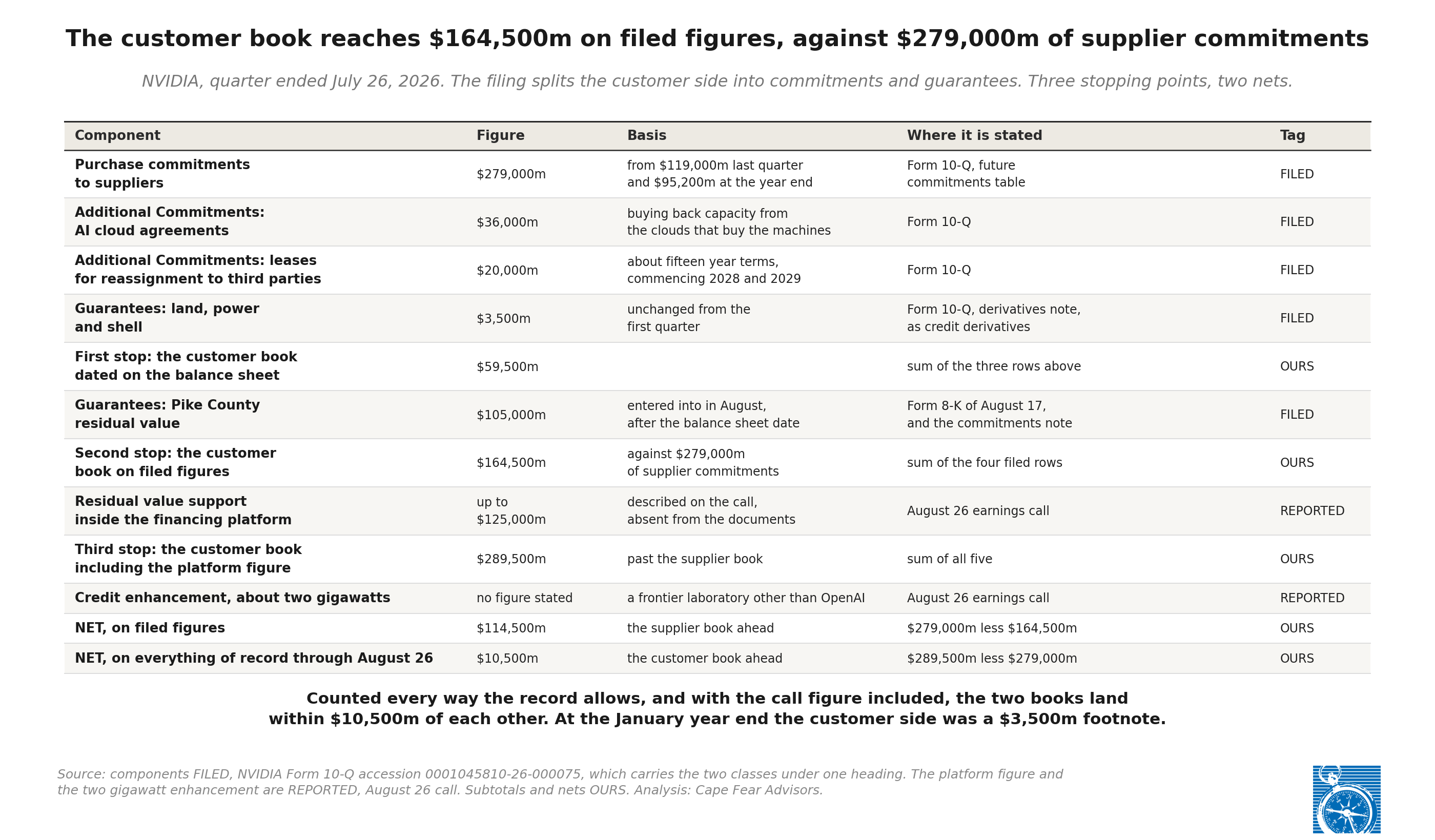
On the filed figures the supplier book is still the larger, $279,000m against $164,500m. The customer side passes it only when the $125,000m described on the call is added. So the levels stand apart on one basis and cross on the other, and a reader who declines to add anything keeps every component and loses only the arithmetic.
What crosses on every basis is the rate. The entire filed guarantee book at the January year end was $3,500m. Against $164,500m that is forty-seven times, while the supplier book ran 2.93 times from the same date. Both counts start at January 25, 2026, and neither of the two customer classes that arrived this quarter stood in the annual report. (5)
The ladder, and the rung left empty
Arrangements of this kind sort onto a ladder that runs from cash on the barrel at the bottom, through trade credit, supplier finance, customer prepayment, component intermediation, vendor lending, equity in the counterparty, contingent support, and the wrapped structures at the top. Distance up the ladder is distance the cash travels before it comes home, and the cash is the same at every rung while the reported figures move. (6)
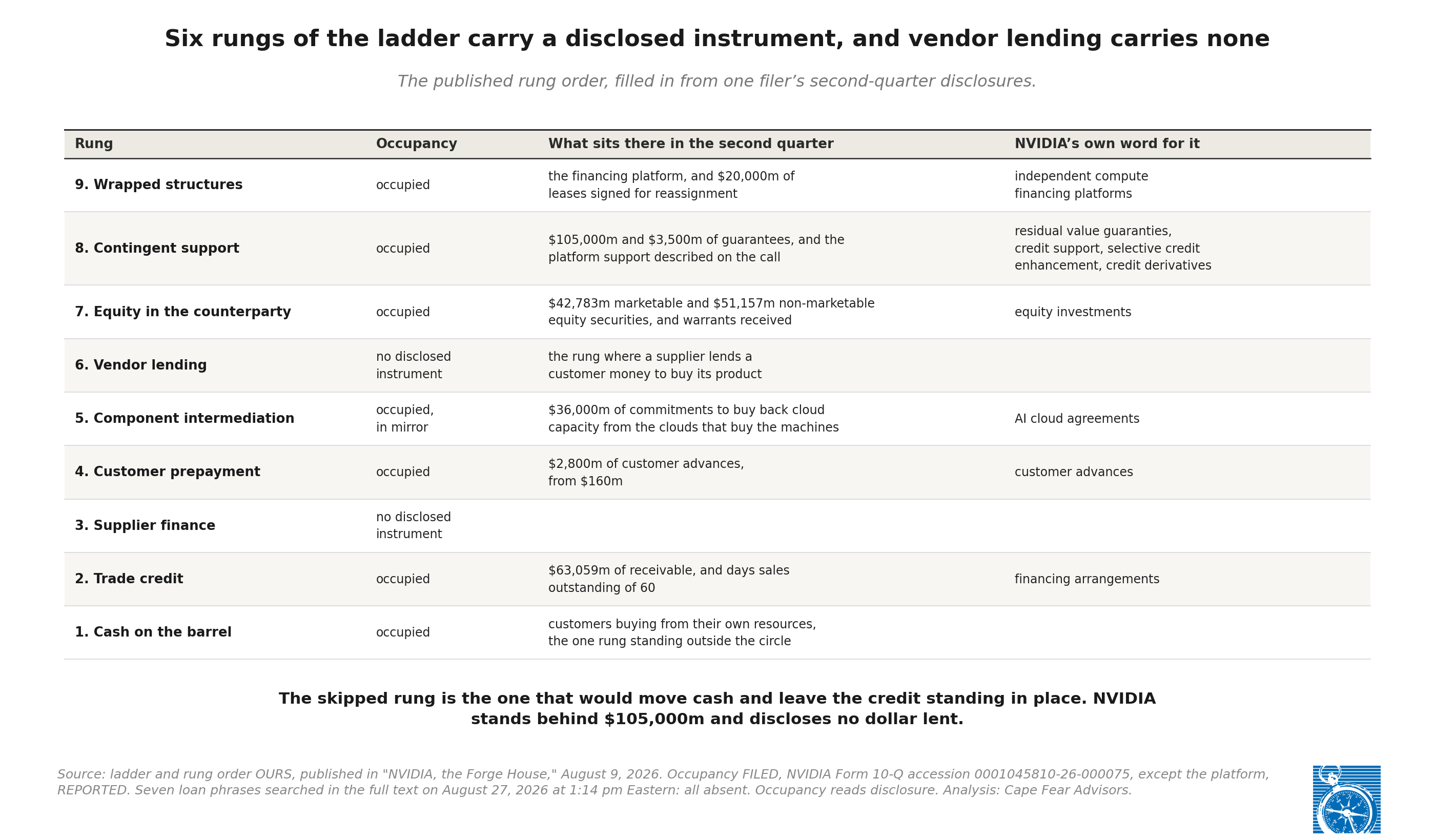
NVIDIA stands on trade credit, with $63,059m of receivable. On customer prepayment, with $2,800m of advances. On component intermediation, in mirror, which the next paragraphs take up. On equity in the counterparty, where marketable equity securities reached $42,783m from $12,886m and non-marketable securities $51,157m from $22,251m, and where warrants arrived this quarter. On contingent support, with $108,500m of guarantees. And on the wrapped structures, with the platform and the $20,000m of leases held for reassignment.
Vendor lending carries no disclosed instrument. Supplier finance and component intermediation carry none either, and vendor lending is the one that speaks, because it is the rung where a supplier lends money to a customer to buy the supplier’s product. NVIDIA occupies the rung below it and the two rungs above it and passes over that one.
The $36,000m is the most direct circle in the filing, and the terms are stated. AI clouds procure NVIDIA’s infrastructure products, NVIDIA commits to buy cloud service capacity back from them, the AI clouds can stop providing that capacity and sell it to third parties at more advantageous rates, and NVIDIA’s commitment falls as third parties take it up. If certain criteria are met NVIDIA participates in the revenue share the AI clouds earn from those third parties. (7)
The rung that runs backward
That is component intermediation with the direction reversed. The published rung has a company standing inside its own supply chain, buying inputs on another party’s behalf. Here the company stands inside its own demand chain, buying back the output of the machines it sold. And the two readings of the same instrument sit on different rungs: written, it is a purchase commitment, which is the fifth rung turned around; working, it is a floor under capacity the customer can sell out from under it, which is what the eighth rung does. One instrument, one flow of cash, and two rungs depending on which end is read, which is the law of the ladder arriving inside a single line of a commitments note.
One party’s side of that bucket is filed by name. On September 9, 2025 CoreWeave and NVIDIA entered an order form under their 2023 master services agreement with an initial value of $6,300m, which sells reserved capacity to CoreWeave’s customers and gives NVIDIA access to any residual unsold capacity. Where CoreWeave’s data center capacity goes unused by its own customers, NVIDIA is obligated to buy the residual through April 13, 2032. So the supplier that sold the machines is the buyer of last resort for what they produce. (8)
The two phrases in the argument name different things, and the piece holds them apart. Vendor financing names one rung. Circular financing names the ladder. Asked on X whether the arrangements were circular financing, Jensen Huang answered No, and the answer is exact at the rung the phrase most often points to, where the disclosures carry no instrument lending a customer money to buy NVIDIA’s product. Every other rung is circular in the ordinary sense, and NVIDIA stands on six of them. The balance sheet carries fourteen asset captions and one receivable among them, and a full-text search of the quarterly report returns none of the seven phrases that would name a loan to a customer. (9)
So every rung above the first is a circle, and the only questions at each are how far the cash travels and what the travel costs. The scarce thing in this chain is a credit standing, and NVIDIA holds it. Lending money would move cash and leave the credit standing where it sits. Standing behind a lease moves the credit standing and leaves the cash where it sits. Huang described the same asymmetry from the other side on August 26: the frontier laboratories “are not investment grade. They don’t have the track record, the capital track record, the financial track record, to be able to capture or secure capital at a low cost. And this is where Nvidia could be helpful.” (21)
The derivatives note names the trade in the company’s own accounting language. A credit derivative is the instrument for transferring credit risk while the money stays put.
Trade credit, and the measure that reads it
The rung the coverage counted is trade credit, and the measure that reads it is the company’s own baseline: days sales outstanding ran 51 in the quarter ended January 25, fell to 45 in the first quarter, and reached 60 in this one. (10)
Accounts receivable stood at $63,059m at July 26 against $38,466m at the year end, a rise of $24,593m. The cash flow statement carries $22,346m for the same item, because the statement measures the change in the operating balance and the balance sheet difference carries movements the statement holds elsewhere. Both are printed here, and the ratios below run on the balance sheet basis with the other stated beside it. Operating cash fell to $24,077m from $50,344m while net income rose 2 percent. (11)
Extending payment terms is what sellers do, the cost of funding a receivable belongs in a company’s general interest expense, and sellers price ordinary terms into the invoice itself. The question a reader would put to a receivable growing that fast is whether the paper got riskier, and the filing answers it in the same sentence that discloses the growth, verbatim: “Financing arrangements with certain investment-grade customers, including extended payment terms under large, multi-quarter agreements, will continue to affect the timing of our operating cash flows.” (12)
Two things about that sentence. NVIDIA calls the arrangements financing, which is what they are. And it names the credit quality of the counterparties, which is the disclosure a reader needs and the one a seller extending terms to weaker names would find harder to give.
Days sales outstanding is a portfolio average, so the sixty days describes the book and leaves the terms on any single account unstated. What the record gives about the accounts that moved it is the credit quality NVIDIA names.
Money moved the other way in the same quarter, and it moved further. Customer advances rose to $2,800m from $160m, seventeen and a half times, and they sit in deferred revenue. That rung runs the circle backward: the cash arrives before the machines do, and what stays behind is an obligation to perform. It is the one place on the ladder where a seller collects before it ships. So the receivable book ran sixty days of sales while some customers paid ahead, and the extension ran 9.3 times the prepayment on the balance sheet basis and 8.5 on the cash flow basis. (13)
The rung the customer needs
CoreWeave is the example here because its terms are filed in full, quarter by quarter, and four credit agreements state an advance rate on their face. CoreWeave’s lenders advance 70.00 percent of equipment cost. The other thirty cents has to be funded from outside the facility and standing there before the loan moves, and the agreements require that balance funded while leaving its source unnamed. (14)
So the sequence at the borrower runs equity, then draw, then equipment, then revenue. Everything downstream waits on the first step.
Undrawn debt commitments stood at $10,199m at June 30. Drawing them takes between $1,133m and $4,371m of equity standing beside the debt, depending on which facilities the balance sits in, and the August facility’s share of that balance stands against a program of about $3,714m of equipment and would take about $1,114m to fill. NVIDIA placed $2,000m in January. (15)
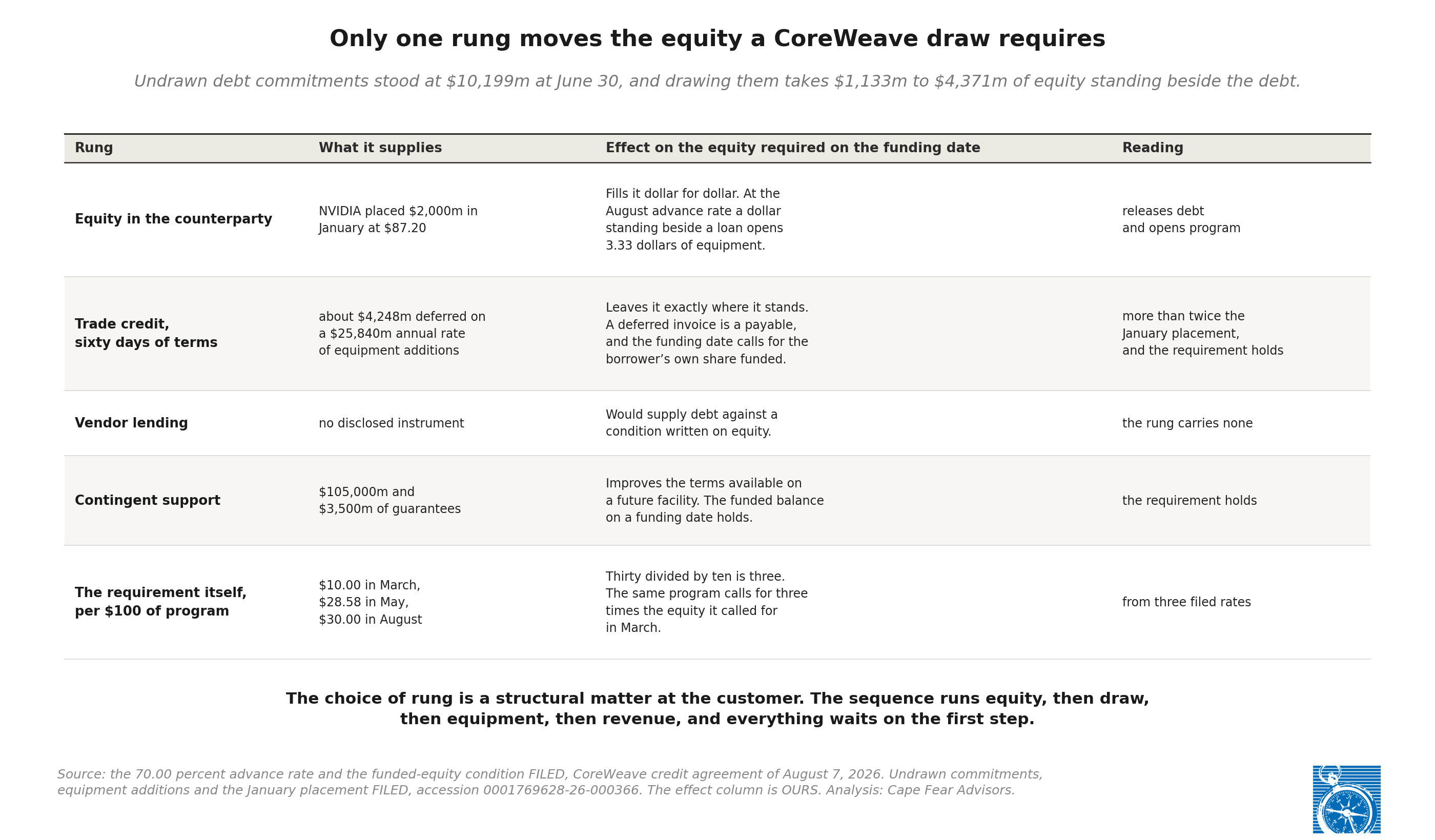
That makes the choice of rung a structural matter at the customer rather than a preference at the supplier. An equity placement releases debt and opens program: at the August advance rate a dollar standing beside a loan opens 3.33 dollars of equipment. The other rungs leave that requirement where they found it.
Extended payment terms are the clearest case. CoreWeave added $12,920m of technology equipment in the first half, an annual rate near $25,840m, and sixty days of terms on that would defer about $4,248m of payment, more than twice the January placement. It would leave the equity requirement exactly where it stands, because a deferred invoice is a payable and the funding date calls for the borrower’s own share funded and in place. (16)
The requirement tripled while this was happening. Equity per hundred dollars of program ran $10.00 under the March facility, $28.58 under May and $30.00 under August. Thirty divided by ten is three, so the same program now calls for three times the equity it called for in March.
And the terms NVIDIA extended this quarter went to investment-grade customers by its own statement. CoreWeave’s paper prices at 550 basis points over SOFR secured and 9.625 percent unsecured. A rating is a view on whether a borrower pays and an advance rate is a view on what the collateral will fetch, and the two are set by different desks, so a characterization carried on the borrower leaves the funding-date requirement where it stands. (17)
CoreWeave’s own March facility makes the point at one company. It closed at $8,500m carrying A3 from Moody’s and A low from DBRS, which its announcement called the first investment-grade rated financing secured by high performance computing infrastructure and an associated customer contract. The rating attaches to the structure: the collateral is substantially all the assets of a single-purpose subsidiary, and the same company’s unsecured notes bear 9.625 percent. Five months later the same borrower was advanced twenty points less of equipment cost at 325 basis points more spread. An investment-grade rating at the facility and a falling advance rate at the same borrower are answers to different questions, and both were true at once. (18)
Contingent support, and its four names
Contingent support carries four vocabularies across four documents.
The current report of August 17 calls them residual value guaranties, and credit support. The chief financial officer’s commentary calls them arrangements that help select customers secure land, power and data center capacity. The earnings call calls one of them selective credit enhancement. And the quarterly report’s derivatives note calls a different class of them credit derivatives, carried at fair value with changes through other income. (19)
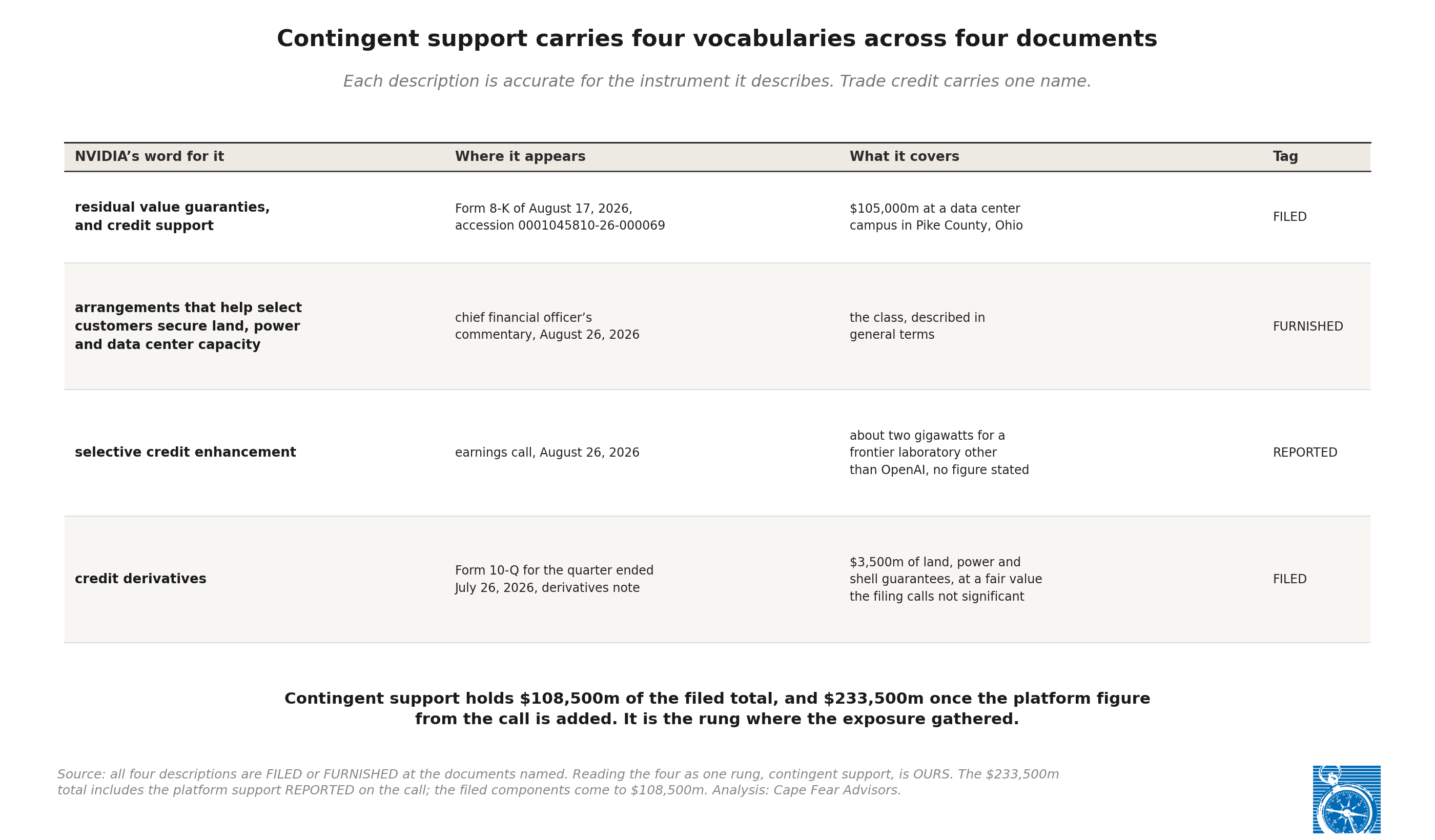
The four are separate instruments with separate counterparties and separate terms, and each description is accurate for what it describes. Reading them as one rung, contingent support, is ours. What the mixing shows is where the exposure gathered: trade credit carries one name and contingent support carries four, and contingent support is where $108,500m of the filed total sits, and $233,500m once the reported platform figure is added.
Why the lending rung stays empty
The prices explain it, and they are filed at both ends of the chain.
NVIDIA raised $25,000m of senior unsecured notes in June across seven tranches, at yields of 4.273 to 5.628 percent and spreads of 20 to 65 basis points over benchmark Treasuries. CoreWeave’s August facility prices at SOFR plus 550 basis points, secured on the equipment, with a parent guarantee. CoreWeave’s unsecured notes due 2032 bear 9.625 percent. The tenant at Pike County lacks an investment-grade rating, which the guaranty states by terminating when a satisfactory rating arrives. (20)
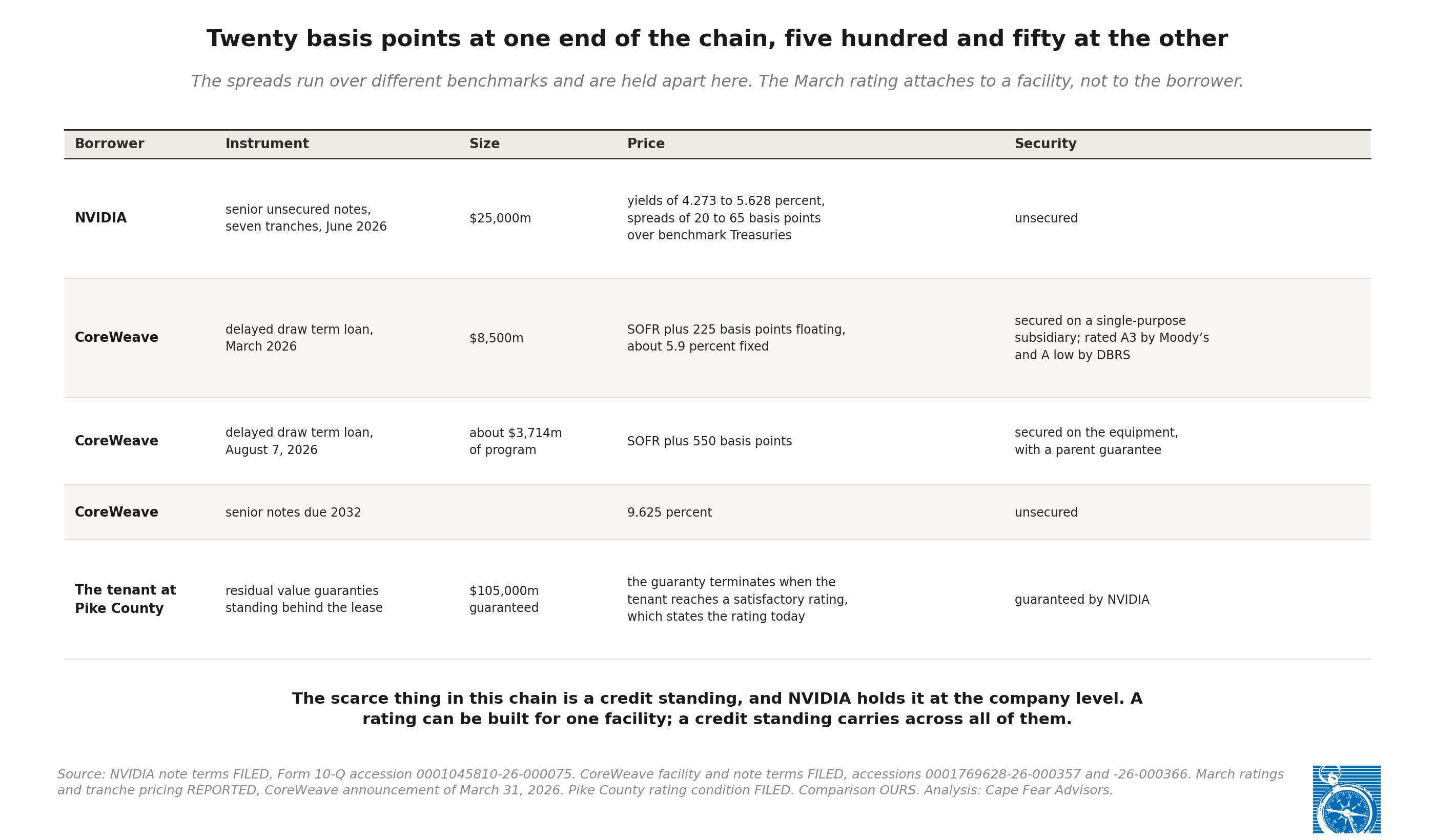
The spreads run over different benchmarks and are held apart here. Twenty basis points unsecured at one end of a chain and five hundred and fifty secured at the other describes a market open to one party and priced to the other as a risk.
The scarce thing in this chain is a credit standing, and NVIDIA holds it. Lending money would move cash and leave the credit standing where it sits. Standing behind a lease moves the credit standing and leaves the cash where it sits. Huang described the same asymmetry from the other side on August 26: the frontier laboratories “are not investment grade. They don’t have the track record, the capital track record, the financial track record, to be able to capture or secure capital at a low cost. And this is where Nvidia could be helpful.” (21)
The derivatives note names the trade in the company’s own accounting language. A credit derivative is the instrument for transferring credit risk while the money stays put.
A backstop is what a closed window produces
The $500,000m platform reads as expansion. Against the two observables that define a supply of credit, the quantity available and its price, the direction runs the other way.
CoreWeave’s advance rate, the share of equipment cost its lenders will fund, ran 90.00 percent in March, 71.42 in May and 70.00 in August, while the spread over SOFR ran 225, 450 and 550 basis points. Twenty points less debt per dollar of equipment, and 325 basis points more price on the debt that remains, at one borrower inside 130 days. (22)
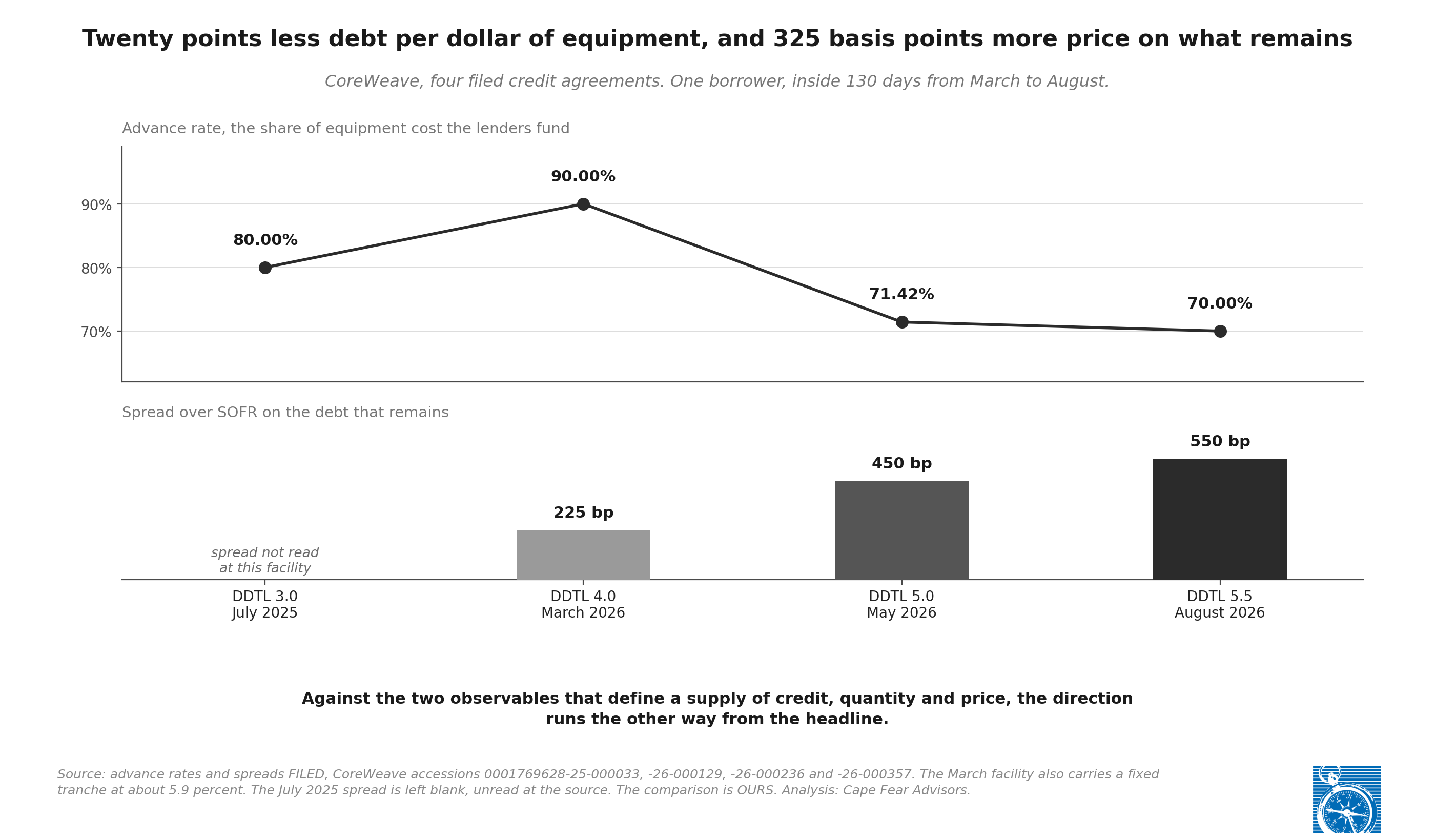
Priced with those filed terms and a cost of equity assumed across a range, the all-in annual cost of financing the same $100 of equipment rose between 46 and 74 percent from March to August. (23)
The platform supplies no money of its own. It mobilizes third-party capital, NVIDIA’s participation is residual-value support, and the press release describes the arrangements as subject to definitive agreements, which places the funded amount at zero. A facility of that size gets assembled when the ordinary window has closed, and its arrival dates the tightening.
The economics still clear
The share of a program that has to be spent with NVIDIA for a placement to return its own cash is one less the advance rate, divided by the gross margin. At 70.00 percent and the quarter’s filed 75.00 percent margin, that requirement is 40.00 percent. Against it, technology equipment stood at $33,823m of CoreWeave’s $52,622m of gross property and equipment at June 30, which is 64.28 percent, up from 61.59 at the year end. (24)
The margin guidance moves the requirement and leaves the answer intact. At the third quarter’s guided 74.00 percent it is 40.54 percent, and across the fourth quarter’s guided 71 to 72 percent it runs 42.25 to 41.67. The requirement rises between 1.67 and 2.25 points across three guided quarters, and at the highest of them it stands 22.03 points below the fleet share. (25)
So the change is one of direction, and the condition holds. Every covenant test in the quarter’s record was met, every guarantee stands uncalled, and the receivable carries no reported past-due balance.
The people who look through the words
Four names travel for contingent support. The parties pricing the exposures read through all four to one question, and three of them repriced it this year.
The bank syndicates did it in a defined term, twenty points of advance rate and 325 basis points of spread. The rating agencies did it by the Pike County tenant standing unrated, which the guaranty’s own termination clause presupposes. And the National Association of Insurance Commissioners did it in a capital formula, replacing a flat 6.8 percent charge on collateral loans with a look-through to the underlying assets at 30 to 45 percent. (26)
A capital charge and an advance rate are the same number read from opposite ends. A charge of c requires the holder to fund c of every dollar from its own capital, and an advance rate of a leaves the borrower funding one less a. On that identity the insurance repricing takes an advance rate from 93.20 percent to between 55.00 and 70.00 percent, and the 30 percent end lands on 70.00, which is the August credit agreement’s own figure. At 70.00 a dollar carries 3.33. The two decisions have no connection and the coincidence is arithmetic. (27)
The bounds are being drawn by the parties who price the risk, and each of them prices the exposure rather than the caption.
What prints next
The choice of rung is a preference for as long as the requirement clears, and it clears with 22.03 points to spare on the worst guided margin. Three things move it.
A fifth credit agreement stating an advance rate re-runs every figure here in two lines. An advance rate at or below 67.21 percent puts the requirement past the fleet share on the narrower conversion, and anyone can run that line on the same two inputs. And the recognition of the $105,000m arrives at the third quarter, before the year is out, since those guaranties were entered into in August and the July 26 balance sheet precedes them. (28)
At the other end of the chain the observables are filed already. CoreWeave’s draw windows close September 30 and December 31, and whether the equity behind its fourth facility arrives reports in November. The cloud services agreements at COLOSSUS carry $1.25bn a month through May 2029 and a ninety-day termination right held by either party after the first three months. Thirty-six months at $1.25bn is $45,000m and three months is $3,750m, so the headline stands on an obligation twelve times smaller. (29)
Standing Disclosure
DISCLOSURE, standing: Anthropic is the developer of Claude, which is used in preparing this research, and Anthropic is named in note (29) as a counterparty to an agreement described in a filing. NVIDIA supplies the infrastructure providers that serve Anthropic; CoreWeave announced a multi-year agreement with Anthropic in April 2026; Amazon and Alphabet, named in prior pieces in this series, hold large positions in Anthropic; and OpenAI, the tenant at Pike County, is a direct competitor of Anthropic. That nearness cannot be checked away, which is why no claim here rests on trust in the tool: every figure carries a public source, and the record grades the rest. Cape Fear Advisors holds no direct position, long or short, in the securities discussed here; any exposure is indirect, through managed funds it does not control, which may include index funds holding the public companies named. Figures are quoted from the filers without characterization, and the same standard of reading is applied to every filer named.
Figures are verified against the primary filings; documents are cited by accession number.
Notes
FILED means the filer said it, REPORTED means a publication or a call said it, FURNISHED means it came in on a Form 8-K exhibit, and OURS means we said it and the error is ours to carry. The ladder, the rung mapping, the three stopping points, the two nets, the growth-rate comparison, the required share and the identity between a capital charge and an advance rate are OURS. Every filing is taken on its face as accurate and complete under the rules that govern it, and the arrangements described are properties of instruments.
(1) Composite. The supplier figure per note (2), the customer components per note (3), and the required share per note (24). Both books are disclosed in the documents cited; the addition of the customer components into a single figure is OURS and no filing states such a total.
(2) FILED. NVIDIA Form 10-Q accession 0001045810-26-000075, commitments note, read at 1:31 pm Eastern on August 27, 2026, verbatim: “increasing supply commitments from $119 billion last quarter to $279 billion as of July 26, 2026.” The $119,000m is the first-quarter figure at April 26, 2026 rather than the year end. The Form 10-K for the year ended January 25, 2026, accession 0001045810-26-000021, gives manufacturing, supply and capacity commitments of $95.2 billion at that date. Both multiples are OURS: 2.34 across the quarter and 2.93 across the six months.
(3) FILED and REPORTED. The $105,000m of residual value guaranties per Form 8-K accession 0001045810-26-000069, Items 1.01, 2.03 and 7.01, accepted August 17, 2026 at 8:41:33 am Eastern, described in the quarterly report’s commitments note as entered into in August 2026. The $36,000m of cloud partner agreements, the $3,500m of land, power and shell guarantees and the $20,000m of leases signed with the expectation of reassignment per accession 0001045810-26-000075. The $125,000m of residual value support inside the $500,000m platform is REPORTED, from the August 26, 2026 earnings call as carried by The Wall Street Journal on August 27, 2026, and appears in no filing read for this piece. The credit enhancement for about two gigawatts is REPORTED from the same call and carries no figure. The three stopping points, $59,500m, $164,500m and $289,500m, are OURS, and each filing states its own component alone.
(4) FILED. Both tables sit in the commitments note of NVIDIA Form 10-Q accession 0001045810-26-000075, read at 1:31 pm Eastern on August 27, 2026. Future commitments, in billions: supply and capacity $279, cloud service agreements $29, data center leases not commenced $25, equity investments $25, capital expenditures $8, total $366. Additional Commitments and Guarantees, in billions: AI cloud agreements $36, data center leases not commenced for third party $20, total $56, with the guarantees stated separately at $3.5 and $105. The filing describes the first table’s cloud service agreements as providing infrastructure to support research and development of NVIDIA’s open models, and the first table’s uncommenced leases as primarily for engineering, product design and testing. Reading only the second table as the customer book is OURS, and it follows the filing’s own heading, which describes arrangements to assist select customers with securing land, power, shell and data center capacity.
(5) OURS, on FILED components, and both counts run from January 25, 2026. Forty-seven times is $164,500m over $3,500m; 2.93 times is $279,000m over $95,200m. The $3,500m stood at the year end: the Form 10-K, accession 0001045810-26-000021, states that in fiscal year 2026 NVIDIA entered into agreements to guarantee partners’ facility lease obligations in exchange for warrants, with maximum gross exposure of $3.5 billion reduced as partners pay the lessors over terms of five to seven years. The perimeter probe ran at 1:38 pm Eastern on August 27, 2026 against that annual report: the phrases Additional Commitments, AI cloud agreement, AI clouds, not commenced for third party, reassign, SB Energy and residual value each returned zero occurrences. So neither of the two customer classes that arrived this quarter stood in the annual report, and the base is the whole of what was there.
(6) OURS. The nine rungs and their order are published in “NVIDIA, the Forge House”, August 9, 2026, in the section headed The ladder, together with the law that the cash is the same at every rung while the reported figures move. Placing NVIDIA’s second quarter on those rungs is new here and is OURS. The rung occupancy figures are FILED per notes (3), (8) and (10), except the platform, which is REPORTED per note (3). Marketable equity securities of $42,783m at July 26, 2026 against $12,886m at January 25, and non-marketable securities of $51,157m against $22,251m, are FILED on the balance sheet at accession 0001045810-26-000075. Reading those two captions as the equity rung is OURS, and the filing states no split between counterparty holdings and other holdings.
(7) FILED. NVIDIA Form 10-Q accession 0001045810-26-000075, Additional Commitments and Guarantees, verbatim: “AI clouds procure our data center infrastructure products and we commit to cloud service agreements, which the AI clouds can unilaterally stop providing to us and sell to third-party customers at more advantageous rates. Our commitments decrease as capacity is used by third-party customers or by us for our research and development efforts. If certain criteria are met, we will participate in revenue share generated by the AI clouds from third-party customers.” Reading the arrangement as a floor under capacity is OURS, and the filing characterizes it as a commitment rather than as a guarantee.
(8) FILED. CoreWeave Form 8-K accession 0001769628-25-000047, Item 1.01, period September 9, 2025, read at 2:06 pm Eastern on August 27, 2026, verbatim: the order form “has an initial value of $6.3 billion, that establishes an arrangement with respect to the sale by the Company of reserved cloud computing capacity to its customers and provides NVIDIA access to any residual unsold cloud computing capacity. Under the terms of agreement, in instances where the Company’s datacenter capacity is not fully utilized by its own customers, NVIDIA is obligated to purchase the residual unsold capacity through April 13, 2032.” Either party may terminate on thirty days’ written notice of a breach, or on an insolvency proceeding undismissed within ninety days. The $6,300m is an initial value at September 9, 2025 and the $36,000m is a commitment balance at July 26, 2026, so the first is one named instrument of the class and no filing states its current value or NVIDIA’s allocation across counterparties. Reading the two as the same arrangement from opposite ends is OURS. The order form is separate from the January 2026 equity placement, which is FILED at accession 0001769628-26-000044 and carries 22,935,780 shares at $87.20 for $2 billion, a collaboration framework, and a buildout of more than five gigawatts by 2030.
(9) REPORTED and OURS. Both of Jensen Huang’s answers on circular financing, with their X status identifiers, the decoded timestamps and the decoding method, are set out in “Circular Financing, in Chips, Land, Power and Demand”, August 17, 2026. The distinction between vendor financing as one rung and circular financing as the whole ladder is OURS, and no filing draws it. The probe, run twice and independently on August 27, 2026, by the checker and again at 1:14 pm Eastern. Seven phrases searched in the full text of NVIDIA Form 10-Q accession 0001045810-26-000075: financing receivable, notes receivable, loans receivable, customer loan, vendor financing, supplier finance and supply chain finance. All seven absent, on both runs. The condensed consolidated balance sheet carries fourteen asset captions, and the only receivable among them is Accounts receivable, net. The claim is about disclosure rather than existence: an absent caption establishes that no such instrument is broken out, an immaterial balance would not be, and Other assets of $15,746m at July 26 stands undecomposed.
(10) FURNISHED. Days sales outstanding of 51 for the quarter ended January 25, 2026 and 45 for the quarter ended April 26, 2026, with the statement that a return to more normal levels was expected, at Form 8-K accession 0001045810-26-000051, May 20, 2026. The 60 days for this quarter is FURNISHED at accession 0001045810-26-000073. The 45 days was published in “NVIDIA, The Fourth House”, July 14, 2026, and the 51 is the baseline this quarter’s reading turns on.
(11) FILED and OURS. Accounts receivable, net, of $63,059m at July 26, 2026 and $38,466m at January 25, 2026, from the balance sheet at accession 0001045810-26-000075; the difference of $24,593m is OURS. The cash flow statement in the same filing carries $(22,346)m for the change in accounts receivable, operating cash flow of $24,077m against $50,344m, and net income of $59,688m against $58,321m. The two receivable figures differ because a balance sheet difference and a cash flow adjustment are separate measures, and both are printed here rather than reconciled. The ratios at note (13) run on the balance sheet basis with the cash flow basis stated beside them.
(12) FILED. The quoted sentence appears at accession 0001045810-26-000075 and is reproduced in full and without elision.
(13) FILED and OURS. Customer advances of $2,800m at July 26, 2026 and $160m at January 25, 2026 sit within deferred revenue in the supplemental note at accession 0001045810-26-000075; the difference of $2,640m is OURS. Both ratios are OURS: $24,593m over $2,640m is 9.32, printed as 9.3; $22,346m over $2,640m is 8.46, printed as 8.5.
(14) FILED. The 70.00 percent advance rate is stated in the “Funding Date GPU Amount” definition of CoreWeave’s credit agreement of August 7, 2026, accession 0001769628-26-000357. The agreements require the balance funded and in place on the funding date and leave its source unnamed, which is the reading of the definition and is OURS.
(15) FILED and OURS. Undrawn debt commitments of $10,199m at June 30, 2026 are FILED at CoreWeave Form 10-Q accession 0001769628-26-000366. The range of $1,133m to $4,371m is OURS, struck on the debt basis: equity beside a loan of D at an advance rate a is D times one less a over a, so $10,199m gives $1,133m at 90.00 percent and $4,371m at 70.00 percent. The August figures are struck on the program basis and the two bases are stated rather than mixed: a program of about $3,714m of equipment carries $1,114m of equity at 30 percent, and the same program carries about $2,600m of debt at 70.00 percent. No filing allocates the $10,199m across facilities, so the August split is OURS and illustrative. NVIDIA’s placement of $2,000m in January 2026 at $87.20 is FILED at accession 0001769628-26-000366 and in the January placement documents.
(16) FILED and OURS. Technology equipment additions of $12,920m in the first half of 2026, from $20,903m at December 31, 2025 to $33,823m at June 30, 2026, are FILED at accession 0001769628-26-000366. The annualized rate of $25,840m and the $4,248m of deferral at sixty days are OURS and illustrative, being twice the half-year addition and sixty three-hundred-and-sixty-fifths of it. No filing states that NVIDIA has extended sixty days of terms to CoreWeave, and the chief financial officer’s commentary at accession 0001045810-26-000073 names investment-grade customers rather than any borrower.
(17) FILED and OURS. The investment-grade characterization is NVIDIA’s own, in the sentence at note (12). CoreWeave’s SOFR plus 550 basis points is FILED at accession 0001769628-26-000357 and the 9.625 percent notes due 2032 are FILED in CoreWeave’s filings. The separation of a rating from an advance rate is OURS. Three distinct things travel under the phrase investment grade: an issuer rating, an issue rating that can sit above the issuer where structure such as a funded reserve is doing the work, and a capitalized defined term inside a credit agreement that may be satisfied by one agency or tested once rather than continuously. OPEN: the definition of Investment Grade Rating in CoreWeave’s March 2026 facility, accession 0001769628-26-000129, has not been read here, so which of the three was in play at that facility is unresolved.
(18) REPORTED and FILED. The ratings, the tranche pricing and the $8,500m size are REPORTED from CoreWeave’s announcement of March 31, 2026, read at 3:52 pm Eastern on August 27, 2026, which states that the facility “received ratings of A3 by Moody’s and A (low) by DBRS, respectively, representing the first investment-grade rated financing secured by HPC infrastructure and an associated customer contract,” carries “a floating rate tranche financed at SOFR + 2.25% and a fixed rate tranche financed at approximately 5.9%,” is secured by substantially all assets of CoreWeave Compute Acquisition Co. VIII, LLC, and matures in March 2032. Initial borrowing capacity is stated at about $7,500m, rising to $8,500m as assets stabilize. The credit agreement is FILED at accession 0001769628-26-000129, where the advance rate of 90.00 percent is stated, and the 9.625 percent notes are FILED per note (17). The comparison across the two facilities is OURS. OPEN: the capitalized definition of Investment Grade Rating inside the March agreement has not been read here, so whether that defined term tracks these facility ratings or something else is unresolved.
(19) FILED, FURNISHED and REPORTED, in the order the sentence names them: Form 8-K accession 0001045810-26-000069, Item 1.01; Exhibit 99.2 to Form 8-K accession 0001045810-26-000073; the August 26, 2026 earnings call as reported by The Wall Street Journal on August 27, 2026; and Note 8 of Form 10-Q accession 0001045810-26-000075, which classifies the land, power and shell guarantees for AI cloud partners as credit derivatives, states their fair values as not significant, and recognizes changes in fair value in Other income, net. Reading the four as one rung, contingent support, is OURS. The $108,500m is the sum of the two filed guarantees and the $233,500m adds the REPORTED platform figure per note (3); both sums are OURS. The $36,000m of AI cloud agreements sits at the fifth rung in this reading rather than at the eighth, per note (7).
(20) FILED. NVIDIA’s June 2026 senior unsecured notes: pricing term sheet accession 0001193125-26-271326, prospectus supplement accession 0001193125-26-273139, closing Form 8-K accession 0001193125-26-275783, giving $25,000m across seven tranches at yields of 4.273 to 5.628 percent and spreads of 20 to 65 basis points over benchmark Treasuries. CoreWeave’s August facility terms per note (14) and the 9.625 percent notes per note (17). The termination of the Pike County guaranties on the tenant achieving a satisfactory credit rating is FILED at accession 0001045810-26-000069. The spreads run over different benchmarks and are held apart rather than differenced.
(21) REPORTED. Jensen Huang, interviewed by Jim Cramer on CNBC’s “Mad Money,” August 26, 2026, as carried by CNBC the same day. No official transcript has been read, and the quotation is taken from CNBC’s account, with its two internal negations preserved as spoken. Colette Kress states a related condition in the commentary at accession 0001045810-26-000073: AI clouds and model makers see extraordinary demand, “yet many are growing faster than their balance sheets and long-term credit profiles can support.”
(22) FILED. Advance rates and spreads are stated in the four CoreWeave credit agreements at accessions 0001769628-25-000033, 0001769628-26-000129, 0001769628-26-000236 and 0001769628-26-000357. The twenty points and 325 basis points are OURS, being differences across the March, May and August facilities. The spread at the July 2025 facility remains unread at the source and is left out of the comparison.
(23) OURS, on FILED terms. The all-in cost calculation rests on two inputs no filing supplies: a cost of equity, shown across a range of 10 to 25 percent, and a SOFR level taken at an illustrative 4.00 percent. The direction holds at every point in that band and the size varies with the inputs. A reader preferring different inputs can substitute them.
(24) FILED and OURS. The identity is one less the advance rate divided by the gross margin, and it is set out in full in “The Required Share” for a reader who wants the derivation. The gross margin of 75.00 percent is FILED at accession 0001045810-26-000075. CoreWeave’s technology equipment of $33,823m within gross property and equipment of $52,622m at June 30, 2026, and $20,903m within $33,941m at December 31, 2025, are FILED at accession 0001769628-26-000366, giving 64.28 percent and 61.59 percent. Using a fleet-wide share as a proxy for the share of a program spent with NVIDIA is OURS: no filing states that share, the FY2025 Form 10-K states that all GPUs in the infrastructure are NVIDIA GPUs, and technology equipment also holds servers, storage and networking, so the realized share is bounded above by the proxy.
(25) FURNISHED, REPORTED and OURS. The third-quarter guidance of 74.00 percent plus or minus 50 basis points is FURNISHED at accession 0001045810-26-000073. The fourth-quarter range of 71 to 72 percent is REPORTED from the August 26 call as carried by The Wall Street Journal and by MarketBeat on August 26 and 27, 2026. The requirements of 40.54 percent at 74.00, 41.67 at 72.00 and 42.25 at 71.00 are OURS on the identity at note (24), as is the headroom of 22.03 points, being 64.28 less 42.25.
(26) REPORTED. The NAIC capital treatment of collateral loans, moving from a flat 6.8 percent charge to a look-through at 30 to 45 percent, is taken from Rod Dubitsky, “Security Benefit Life (SBL) Bet It All on a Risky Asset, Then the NAIC Closed the Loophole”, August 26, 2026, whose figures those are. The rule has been read at no primary source here. The advance rate and spread moves are FILED per note (22), and the Pike County rating condition is FILED per note (20).
(27) OURS. A capital charge of c and an advance rate of one less c produce the same leverage, one over c, so the two describe the same quantity from opposite ends. A charge moving from 6.8 percent to a range of 30 to 45 percent is an advance rate moving from 93.20 percent to a range of 55.00 to 70.00 percent, and one over 0.30 is 3.333. The correspondence between the 30 percent end and the August credit agreement’s 70.00 percent is a coincidence of arithmetic: an insurance capital formula and a bank syndicate’s defined term have no connection, and the full range is printed rather than the near end alone.
(28) OURS, on FILED dates. The reopen conditions are OURS. The falsification line of 67.21 percent runs on the narrower conversion set out in “NVIDIA, AI’s Monetary Policymaker”, August 24, 2026, being a 60 percent operating margin after a 15 percent rate, and that conversion is OURS and illustrative. The recognition timing follows from the dates: the guaranties were entered into in August 2026 and the balance sheet date is July 26, 2026.
(29) FILED and OURS. CoreWeave’s draw windows of September 30 and December 31 are stated in the DDTL 5.0 and DDTL 5.5 agreements at accessions 0001769628-26-000236 and 0001769628-26-000357. The cloud services arrangement is FILED in Space Exploration Technologies Corp. Form S-1, accession 0001628280-26-042639: Cloud Services Agreements with Anthropic, entered into in May 2026, covering compute capacity across COLOSSUS and COLOSSUS II including approximately 325,000 NVIDIA GPUs, at $1.25 billion per month through May 2029, and terminable by either party on ninety days’ notice after the initial three-month period. The $45,000m and the $3,750m are OURS, being 36 months and 3 months at the stated monthly rate. The clause is ordinary in agreements of this kind and no party has given notice.
Analysis: Cape Fear Advisors. The constructions are ours and the filings are the filers’. A reader preferring different inputs can substitute them and run the same two lines.
This piece also appears on Substack. Cape Fear Advisors is an independent advisory firm based in Portsmouth, NH.
Contact Cape Fear Advisors