

The numbers that mattered sit on pages other than the one with the record. Arithmetic, not psychology, read across more than one page.
On July 22, Alphabet, the parent of Google, reported the biggest profit in the company’s history, and, as far as the public record shows, the biggest any listed company has ever reported: net income of $112.2 billion for the three months ended June 30, up nearly threefold from a year earlier. The size can wait a moment; it is the least interesting thing about it.
Because in the same quarter the cash went the other way. Alphabet spent more building than its operations brought in: $39.1 billion of cash from operations against $44.9 billion of capital expenditure, so free cash flow was negative, about $5.9 billion, and the full-year capital plan was raised again, to a range of $195 to $205 billion. The headlines went there, to the negative cash flow, and they were right to. That was the real event.
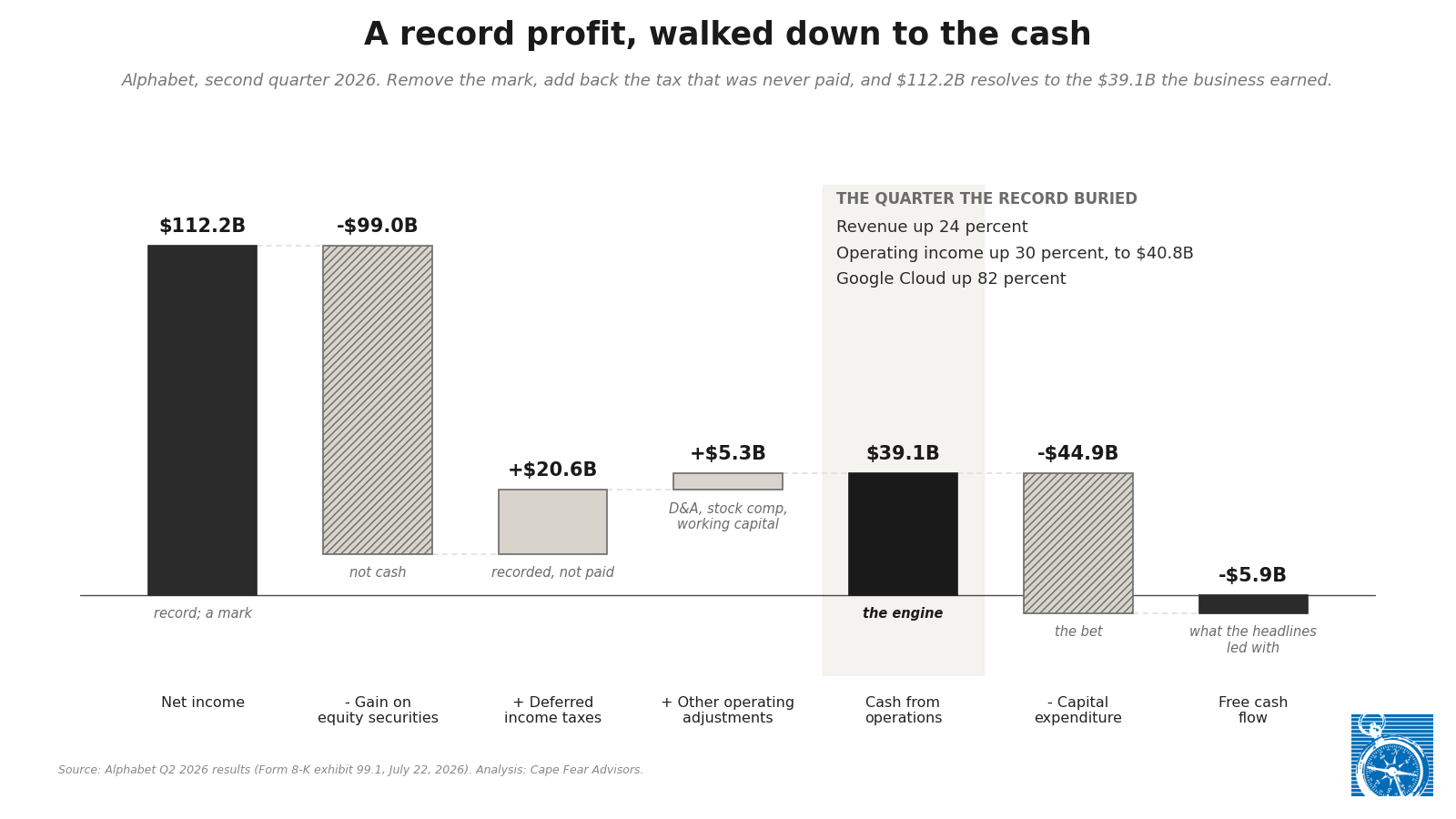
The record was not the event, because the profit was mostly not cash. Of the quarter’s income, $99.0 billion came from a single line, “gain on equity securities, net.” That line is a mark: the recognition of a change in the value of what Alphabet owns of other companies. No sale occurred, and no dollar was collected. Take it out and the operating quarter reads normally; diluted earnings without the gain were about $2.85 a share, against roughly $2.87 expected. The record was the mark.
It survives even the tax. Pretax income was $138.8 billion. Against it the company booked a $26.6 billion tax provision, but $20.6 billion of that was deferred: a tax recorded, not paid, the accounting shadow of a gain recorded and not collected. One statement over, the two undo each other. The cash flow page removes the $99.0 billion gain and adds the deferred tax back, and the $112.2 billion record resolves to $39.1 billion of cash from operations. Set $44.9 billion of building against that, and there is the minus sign the headlines led with. The reconciliation is Alphabet’s own, printed one page after the record.
The quarter underneath
Underneath all of it was an excellent quarter, reported plainly and then passed over. Strip the mark entirely and Alphabet still grew revenue 24 percent to $119.8 billion, lifted operating income 30 percent to $40.8 billion, and widened operating margin to 34 percent. Google Cloud grew 82 percent and more than tripled its operating income, to $8.8 billion. The business underneath is large and generative: it produced $39.1 billion of operating cash in the quarter, roughly $185.7 billion over the trailing year, and it very nearly paid for this quarter’s build. Capital expenditure of $44.9 billion, extraordinary on its own, was met all but about $5.9 billion by the quarter’s own operating cash. That is the shape of a formidable company, and it is the part the release reported without dwelling on, before the call moved quickly to the capital plan. A house like this does not lean on a mark to make its number, which is the quiet point beneath the loud one: the mark did not make the quarter, and the quarter stood without it.
Two marks, two worlds
The mark itself came from two places, and the difference between them is the whole story.
The first is SpaceX. Alphabet put $1 billion into SpaceX in January 2015, when the company was valued near $6.7 billion. SpaceX went public this June, and once a public price exists the accounting stops being a matter of judgment: the holding is carried at that price, and the change runs through income. Alphabet’s stake was worth about $94 billion at quarter end. This mark is legible because a market makes it, and the doubt around it is legible too, because a market says it out loud: the shares have slipped back below their $135 offering price since the debut, and Alphabet cannot sell into the slide, roughly $80 billion of the position under the standard post-offering lockup and the rest restricted into 2027. A bet the market can price, in public, carrying every question a public price carries.
The second is Anthropic, and here the page goes dark. Alphabet has invested a reported $13.3 billion in Anthropic, a private company whose valuation is reported to have moved from about $350 billion to about $965 billion over the period. When a private holding reprices in a new round, the holder marks it too. So there is an Anthropic mark inside that $99 billion. How large, no one outside the company can say, because Alphabet did not break it out. The $99 billion is a single aggregated line. On the earnings call the finance chief described it only as “primarily due to unrealized gains in our equity securities portfolio.” Neither SpaceX nor Anthropic was named. No analyst asked.
So the two halves of one number sit in two different worlds. One is a bet the market prices, and prices downward, in the open. The other is a bet with no price at all, held by one company that has not broken it out and issued by another that files nothing. A reporter estimating the Anthropic figure is not guessing idly; there is nothing filed to read. The number survives only in other people’s arithmetic: take out the visible half, or borrow the same round’s mark from Amazon, which does name its Anthropic stake, and triangulate toward it.
Three ways a figure stays off the page
That is the thing never discussed, and it is the real subject. The largest figures on these statements are often the ones no one is required to explain. Alphabet folds a $99 billion gain into a line and moves on. One filer over, Apple books roughly $20 billion a year from Google into Services and calls the arrangement “quantitatively and qualitatively immaterial,” the figures withheld from its own letters to the SEC. Anthropic, not yet public, discloses nothing at all. Three ordinary and permitted ways a very large figure stays off the front of the page: folded into an aggregate, called immaterial, or not yet filed. Each is available only to a company large enough to write its own disclosure.
Three postures toward a forced entry
What each does with a mark it cannot avoid booking is a tell. Amazon named Anthropic plainly last quarter and let a $12 billion mark carry much of its profit, on real operating cash. Microsoft carries a dedicated line to remove its OpenAI gains from its own adjusted results, asking to be judged without them. Alphabet booked the biggest mark of all and gave it a sentence. Name it, set it aside, or pass over it: three postures toward one forced entry. A house does not rest its number on a mark, because marks move, and the direction is not the house’s to choose.
The next week tests it
None of this is abstract this week, because the next several days test it in the open. Microsoft reports July 29; a year ago its OpenAI gains were lifted by a one-time event that has now lapsed. The line to watch is whether the mark now runs the other way, and whether the company still sets it aside. Amazon reports July 30, and its named Anthropic figure is the closest thing anyone has to a key for the number Alphabet would not print. Alphabet’s own quarterly filing follows in early August, and it will either name the two companies and split the gain or keep the aggregate. Anthropic is reported to be heading for an offering as soon as October, the first moment its own numbers would answer for themselves.
The record in context
Positioned correctly, the record is a distraction, not a headline. At $112.2 billion it is, as far as the record shows, the largest quarterly profit any listed company has ever reported, more than double the prior mark, Saudi Aramco’s roughly $48 billion in 2022. Those are not the same kind of record. Aramco’s was oil, collected in cash. Alphabet’s is a mark, the kind Berkshire Hathaway’s owners are told every year to disregard, because unrealized gains make the profit line move on prices rather than on performance. Alphabet’s own finance chief said the word in passing: unrealized. The company did not sell the record. And yet the ledger will carry the line and drop the note. The record will read “largest quarter ever,” and it will not carry the footnote that the number was a mark on two bets, one the company cannot sell and one no one can price.
From returning capital to raising it
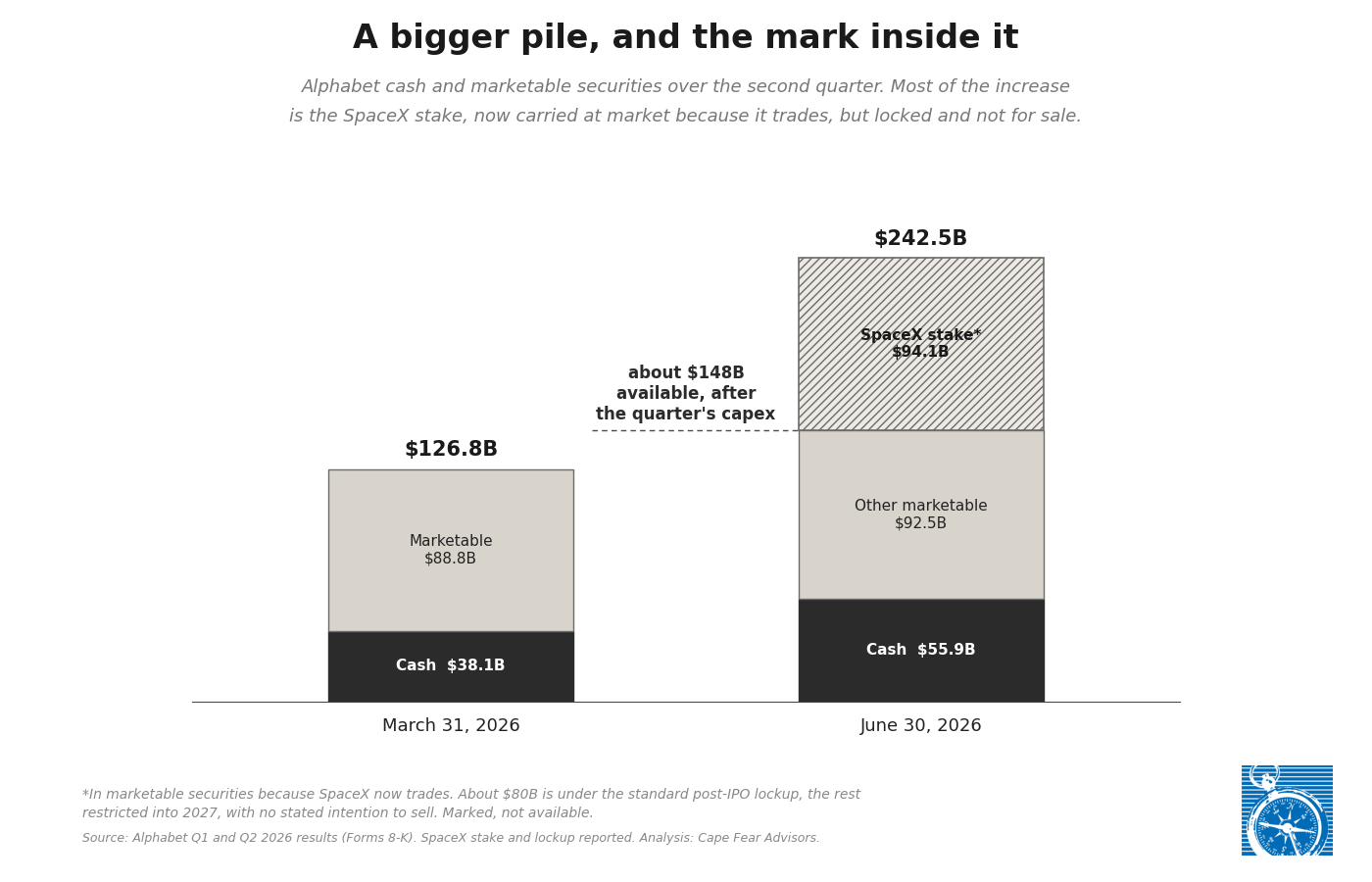
The engine nearly covered this quarter; the build ahead is another matter. Paying for it has turned Alphabet from a company that returns capital into one that raises it. In early June it launched an $80 billion equity program, reported as its first equity raise since the 2004 offering, and set its buyback to zero. In the quarter itself it took in about $74 billion of new debt and equity, and ended June holding about $242 billion in cash and marketable securities, roughly double the $127 billion of three months earlier. The rise is itself a mark. At the IPO the SpaceX stake moved into marketable securities, so about $94 billion of that $242 billion is the same stake seen earlier, marketable because it now trades and still locked. Setting it aside leaves about $148 billion available, and cash alone still rose, to $55.9 billion, after $44.9 billion of building.
Those raises, at close to the highest ratings and out to a hundred years, this series has followed before, in The Croupier Counts First and Three Houses, Three Placements. One buyer is worth naming. The same Berkshire Hathaway whose accounts are the standing example of why a reader disregards an unrealized mark took $10 billion of the offering, named in its own prospectus: $5 billion in Class A at $351.81 and $5 billion in Class C at $348.20. The investor most associated with ignoring the mark put cash into the build. Cash is the one thing a mark is not.
“The largest number in the history of corporate profit turns out to be the one that mattered least, in a quarter with better numbers to talk about.”
None of this is a change of mood, and none of it is hidden. It can look like a conjuring trick, but nothing is conjured: the profit is real, the cash is real, and they sit on different pages. The headlines had the cash flow right; what stayed closed was the profit, one line that holds two marks and a tax that is also not cash. Set the income statement beside the cash flow, the holder beside the issuer, the line beside its footnote, and it resolves into plain arithmetic. Anyone can do the adding, and once it is done, the largest number in the history of corporate profit turns out to be the one that mattered least, in a quarter with better numbers to talk about.
Related, on the Quality of Cash shelf: The Quality of Cash: What Has to Happen Next (the anchor); Apple, The Immaterial House; The Croupier Counts First; Three Houses, Three Placements.
Notes
Alphabet Q2 2026 results, Form 8-K exhibit 99.1, accession 0001652044-26-000066 (quarter ended June 30, 2026). Revenues $119,796M (+24%); operating income $40,770M (+30%); operating margin 34%; net income $112,193M; diluted EPS $9.11. Gain on equity securities, net $99,031M. Cash from operations $39,069M; capex $44,924M; free cash flow negative $5,855M. Full-year 2026 capex guidance $195-205B. CFO remark on the equity gain from Q2 2026 earnings call transcript.
EPS excluding investment gains (about $2.85) versus consensus (about $2.87): reported earnings coverage, July 22-23, 2026.
Q2 financing: new debt-and-equity proceeds about $74.4B. Cash and marketable securities $242,474M at June 30 (from $126,840M at March 31). SpaceX stake about $94.1B at June 30.
Alphabet equity raise: about $80B program, FWP accession 0001193125-26-251733. Structure: $30B concurrent offerings, $40B ATM program, $10B Berkshire private placement ($5B Class A at $351.81, $5B Class C at $348.20).
SpaceX stake: $1B invested January 2015 at ~$6.7B valuation; ~4.9% ownership; ~$80B under lockup, $14.1B restricted through Q3 2027.
Anthropic: ~$13.3B invested by Alphabet; valuation ~$350B to ~$965B; offering reported as soon as October 2026.
Amazon Anthropic mark $12.3B, named: 10-Q accession 0001018724-26-000014. Microsoft non-GAAP line removing OpenAI gains: 10-Q accession 0001193125-26-191507. Apple ~$20B/year from Google, “quantitatively and qualitatively immaterial”: CORRESP accession 0000320193-24-000061.
Saudi Aramco ~$48.4B Q2 2022, prior largest quarterly profit.
Standing Disclosure
Anthropic is the developer of Claude, which is used in preparing this research, and Anthropic is also one of the two holdings whose marks this piece reads. That nearness cannot be fully checked away, which is why no claim here rests on trust in the tool: every figure carries a public source, and the record grades the rest. Others named in this piece have ties to Anthropic: Alphabet, the subject, carries a reported $13.3 billion position; Amazon, cited here for its own named mark, holds a stake as well; and SpaceX, the other of the two holdings marked here, counts Anthropic as a major compute customer. Companies not named here may hold positions or supply relationships that bear on the filers discussed, and that possibility is part of why every piece is re-checked for bias, ground facts, and filings rather than read against a fixed list. Figures are quoted from the filers without characterization, and the same standard of reading is applied to every filer named.
Analysis: Cape Fear Advisors.
This article is also available on Substack.
Contact Cape Fear Advisors